Deconstructed Classical Yuri Umemoto
Yuri Umemoto
Photography
Diana Pfammatter
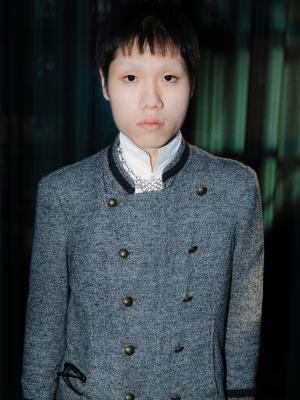
Yuri Umemoto is an innovator. The young Japanese composer creates in a field that is not necessarily known for pushing things forward: classical music is, more often than not, canon music. Looking back rather than ahead. Along comes the 2002-born Umemoto from Tokyo, who incorporates every influence he encounters in his music, which he describes as a self-portrait. A pure expression of personality. The grandeur of rap music, the pop moment of an Anime voice reflecting on mundane moments of contemporary life, the meaning of growing up Catholic in a society that mostly isn’t.
During a residency on Schloss Solitude near Stuttgart, Yuri Umemoto made his way over to Berlin to present his “Concerts” with Özgür Kaya on cello and Weronika Weiss on violin at CCA Berlin, by invitation of Tobechukwu Onwukeme. Before the performance, which saw Umemoto conduct, he sat down for a conversation with Dounia Biedermann and Mathis Neuhaus, CCA Berlin’s music curators, to talk about his practice and his influences. A starting point only, as it turns out, to dive way deeper into reflections about the connection between mind and body, relationships, and what it can mean to be productive.
Mathis Neuhaus
Where did your musical journey start? What’s been your first instrument and when did you start composing?
Yuri Umemoto
I was born in Tokyo. My parents are Christian, Catholic. This is a rare case for Japanese people. So, this is important for my life as a Japanese person. I was going to church every week, every Sunday. When I was a child, I was an altar boy. And I remember the singing. My first memory of music is this music. Church music.
Dounia Biedermann
And when was the first time that you started composing?
Yuri Umemoto
It wasn’t late exactly, but I was already 15 when I started composing in music school. My first career in music was the choir, which I did for ten years prior. I joined the boys choir as a soprano. High tone. And I am so proud of it. The changing of my voice had a big impact. For a singing boy, the prospect of a changed voice is scary. I entered music school when I was 13, and continued studying as a voice major. But my voice changed completely and I wasn’t interested in singing anymore.
Dounia Biedermann
On your album “Mass” the topic of church and Catholicism is very present, with Latin lyrics. But it’s an Anime voice.
Yuri Umemoto
Yes, but I am finished with this kind of work now. I was doing it for too long. I worked for five years on this kind of music, with the Anime voice. Every time I am doing something for too long, I get bored. Bored of everything. My music is my life, it’s like a self-portrait.
Mathis Neuhaus
When you say your music is a self-portrait: what other influences are important for you?
Yuri Umemoto
When I was a child, I loved playing Lego block. And every time, even with a huge building set, like a Star Wars spaceship or a castle, I stopped before finishing it, enjoying the deconstruction more than anything. Every time I was bored too fast. It’s still the same today as when I was a child. It’s an interesting question to me why I still continue composing music. Sometimes I meet an old-man composer. And I can always only wonder: “Wow, you guys continue composing for half a century. Why? Why can you do that?”
Mathis Neuhaus
How was the relationship with your teachers in music school?
Yuri Umemoto
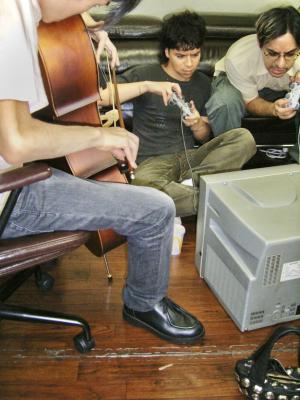
I feel like I only learned for the first two years with my composition teachers, after that, not so much. After learning how to write musical notes, how to write orchestration, I didn’t gain much. I was very focused on that in the beginning. Today, I am learning from my friends. And not only in classical music. Maybe 30% of it is classical. The other 70% are everything, every sound, fashion, all kinds of art in the world. Not only music.
Mathis Neuhaus
This mindset of getting bored easily and wanting to try something new: how does that relate to your music?
Yuri Umemoto
My music is very minimal. I’m doing only one or two or three things in my music. It’s very clear and not complex compositions. But the context is very complex. Very hard to understand. Maybe no one understands a hundred percent of my music. Also, I’m not understanding my music. I understand maybe half of it. I’m talking about a narrative. My language. My narrative of music. When I speak Japanese, I talk too much. I have a huge vocabulary. But when I’m writing music, it’s very simple. It’s the opposite almost. I have two sides. One of my sides is talking too much. And the other side is very quiet. Two personalities, mixed. In music, I only show the quiet personality. This is what I want the music to be.
Dounia Biedermann
And outside of music?
Yuri Umemoto
I feel so lame. Every time I am late, like to this meeting, every time I am making a mistake. Like when riding a train: every time I miss the station. Last time at the airport, I was nervous to miss the airplane. I arrived five minutes before boarding. I also don’t like my face, I don’t like my body. I almost don’t like anything. I am not confident. But in music, I can do anything. And I can fix everything. I don’t like performing live so much, because live performances are totally me. And I make mistakes in performances. When I play the piano, every time I make mistakes. Vibrating my leg, vibrating my foot. The first time I played the piano in front of an audience, I was maybe 15. In summer class of my choir. My teacher asked me if I could play the piano for a small concert. Everything vibrated and shook. My foot is shaking. And I sat down and put my right foot on the dumper pedal. So, the dumper pedal vibrated. The piano is a very resonating instrument, the place was so quiet. My body combusted, everything resonated. A shameful experience for me. Traumatizing.
Dounia Biedermann
But you’re still doing it.
Yuri Umemoto
Yes, but I don’t want to. Today, I will only play for one minute.
Dounia Biedermann
Sounds like music gives you freedom. If you are composing for others, they can perform your life.
Yuri Umemoto
Playing an instrument is a connection with my body. Amplifies my body. But composition does not amplify anything. It’s just my mind, not body. My reason. Guided by my reason. Not through my body. This is important. Not lame. No shame. My reason is not lame. Every time in my life I feel, my reason is not lame. But my body is lame.
Dounia Biedermann
But maybe your reason also should tell you that your body and your face are not lame. Ideally, there is a connection.
Yuri Umemoto
This touches on a personal topic, but I’m sometimes spending time with a girl at a residency currently. She said it’s okay to talk about everything. So, I talk. It’s such a private story. But she confirmed. She is asexual, and while our bond is very deep, we are not in a sexual relationship. It’s important to clarify this so the narrative isn’t misread through a heteronormative lens. I don’t know what I am exactly. But I never feel like sex is good.
Dounia Biedermann
Because of the way you look at your body?
Yuri Umemoto
I’m enjoying sex. I can feel the pleasure. And I feel dopamine. But I never feel, I don’t know. I never feel—
Mathis Neuhaus
Lust?
Yuri Umemoto
It’s the same as I said earlier. I’m not completely uninterested in sexual communication. But I don’t like this kind of communication. I respect it. It’s so important to human society. But I’m not this kind of type. The girl comes to visit and sometimes stays with me. My Japanese friends ask me, “Do you guys have sex?” This is such a disrespectful question. But they are living in a heteronormative society, so of course they are asking. But it makes me feel so bad. Everyone thinks this kind of relationship is the most important relationship. And the relationship we are having can only be the second prize. So, in Japanese society I feel like a loser. She said one time: “In a world where sexual attraction is invalidated, you have become the number one person for me.” Wow. I never thought about that.
Dounia Biedermann
That sounds lovely.
Yuri Umemoto
I’m a romantic person. She is not. I’m so worried if she likes me. And sometimes I ask.
Mathis Neuhaus
Sounds like a productive residency.
Yuri Umemoto
Yeah, this is productive, in my opinion. People don’t think of it as productive as sex. But it might be one of the most productive things there is.
Dounia Biedermann
Do you think your music is beautiful?
Yuri Umemoto
Yes. But what is beautiful depends on who is looking. It’s the same as 100, 300 years ago, Japanese people thought white face paint is beautiful. Or painting the teeth black. It’s beautiful. Or few hundred years ago Japanese people thought more fat people were beautiful. It changes. Beauty standards change. For contemporary music society, some people think atonal music is completely beautiful. But some people do it purely for merit gain. They create atonal music for competitions, to win awards, for professor jobs. Deep down, they might not feel it’s beautiful. I’m so respectful about this. No irony. This is a different style of life. And every desire is beautiful. Win awards by making songs. Beautiful. Fuck by making songs. Beautiful.
Mathis Neuhaus
It lies in the eye of the beholder.
Dounia Biedermann
There’s no hierarchy.
Yuri Umemoto
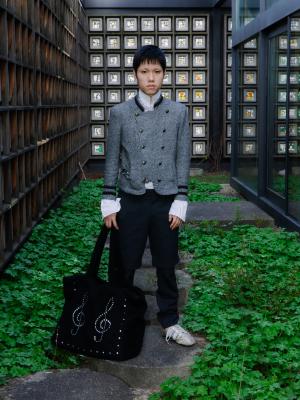
Exactly. Like people showing new clothes. Like, I loved the last Gucci show. Experimental rapper, very ironic, doing an ironic show. Like tourist fashion. That’s very stimulating to society. I love that so much. I love this kind of approval. Showing off and flexing. This is so beautiful. And the designer of Gucci thinks approval is beautiful. And that is a beautiful standard for high fashion now. Some artists feel the need for desire, approval. And every desire is beautiful. Human life. To make something beautiful.
Comments
1 For those interested in Japan, pieces on Yung Beef, Terre Thaemlitz, or Oneohtrix Point Never are recommended for varying reasons.
2 Another conversation that focusses on the choir, but a very different one, is with Soraya Lutangu Bonaventure.