Keeping Busy Yung Beef
Yung Beef
Photography
Callum Pidgeon
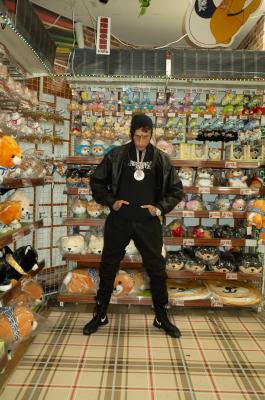
From shooting a movie in the streets of Tokyo to organizing the Infierno Festival in his hometown of Granada, it’s tough to keep up with the pace of trap artist Yung Beef. Next to these extracurricular activities, the artist is breaking norms and pioneering a multidisciplinary approach when it comes to finding means of sharing and creating music. His approach is a declaration of an artist at ease, sculpting his body of work into a cultural testament that indicates shifting paradigms within the industry. Fernando Galvez Gómez, has come a long way since his first mixtape A.D.R.O.M.I.C.F.M.S. 1 in 2013, constantly reminding people that adapting is necessary, although never without integrity.
Max Wild caught up with the busy rapper in-between his travels, to talk about Japan, the art of freestyling, and navigating and disrupting the creative industrial complex.
This interview was originally published in issue #29.
Max Wild
You spent some time in Japan recently. What have you been up to over there?
Yung Beef
I kept quite busy. I produced my single “Pink Floyd” , and we shot the music video in Tokyo as well, I gave some concerts. The main reason me being there was making a movie with Maria Simún.
Max Wild
What kind of movie?
Yung Beef
It didn’t have anything to do with my music, well partly, but not mainly. I can’t tell you too much about it yet, but in a way, it’s based on my life, in an abstract way. My music also features in it, it’s experimental, we shot a lot in some weird places here in Japan. Not just weird places but weird situations, I know it sounds obscure, I have to keep it that way for now—but I am quite happy with it. You’ll see soon, bear with me.
Max Wild
I visited Japan back in 2017 and I vividly remember how overwhelming it felt. The switching of codes in signs, customs, and aesthetics was fascinating, but draining at times.
Yung Beef
It’s intense. I want to move there, the language is intriguing to me, there are a thousand things I experienced in my everyday life that seemed so odd to me, and I didn’t even scratch the surface.
Max Wild
You mentioned your single “Pink Floyd”, how did that come about?
Yung Beef
Pablo [Chill-e] came to visit me while I was there and at the same time Cooking Soul was there, a producer I’ve worked with in the past. We have a good relationship, and we started a project together a while ago which, to be honest, we didn’t finish at all. So, I guess reuniting in Tokyo was a second chance of some sorts.
Max Wild
You have a few things cooking beyond your music, like the movie you mentioned, or the festival that I want to talk about in a bit. As an artist, did you always consider your practice going beyond solely producing music?
Yung Beef
To be honest, I never considered myself anything, I worked as a cook until I was 26 years old.I always appreciated music and liked producing music as well, and in another life, I could have been happy with just that. But the way things are nowadays, it’s not enough.
Max Wild
What is not enough?
Yung Beef
I need to have a multidisciplinary approach out of necessity, you know? Especially if I want to make a living off of it, and if I want to see a positive outcome for what I have planned out for my life. Everything is becoming substantially more visual. For example, I modeled for some brands. Fashion has a big significance right now and has always been important to me. I consider it art. The symbols of urban fashion—I am aware of that. I have an opinion on it and I want to take that into consideration when thinking about my body of work. Not only focusing on the music industry, but to be aware how different industries interact with one another and can elevate each other is essential in order to be successful. And if I want to have a say in it, I need to smarten up about it, same goes for the checks-and-balances part of my work. It’s not just making music anymore; it’s imperative that my perspective becomes more panoptical.
Max Wild
The same thing goes for labor in general, adaptation and versatility are key.
Yung Beef
Yes, and everything is going very fast these days, not only the pace of my output matters, but the pace of how I digest information and extract value from it. The more you know your stuff, the better.
Max Wild
I take it then, in regards to your work, you go more for your gut feeling than meticulously planning things out?
Yung Beef
That is true. I have a hippie’s approach to making music, I have a soft spot for the magical, so to speak. I carry a lot of energy with me, and I react to energy in terms of creating music, or organizing a festival, or doing a runway show, you know? So, I guess for “Pink Floyd”, like many other things I put out there, it was an accumulation of energy that led us to do it, we just took advantage of the momentum. That’s it. I also never write anything down.
Max Wild
You never write down your lyrics before you get into the studio?
Yung Beef
I used to write tracks down back when I didn’t have a studio at my free disposal. But I do have one now, and I am accustomed to just go in and create ad-hoc. It’s all in my head already, I [just] need the microphone and I am ready to go.
Max Wild
Your studio is in your hometown Granada, Spain, where you currently reside, right?
Yung Beef
To be honest, I don’t know where I reside at the moment. But our studio is in Granada, as well as the headquarter of our independent label La Vendición. We were based in Madrid, but after the pandemic we decided to move things here.
Max Wild
It’s always nice to move about in your old stomping grounds. It’s reassuring at least, and communal at best.
Yung Beef
We are having our Infierno Festival here in June, right in the area next to our studio, where the people also will camp out. The festival has evolved in the last couple of years, and it’s fun to bring some international acts to Granada. It’s the third edition, the first one taking place over two days. There are many things to do, but we are grinding.
Max Wild
There is a substantial amount of work and scheduling behind this. It’s not like that’s your only endeavor.
Yung Beef
Yes, we reckon there will be around 15,000 people attending the festival this year and we want to set up an artist camp, because I as mentioned, our studio is right next door. We want to make the most of it, build some bridges between Chile, Mexico, Argentina, Columbia, USA, Japan, Spain, amongst others.
Max Wild
We talked about your multidisciplinary approach before, I imagine it is exciting to not only create your own stage, but a whole physical platform for like-minded artists.
Yung Beef
Yes man, with La Vendición, we are blessed. But we worked towards this, we set ourselves up for this. The truth is, we always have done everything with a 360-degree approach in terms of thinking about our work. We organize parties nearly every week, we have means of distribution, and we have the energy. In the end, it’s an alternative to the capitalist music industry, you know? We can’t take money out of the equation, that would be naïve, we generate money and we pay the artists. But first and foremost, we want to be self-sustainable, without anyone’s help.
Max Wild
Does your experience with Sony Music have anything to do with this standpoint? I believe it was in your early days when you signed with them as a member of La Mafia del Amor .
Yung Beef
For sure. That time was the worst period of my life, speaking as an artist. I’ve never felt as restricted as I was back then. To me, these multinationals, they do shady business. So, in order to disassociate myself from any of these corporate entities, I’ll pay whatever price necessary. I don’t want to be a part of that ever again, really.
Max Wild
You are not the only one thinking like that, I’d say going independent as an artist is as valid an option as ever nowadays. So-called institutions are heavily scrutinized.
Yung Beef
The music industry in that sense is not different to any other one: Employees are not being treated as they should, namely as the bedrock of every business. People get paid a fragment of what they are really owed in relation to what they work, and in the music industry, you are being used as a sample for recruiting more artists; their contacts throughout the industry and their means of distribution are things I am willing to work without in favor of having artistic integrity.
Max Wild
The industry has had many a paradigm shifts since you’ve been part of it.
Yung Beef
I don’t want to sound like an old head, but man, the truth is that when I started making music, even a couple of years before 2014, experiencing and sharing, and also owning music, was way more fun than now. It was free-flowing and uncontrolled, the algorithms nowadays dictate what you supposedly want to hear, and it makes people lazy. SoundCloud was thriving, other pirate platforms were being used to find, but also distribute music and sample, [and] the way everything broke down after paying for music streaming around 2006 made the playing field even. But now with Spotify, iTunes, and any other music distributors, you are dependent on major labels, because they have the means to flush you upwards in the streaming charts. So, it is what I was talking about before, majors hold the power, it runs through them. To be relevant on these platforms, you need to go through a record deal. But it’s a cycle I guess—eventually something else will come along that disrupts all of this, and independent artists are always looking for other ways to be successful. Keeps you on your toes, you know?
Max Wild
You’ve lived in London for a while, you just came back from Japan, and are now getting comfortable again in Spain; do your whereabouts change your methods of producing music?
Yung Beef
I am very adaptable. Also, I like adapting. Being in a foreign country doesn’t change how I work, but it’s interesting to see how you react to a different environment, you know? It’s very self-reflective when you break with routines, going somewhere else creates somewhat of a white canvas in terms of habits. I try to be myself wherever I go, because that is what has shown to be successful, all while being curious and learning from your surroundings.
Max Wild
I reckon La Vendición is a nod to the Spanish word “Bendición,” which means blessing. One of your EPs last year is called Bajo Bajo Mundo, alluding to the underworld, and some of your tracks, like “Infierno” , also reference religious narratives, both lyrically, but also visually. Are you faithful, or is it just means to an end?
Yung Beef
Religion or the lore behind it is just very useful in terms of conveying a message. Good or bad, heaven and hell, sinning or living faithfully—it’s the oldest story we know and has universally recognized codes and symbols. Personally, I have very individual beliefs and I wouldn’t assign them to a specific religion. I am spiritual, and I want to respect everyone’s opinion on these matters.
Max Wild
My background is Latin-American and I always wonder how these ancient religious symbols have carried over into contemporary society. I am talking about flashy bumper stickers, graffiti, tattoos. At the same time, you have a niche movement that spiritually ascribes themselves to Satanism, different in terms of content, but equally powerful viewed through an aesthetic lens. I know you have read up on Satanism.
Yung Beef
When I talk about Satanism, I refer to a set of philosophical beliefs that prioritize individualism, personal freedom, and self-discovery. For me, it’s anti-religion. It doesn’t impose on you like a lot of religions. It’s just being good in your heart, you know? It emphasizes skepticism, science, and personal achievement. I don’t care about religion, but these are all things I can get behind and honestly, everyone else should as well. And it’s fun to provoke with its idioms. It gets people riled up, that’s entertaining to me. But I am not a Satanist.
Max Wild
The music you make is hard to pigeonhole. I can sense that trap is at its core, but you have drawn inspiration from an array of different rhythms and timbres throughout the last couple of years. Is experimenting not part of the process, but rather the process itself?
Yung Beef
I just sit down and create something with what I have, what I know. I want to create something beautiful, and I’ve been most productive when I work with things that call my attention, which ideally are novel to me. I do have a method, which is simply applying what I know or what my collaborators know. It’s exciting to think that I am creating something no one else has thought of, you know? The product sometimes is something I hadn’t thought of in the beginning, that’s cool. I guess that’s it.
Max Wild
Thinking about the process rather than the outcome is a fruitful way to tackle something, I have noticed.
Yung Beef
That is interesting. Because it takes the circumstances into consideration, you know? You have an idea in your mind, but developing it depends very much on the moment you’re in and who you surround yourself with. Let’s say you want to make a love song and you lock yourself up in the studio with five lads, the outcome is going to be one way. You lock yourself into the studio with five people you are in love with, the outcome is going to be completely different. But in the end, it’s the same thing, a song about love. The form of expression, the language, it all changes depending on the situation you are in at that moment.
Max Wild
When PXXR GVNG [aka Los Santos] first appeared in Spain, you monumentally changed the influence trap had on the Spanish music scene. Did you guys realize that at the time?
Yung Beef
We noticed a vacuum in Spain, but also because at that time I was living in London, where obviously trap was recognized and established. Of course, we were not the first Spanish people making trap music, but we did it in a way that found its way to a broader audience. When I came back to Spain, the scene was small but we had pretty much mapped out what we wanted to express and how we wanted to do it. We articulated what it was about being on the streets and essentially said what the streets wanted to hear. We had integrity and you can always tell if something is done with integrity or not. We were four guys, all sharing the same principles, riding the same wave, it just flowed well.
Max Wild
The year started quite busy for you, are you keeping up the pace?
Yung Beef
Yes, I am organizing a show at the Movistar Arena in Santiago de Chile, it was a revelation that we can actually organize and fill concerts at that level now. We are stepping it up a notch, you know. In terms of my music, right now I have an album coming out, El PLUGG 3. Then I have another album with Pablo Chill-e, my favorite artist at the moment, and I have another album coming out this year, it’s exciting. I have several projects, I try to keep busy, I get bored if not. What else is there to do, I don’t study or anything.