Ruining the Architecture Tobias Koch
Tobias Koch
Photography
Giacomo Gianfelici
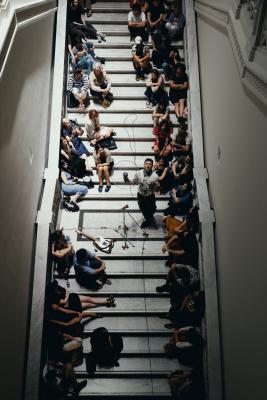
The sound performances of Basel and Berlin based composer and sound artist Tobias Koch attune audiences to sound as spatial-temporal experience. Making audible the feedback loops and resonant frequencies of the room itself, Koch studies how space alone can compose musical arrangements. The artist’s formal intervention and technical skill lie in treating sound as a sculptural phenomenon rather than strictly “ephemeral-auditive.” Redirecting what’s immanently available, to Koch, “the architecture itself becomes an instrument.” A room’s material constituents—elasticity, density, temperature, humidity, negative space—act on the behavior of sound waves. Thus, sound is disturbed by the material realm which it simultaneously shapes. In March 2024, we met up to talk through the questions fueling his practice, over coffee in the lobby of Hôtel Americain in Paris.
A lineage of forward-facing 20th-century composers that hone in on technology and experiment with instruments and techniques for probing the materiality of sound and the listening apparatus—like Maryanne Amacher, Alvin Lucier, and Pauline Oliveros (all born in 1930s USA and no longer alive)—historically situate Koch’s work within a context of listening experiences that revisit the conventions that traditionally govern the senses. “Music becoming simple as the wind—traveling everywhere. We are listening to each other,” wrote Amacher*. Music hails not from an individual but from a shared commons (“each other”).
Koch’s two-year practice of site-specific, solo live sound performances (under the title Room Service) where digitally rendered compositions are amplified by the surrounding acoustic frequencies or architectural matter, unfold in a series of live instrumentalisations by the artist. A compelling (and ongoing) series of collaborations across artistic disciplines precede these solo performances. Examples include: Such Sweet Thunder, a stage performance at the intersection of dance, music, and sculpture, with dancer and choreographer Thibault Lac and visual artist Tore Wallert; terratones.fm, an ongoing sonic ecology project with his sister, artist Dominique Koch; as well as multiple projects across music, theater, and installation with multidisciplinary artist PRICE (Mathias Ringgenberg). The film Drii Winter (2022), for which Koch designed sound and music, and which was directed by Michael Koch (another sibling), was awarded best feature film at the Swiss Film Awards 2023 and was the official Suisse submission for the Oscars Academy Awards 2023.
On March 9, 2024, at La Ménagerie de Verre, a venue for experimental performative practices in Paris’s 11th arrondissement, Koch strides amongst onlookers, neither decidedly nor aimlessly. While he adjusts theater lights, a recorded voice ruminates on the status of the image in today’s iPhoned reality. The room is basement-like, its ceiling low. Desiring to draw bodies together, Koch does not seek instrumental niceties, nor produce technological high-end music-scapes. Rather, Koch is after sound’s capacity to shape an “emergent community,” as artist and theorist Brandon LaBelle puts it. Koch’s use of a parabolic microphone—oftentimes used for nature recordings, sports broadcasting, and eavesdropping on conversations (e.g., espionage and law enforcement), activates the room’s architectural formation, sensitively remediating us—the audience—on spatial terms.
This interview was originally published in issue #29.
Stefa Govaart
I wanted to ask you first about the title of last night’s performance Sound Ruins. It summons a particular relation to time and history. I am thinking of remainders, of withering and decay; forms of material disintegration that stick. I wonder what ruins are for you.
Tobias Koch
Sound Ruins was the name of my research project at Istituto Svizzero di Roma where I was a resident in 2022–2023. I wanted to focus on a building’s acoustic qualities and their lasting effects, be it a church, ballroom, or abandoned house. Rome’s historical magnitude seemed to provide the perfect environment to do so. I was interested in how the acoustics of the Pantheon were instrumental in the invention of polyphonic music. All of these ruins are durable but may change at any given moment. Their materiality is persistent yet unreliable. If spaces tend to be assessed on the basis of their looks, how may we use our ears when we visit historical sites? What is the aural capacity of the past? Shifting focus, I wanted, and continue to seek out ways to foreground the acoustic particularities of a space, hoping to re-activate architectural sites through a contemporary approach to sound that composes “with” the past. Sites have audio-afterlives that linger like ghosts, carrying sonic properties that I try to materialize into a composition. Sonic qualities like echoes, reverb, vibration, infra- and ultrasound frequencies, and so on, might seem invisible, but—and this is the point: invisibility doesn’t equate to immateriality. Sound and music aren’t simply ephemeral. Sound is tangible.
An emerging research field called “Archeoacoustics” examines intentional sound design elements in ancient sacred temples, cathedrals, and what remains from amphitheaters and other archeological sites. Investigating their intentional acoustic design and the musical practices that ensued, researchers, through acoustic simulation, recreate the aural experience of the architecture. I’m interested in the emotional component of this. The acoustic design of spaces collectively shapes memory: listening is remembered experience—beyond nostalgia. Like smell, sound conjures recollection. This triggers our emotional body, which fascinates me.
Stefa Govaart
Sound Ruins, and your work at large, enhances an audience’s access to the perceptibility of architectural remainders. The work invites viewers to listen differently, calling on the emotional capacities of their bodies through architectural means.
Tobias Koch
Yes, rooms, sites, buildings have histories, competencies, and potentialities. Personality, if you will. How to tend to this? I am thinking of Alvin Lucier’s I Am Sitting in a Room (1969) featuring the artist recording himself narrating a text for a brief moment, and then playing it back into the room while re-recording it. This process is then repeated over the course of 45 minutes, while the words increasingly lose their intelligibility as the characteristic, most resonant frequencies of the room itself take over. As a consequence of the particular size and form of the space, certain frequencies of the recording come to the fore while others are weakened or impaired. We now listen to what the room gives back. This is how my performances become site specific compositions as well, through activating the space with sound and tracking how the architecture responds.
Stefa Govaart
Pauline Oliveros’ practice of deep listening comes to mind. What do you take from this technique?
Tobias Koch
Oliveros’ deep listening explores the difference between hearing and listening. The ear hears while the brain listens, and the body senses vibrations. The practice was developed out of her playing music in an underground cistern for water storage, a space with a remarkably long, 45-second reverberation. Describing the acoustic experience of making music in that very space, Oliveros explains that the acoustic qualities aren’t of a lesser importance to the sonic landscape of a space than the actually played live instruments and/or musical arrangements. Music is not detached from the space in which it takes place, but rather forms an altogether new entity. Being aware of that confluence is part of what Oliveros calls deep listening. I’m inspired by this way of thinking. I want to allow for the environment itself to become an integral part of my musical instrumentation and composition. You could say that I try to create an acoustic imprint that can only be perceived on site, at that very moment. To enhance the viewer’s susceptibility to such an experience, I hope to induce a somewhat collectivized listening mode. One way I try to achieve this is by having them witness my own listening to the sonic situation. I want them to track how my own aural perception makes decisions for me.
Stefa Govaart
The question is then how to sensitize the complex trafficking between the (human) ear and brain. Yesterday night you played, what I assume to be, a more or less, unique, self-built instrument. It challenged my ability to locate sound output in relation to its source. I didn’t know how to situate what I was listening to. Can you say more about this instrument and its function in last night’s performance?
Tobias Koch
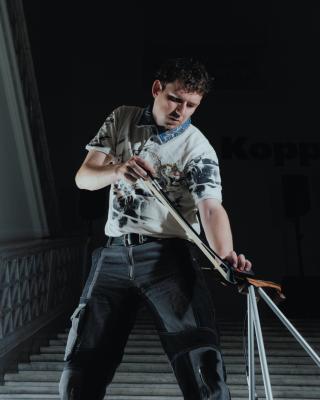
It’s all wood, and made of three pieces. There is the main wooden block that has a contact microphone inside, and a thin piece of wood on top of it. I strike the thin piece with a bow while bending it with a third wooden block, creating changes in pitch and timbre. The instrument is called a daxophone and was invented by German instrument builder and guitarist Hans Reichel in the 1980s. It never got to be produced but you find instructions online how to build it yourself. I came across it as I was doing research on vocalization. I like how the instrument has a vocal quality. Its sound sits between human shriek and animal howl. But it is played in this fairly traditional way, with a cello bow. It’s kind of sabotaging the relation between image and sound. What you hear isn’t what you see. So yes, I like to imagine that audiences may be relieved from being preoccupied with what they think they know. Someone unfamiliar with a daxophone will likely be surprised by the unexpected and new soundscape the latter produces.
Stefa Govaart
It’s probably also the most visual moment of the performance, as the instrument takes on a sculptural quality, and you are static, not moving around, having adjusted the lights to frame the moment as a scene, a portrait of sorts. How do you conceive of your performances dramaturgically?
Tobias Koch
As my background is not in performance, I have a lot to learn about how to navigate a live audience. I think dramaturgically about sound composition, considering the dynamics, volume, silence, frequency range, and spatiality of my music. I don’t know if I can say the same yet in terms of choreography or my physicality. So far, the music guides my movement in space, and I feed off the energy of the audience quite a bit. I work with a series of different elements that I approach in a modular way, piecing them together differently each time, depending on the venue and the context. I use different musical instruments and combine them with ways to use architecture itself as an instrument. For example, I use a parabolic microphone to amplify the resonant feedback frequencies of each space I am performing in. Or, I attach contact microphones to windows and other surfaces to play them like instruments. I also incorporate my singing voice. And then there are pre-recorded elements to structure the timing of some of these live elements or to add layers to them.
Stefa Govaart
In “Sound Ruins”, you overdub your flute playing with a prerecorded voice. You also sing a cover of “In Dreams” by American ballad singer Roy Orbison, which brings in this whole other quality. What was the research on vocalization about?
Tobias Koch
The voice is Jeremy Narby’s, a Canadian anthropologist. It is an excerpt of a conversation we (Dominique Koch and I) had with Narby for the terratones.fm project. At the time I was looking into different instruments, tools, and software that try to reproduce vocal sound. There is this whole music genre in Japan, for instance, based off of a voice synthesizer software called Vocaloid. It generated huge popstar figures. Hatsune Miku is the most famous one. She is an entirely digital character. But as a hologram she plays concerts with a band and everything, in front of a packed stadium with people going wild. Miku is a digitally generated cultural icon. Vocaloid is a software where you can play vocal sounds the same way you would play a saxophone or violin on the keyboard. The software allows me to synthesize singing by typing in lyrics and playing the melody with speech. It allows me to change the stress of the pronunciations, add effects like vibrato, or change the dynamics and tone of the voices I use. However, the software never became a commercial success, until they started a kind of rebranding by creating avatars for every voice-preset. All this is fascinating to me, how people began to make music in the characters’ names. This is how they became pop stars. A collectively generated voice…that’s interesting. It also makes me think about the ways in which the voice is linked to culturally mediated associations and habits of thought. A “nice” vs. a “not-nice” voice, etcetera. Humans are most sensitive to vocalized frequencies. Living in and through language, we’re best trained to receive the voice.
Stefa Govaart
It’s uncanny when you hear a voice of someone you don’t know that’s similar to the voice of someone you know.
Tobias Koch
Voice recognition is just so strong as it’s all about connection and safety. In sound production, you can endlessly distort or manipulate vocal sounds, and still you hear voices, not something else. Whereas with other sounds, if you start to work on them, manipulate and sculpt them, they quickly become unrecognizable frequencies. I love how humans have deep connections to vocal frequencies. I want to heighten the possibility of being affected, to interpellate audiences as emotional beings.
Stefa Govaart
I wonder about the kind of sites you are drawn to, since the material of a space matters to the way you compose.
Tobias Koch
Materials with high densities, such as concrete or solid plywood, strongly reflect sound. Materials with low densities, porous materials like textiles such as curtains or carpets, or seats with fabric upholstery, tend to absorb or swallow sound. This comes off as dry acoustics, with little feedback. I prefer spaces with plenty of resonance, reverb, and echo even. Many musicians consider this bad acoustics, but I tend to seek spatial reaction to make an architecture’s acoustic personality audible. This is what I do when I use the parabolic microphone to produce feedback frequencies. The more reverb, the more resonant frequencies with which I spatially compose what I call the “architectural melodies” of a space. I also love the weather: wind and rain are an endless source of inspiration which I explored in the work terratones.fm. Once after a performance an audience member came up to me and told me they had this extremely physical experience. Nothing visual, just the experience of spatiality. The performance took place in this old, giant museum in Rome. The kind with marble pillars and marble everything basically. They told me they had never liked this kind of pompous, historical Roman architecture, which they described as “cold” and “too grand for a small human being.” But during the performance something shifted for them. They started to experience the architecture differently: the coldness of the marble turned soft and warm. Something happened to them on a material plane. They could now perceive their environment in a different way through the listening experience. I love that.
Stefa Govaart
Finally, I was hoping to ask you about the political dimension of sound. “Eavesdropping, censorship, recording, and surveillance are weapons of power. The technology of listening in on, ordering, transmitting, and recording noise is at the heart of this apparatus,” writes the social theorist Jacques Attali in Noise: The Political Economy of Music, published in 1977. Nearly 50 years later, and post 9/11, the compounding of techniques for surveillance renders Attali’s assertion prescient, and urgent. How does your work negotiate questions of power and reproduction in light of what some call “surveillance capitalism”?
Tobias Koch
Sound can be a powerful tool for exerting power and control. Vibration is an acoustic force really: it can be very violent and is used to produce discomfort, express warning or threat, or spread fear. The sounds we hear in our environment have a significant impact on how we perceive the world around us. However, we often fail to notice it consciously, which makes us vulnerable to manipulation by the surveillance techniques of state power. Critical listening is of the utmost importance, a tool to be developed to navigate the world. How we listen is not only about understanding the world around us, but also about potentially disrupting power structures. Here I’m thinking about riots, or drones. For me, being aware of all of this is the core of critical listening, and a way of experiencing and practicing sound (and life in general) away from authoritarianism. Listening will never be a universal experience: it is heavily mediated by culturally and socially embedded custom and habit. This renders it inextricably political.
Moreover, there is no sound without an environment. Sounds are not singularities. They are always in dialogue with something. The context of the environment in which sounds occur render sound “sound” in the first place. That is part of its poetics, but also why it is such a powerful tool of control. The ideology that we live in, what you call surveillance capitalism, mostly relies on binary categorizations. Sound kind of escapes that. You can’t tell apart a good from a bad, a legal from an illegal, or an expensive from a cheap sound. Sound challenges predetermined categorizations and socially constructed binaries. In that sense, engaging with sound and listening practices re-sensitizes techniques for understanding the means of worldly mediation. We have to put to use and think critically about the limited agency we do have over our sound environments, individually and collectively, both as listeners and sound producers. We can exercise freedom, and share knowledge and information, through sonic instead of visual means.
Footnotes
See the undated text “Time and Wind Places” in Maryanne Amacher: Selected Writings and Interviews, ed. Amy Cimini and Bill Dietz, Blank Forms Editions, 2020.
↵