Organic Evolutions Suzanne Ciani
Suzanne Ciani
Photography
Elizabeth Herring
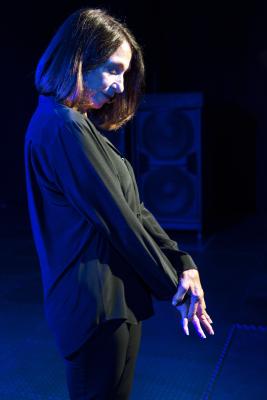
There is no other way of putting it: Suzanne Ciani was far ahead of her time. Back in California in the late 1960s, she was amongst the very first people to explore and play the now notorious Buchla 100, an instrument invented by Don Buchla in Berkeley in 1963. A daunting modular system of colored wires, knobs, and lights that does not resemble anything but itself, the Buchla was an exceptional tool that called for new compositional techniques and rewarded patience as much as it demanded it.
As Mathis Neuhaus finds out in conversation, Ciani also had to exercise patience before she was given her due and her trailblazing role in (electronic) music was acknowledged: not only did she choose an instrument that the public did not understand at the time, but that brought her into a male-dominated scene that favored gender over abilities or talent. In spite of these hurdles, Ciani continued following her artistic path, putting out numerous LPs—on labels such as Finders Keepers Records and RVNG Intl.—and eventually playing live all over the world as well as famously putting her new tools to work in the advertisement business: she created the Coca Cola Pop ‘n Pour sound on a Buchla in the 1970s before anyone was even considering what “sound design” might mean. Even though a commissioned work, the Pop ‘n Pour is a musical microcosm that gives an idea of Suzanne Ciani’s agenda: inventive, pioneering, and highly imaginative, she creates pieces that are distinctively her own.
Ciani and Neuhaus met at Dekmantel Festival in Amsterdam in 2019, while Elizabeth Herring photographed Ciani at Trauma Bar und Kino in Berlin a little later on.
This interview was originally published in issue #20.
Mathis Neuhaus
Have you had a moment of epiphany in your life in which you realized what you want to do with your life?
Suzanne Ciani
What immediately comes to mind is an experience that I had when I was eight or nine years old. I was standing in the schoolyard and it was just one of those moments in which everything crystallized, and I didn’t even know what it was at the time. Out of nowhere, I had this sense that I had a destiny, almost like an extraterrestrial experience. I have always felt that I had a mission, but that it was not to reveal itself until much later in my life. Because in my early days of playing electronic music, the world was not ready. Back then, the idea was that if you hadn’t achieved success as an artist by the age of 40, it was over. There was no concept of having an extended career.
Mathis Neuhaus
Your first musical education was playing the piano, right?
Suzanne Ciani
My first musical love was the piano. I was married to it. I played for hours and hours each day. We had a beautiful Steinway piano at home, but I had four sisters and a brother. At first, I had to fight them to get to play, but then I took it over completely and that was that.
Mathis Neuhaus
The Buchla came way later, I assume…
Suzanne Ciani
Way later. I already had a master degree in music composition. I moved out to California from Boston for grad school at the University of California in Berkeley, and that was when a complete shift happened. Different things intersected there: I met Don Buchla and also went to the San Francisco Tape Music Center, which was housed at Mills College, and it was in that time that instruments like the Buchla became available. The San Francisco Tape Music Center was the first public access electronic music facility.
Mathis Neuhaus
As I understand it, the piano and the Buchla both have remained important musical elements in your career.
Suzanne Ciani
Yes, but back then these two elements were in conflict, because I went to work for Don Buchla and saw the world through his eyes. And what was fundamental was that this instrument had a new interface. Robert Moog included a keyboard in his synthesizers because people did not understand how to play them otherwise. Don Buchla thought: “This is the end. Nobody will ever understand these instruments if they have a keyboard.” And so, my job was to keep these worlds separate. I wouldn’t even touch a piano, because I did not want to be seen as a pianist playing the Buchla. That would have confused people. And that conflict is still apparent today. When I go back to the Buchla these days, I do not play the piano.
Mathis Neuhaus
For someone who does not know much about the instrument: is there some kind of protocol for playing the Buchla?
Suzanne Ciani
The Buchla is a compositional instrument that is improvisatorial. The piano can be such an instrument, but the Buchla is it by definition. That demands a different compositional approach . With the Buchla, you have what I call raw materials. You define a starting point and then you perform operations that are very organic. There is a way of dealing with the materials on a macro level. In the piano, you get one event for each action. With the Buchla, it is multiplied. I get a key, I transpose it, I stop, I sequence, I start another one. Controlling the voltage allows me to do operations that are way more powerful than what a piano allows for. For instance, if you want to play very fast on the piano, there is a limit, whereas with the Buchla there is none. It is a different universe, really.
Mathis Neuhaus
The Buchla was invented in California in the 1960s. Considering the time and place, would you say it has a spiritual or esoteric element to it?
Suzanne Ciani
The first time around this instrument was not understood, which is also why I’m so excited in the renewed interest in analogue modular. The Buchla is very much tied to the person of Don Buchla. He was an extraordinary inventor; I call him the Leonardo da Vinci of analogue musical instrument design. He was an eccentric person and had an original take on life. He was a genius. He was a physicist and engineer, and he applied his genius to many different fields. And he was stubborn. As he was creating his instrument, it actually developed traction. People started to notice and it became marketable, but he never succumbed to the rules of market. He was uncompromising because of his long-term vision.
Mathis Neuhaus
You said the Buchla is a compositional instrument, but it is also very suited for live performances.
Suzanne Ciani
The beauty of it is that you have to be in the moment, and that it gives you the power to respond to your materials in the moment. Traditional music has always separated the composer and the performer and that worked very well for a long time because you had one person concentrating on providing the structure and another person focusing on interpreting that given structure. I have done classes with young students, where I give them my sequences and my musical starting point. But that does not define at all what is going to happen. It is jazz, really. I was just reading an interview with Herbie Hancock in which he defines jazz as an improvisational and risk-taking adventure. And that’s also what playing the Buchla is like. Traditional jazz took a known song as its starting point and explored from there. You need a frame to be creative in.
Mathis Neuhaus
How does all this translate to your recording practice?
Suzanne Ciani
I record my music live because I want to show off the power of the instrument. I do not want to make studio albums and record one sound at a time. It might be interesting to know that for the collaboration with Kaitlyn Aurelia Smith [Sunergy was released as a part of RVNG Intl.’s FRKWYS series in 2016], I used the same sequences and parts of the protocol that I was using in the 1970s. When I came back to the Buchla, I had to reassess and remember what I had been doing at the time. I had gotten a grant from the National Endowment for the Arts, for which I wrote a 40-page treatise on how to play the Buchla. Nobody was interested in that, but here it is, 40 years later, still holding valuable information about certain techniques.
Mathis Neuhaus
The Buchla also embodies another very Californian idea, at least in relation to Silicon Valley: human and machine becoming one entity. Do you draw on this idea in your work on the Buchla?
Suzanne Ciani
The Buchla, in a sense, meets you half-way because it is intelligent. It is a responsive machine that allows you to have a conversation. You say something, it says something back. It communicates. All the lights and indicators give it the feel of a living being, and this is a very Buchla-thing. Before it, no musical instrument could really be described as communicating. You did not know what was going on inside. With the Buchla, you can interact in an organic way by responding and making meaningful changes in the moment. When you play the piano, it is responding to a certain degree, too, but it’s more predictable. The Buchla has layers of organization that are not entirely unpredictable, but way more complex in terms of what the instrument is giving back.
Mathis Neuhaus
What’s the relation between an academic and autodidactic musical education in your view?
Suzanne Ciani
It is certainly meaningful to bring the root systems of music to whatever you are doing and academia can help you with that. But I also value my personal and self-taught experience with the piano. I tried to keep my own music private. I never went to a conservatory because I did not want my personal music to be impacted by an institution. I think private development in a creative sense is the most intimate thing. And you should protect that. You should have your own personal relationship with your art. There is no external judgement, because you are not doing it for somebody else. There are no external rules.
Mathis Neuhaus
As an artist, you can profit from academic institutions, but it can also be very liberating not to operate within an institutional framework.
Suzanne Ciani
You do not have to spend all your time in one or the other. Academia has its place and so does being an independent artist, regardless of whether you’re accepted or not. And not being accepted can also be stimulating. It makes you stronger because it forces you to find your own way and become responsible for your own vision. When you are being educated, you might be asked to do things in certain styles, like “Play this in the style of Bach.” That’s exercise. It is like going to the gym to get muscles. And once you have the muscles, you can apply them as you see fit.
Mathis Neuhaus
I think it is fair to say that your artistic career was defined by innovating what sound and music could be, especially in the beginning when the Buchla came into play.
Suzanne Ciani
Again, it was organic. I was not on a conceptual mission to redefine music. It was an unconscious thing. As I said, I really fell in love. The energy of love is very powerful. It’s a form of passion that does not need any thinking. The Buchla took me over and I did it morning, noon, and night. The same way I had done the piano morning, noon, and night before. And then I went back to the piano, and then I went back to the Buchla. It was all unpredictable.
Mathis Neuhaus
You talked a lot about how difficult it was for you to get into this field as a woman. Is there a certain element of activism to what you are doing?
Suzanne Ciani
While I was doing what I was doing as a woman, I kept encountering blocks and limitations. And then I would adapt to them. The beauty of electronics is that in many ways it’s a private universe. You actually did not need to be accepted by anybody. You could just go in your inner world and manifest everything, all by yourself. You did not need an orchestra, you did not need approval. It was liberating to do electronics. I am so happy that I have lived long enough to come out again and have a completely different experience. Are there some aspects of being a woman in technology? I would say the first time around, we were ignored, discredited. And the sad thing is, really, that we were invisible. There were women, many of them, in music technology, but we weren’t seen and did not have credibility. Buchla only had eyes for Morton Subotnick, a man. I could not even knock on the door. Now that has shifted and that is a good and healthy feeling to know that your existence as an artist is being acknowledged. For me, what I would like to see, is for us to uncover the historic presence of women in all this. I did a concert at Royal Albert Hall a year ago that billed “women pioneers,” and they premiered a piece by Daphne Oram. That piece was written in the 1940s and it had never been performed. And it was brilliant. I did not even know what Oram had done or who she was. They interviewed me before the concert and asked: “What do you have to say about Daphne Oram?” Nothing. I did not know a thing. I did not know who she is. I knew her name and that is it. I cried when I heard the exquisite beauty of the piece and the magnitude of it. Nothing has been done on that scale with orchestra and electronics since. She live-processed an orchestra. Her associate at the Radiophonic Workshop, Delia Derbyshire, died an alcoholic. These women could not have careers because they did not have a chance to practice their professionalism and their craft.
Comments
1 This comment ties in nicely with a conversation between the artists Grand River and Martina Lussi, who talk about the differences of composing by playing the guitar versus the piano.