Exquisite Corpse Spydergum
Spydergum
Photography
Hannah Brandes
Marc Übel
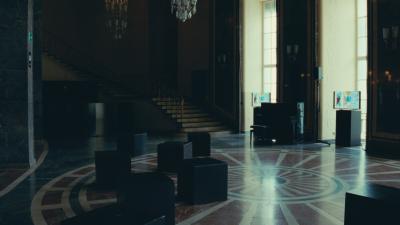
An exquisite corpse is a surrealist game. Devised in Paris in the 1920s, it has each player add a phrase or a drawing to a sheet of paper, then fold it so that the next player sees only what came directly before. The game takes its name from one of the first sentences it produced: “Le cadavre exquis boira le vin nouveau” (The exquisite corpse shall drink the new wine). The resulting composition belongs not to one person but to everyone involved, which makes it a fitting form for an interview with Spydergum.
Founded in 2024 by Agnese Menguzzato, Diane Esnault, Philipp Hülsenbeck and Andrea Bambini, the large electroacoustic ensemble brings together figures from Berlin’s music community alongside musicians from all over the world. There are no scores and no fixed line-up in this ever-evolving constellation focused on process and improvisation. Spydergum first came together during a residency at Morphine Raum in Berlin in November 2024. Its sound draws on an assemblage of acoustic instruments, voices and electronics.
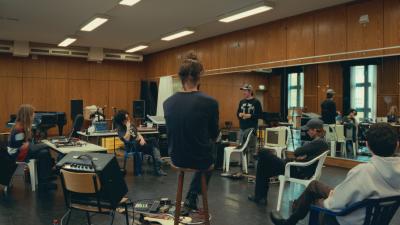
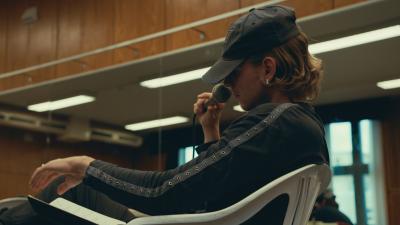
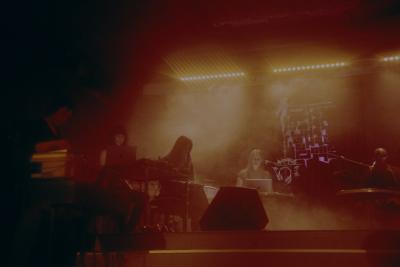
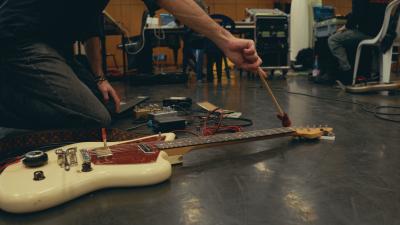
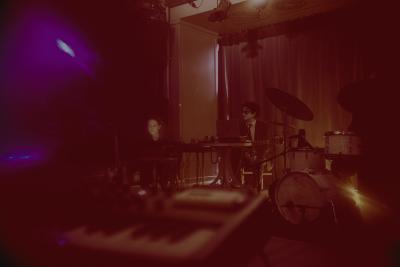
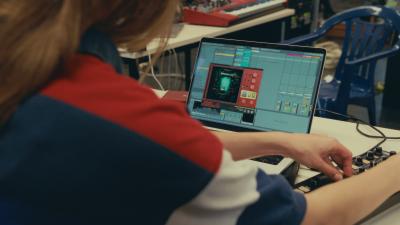
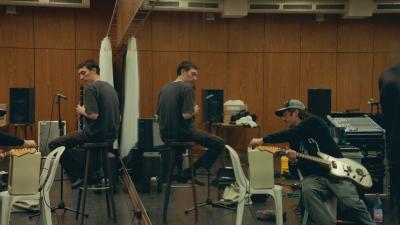
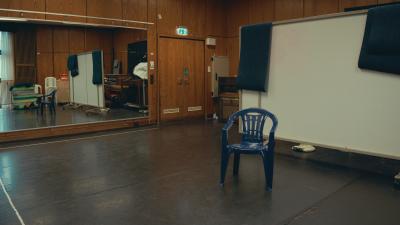
The collective’s eponymous debut album, distilled into 19 fragments from hours of recordings made during the residency, will be released on Unguarded on 6 November 2026. Prior to the release, the ensemble will perform on the main stage of Volksbühne Berlin on 2 November, following a sold-out debut at the theatre’s Roter Salon in May 2025. The photographs accompanying this text were taken at the Roter Salon show and during rehearsals for the Volksbühne concert.
For the conversation below, 19 Spydergum members followed the rules of the game. After an opening question, each of them saw only the previous question and answer, responded, and passed on a new question. In order of appearance: Andrea Bambini, Philipp Hülsenbeck, Diane Esnault, Agnese Menguzzato, Jungstötter, ronja, Simone Antonioni, Abigail Toll, Zylva, Gora Sou, Perfect Deleted Futures, Legion Seven, Ludwig Wandinger, Laurén Maria, Daniela Huerta, Concepción Huerta, Luka Aron, Severin Black and Ruggero Fornari. As in the ensemble’s music, individual voices are not marked: every answer is attributed to Spydergum. Motifs surface, disappear, and return. The last question remains open.
Mathis Neuhaus
With a project like Spydergum, how do process and outcome relate to each other?
Spydergum
The movie 2001: A Space Odyssey opens with apes finding a bone, the beginning of technology. What follows is a famous jump cut, with the bone thrown in the air becoming a spaceship in the next scene. Now imagine the apes had just continued doing their thing. This is pretty much Spydergum. No bones to use, no scores to play, not even a defined ensemble. A celebration of content-related freedom. Maybe we are trying to dethrone the fetish of the outcome. Maybe we are just too lazy to write music for 22 elements. Process and content are a black box. We had no clue what was going to happen before coming together for the first time at Morphine Raum, just as we have no clue what’s going to happen in real life. There are no expectations, because there is work ahead. A collage of languages created by the elements of the orchestra, always changing. We work the process to work the outcome.
Spydergum
How did we create the ensemble? What were the criteria?
Spydergum
The ensemble came to life when open mindsets, the urge for exchange, and different people met with curiosity. A genuine curiosity for other people’s sound, their approaches to music and their personalities. This goes beyond musicians, to people working in the arts in general. There was a need to connect, having realised how much time we spend alone, working on our own things, always dreaming, imagining how some day we might share the space with other people on line-ups or rosters. The sessions at Morphine Raum were a chance to invite people, some of whom we had never met in real life before. Everyone there wanted to see what this could become and made an effort to bring their magic. My curiosity was also directed towards people we had been working with for years but had never encountered in an environment with no set rules or hierarchy. People observed, listened, read the room and stepped up at the right moment to take the lead for a while, just before relaxing back into the overall dynamic again. A big puzzle we had no clue how to put together, but we were confident enough to believe that all the pieces would fall into place. There is a growing list of people I would love to see join Spydergum some day, to see where they will take us. There is space for ambition, but I wish for curiosity to always remain the focus of the ensemble.
Spydergum
Why do you want to be part of an ensemble?
Spydergum
My own creative process is mainly about a cherished solitude and sheltering myself. I need it. But, seeing how individualism reigns in our societies, I definitely think we need a change. I myself oscillate between different creative circles and scenes and hate “labelling” in general. To grow as an artist, you have to keep being curious and keep your five senses open to the outside, as widely as possible.
Spydergum
If you had to depict the ideal environment to experience a Spydergum performance, where would it be?
Spydergum
I envision a festival like Glastonbury. Almost every artist I ever liked has performed there. I feel the festival still holds a sense of music and community that is rare to find elsewhere, which would be a fitting context for Spydergum.
Spydergum
How did stepping into Morphine Raum and playing in Spydergum make you feel? Did it somehow influence the way you feel about playing music, even your own? Did it spark some thoughts about the perception of yourself on “stage”, or your practice?
Spydergum
It cracked open improvisation for me in a beautiful way. I’m not classically trained, and before this I always had a need for tinkering and control in music. Improvising happened, but never in this kind of group setting and never without a safety net. Arriving at Morphine Raum was a thrill, especially because I committed to vocals, which always feels like an extra level of exposure. It felt like unlocking a skill, or a positive regression. There was that same feeling and internal logic to my vocals, but I was unable to edit or sharpen anything, so I just had to lean into every first thought. A raw result, close to the essence. I want to trust this feeling more.
Spydergum
With this many people playing together, how do you find your cues and moments during the recording? Does a particular scene come to mind?
Spydergum
To me, the most important thing is to listen very carefully. With so many people playing together, it becomes less about the individual and more about understanding yourself as part of something bigger. You probably spend more time listening than actually playing, waiting for the right moment or the right space to contribute something. It’s a very different experience from how I usually make music or perform live. I’m used to being involved almost all the time, whereas here, making music can also mean holding back and allowing other things to happen. There’s something quite relaxing, almost meditative, about that, even though it requires a lot of focus. You’re constantly listening and responding, trying to sense when to step in and when to leave space for others. I think that tension between being completely focused and also letting go is what makes it work, both for myself and for the listeners.
Spydergum
What do you look for when you step on stage for a concert with Spydergum?
Spydergum
I like being challenged in the moment and having this back and forth between the elements of a big group. A subtle understanding of when to speak your part and where to move within a bigger picture is musically thrilling. And also having the possibility of spending time with people whose work I admire. It’s a good occasion to come together, since this is very difficult, if not impossible, otherwise.
Spydergum
What’s the sonic imaginary you associate with Spydergum?
Spydergum
Spydergum is a communing of shapeshifting sonic bodies from different backgrounds in physical space. All of us bring our unique way of playing, interpreting our spatial surroundings and each other’s body language. It requires vulnerability and a huge sensitivity to how we all read and offer cues.
Spydergum
What role do you think larger, communal ensembles like Spydergum play in today’s music scene, particularly in Berlin?
Spydergum
What stands out to me about Spydergum is that the members don’t seem to stem from one particular scene, but from different realms. Each person brings their own flavour to Spydergum’s sound, with their different backgrounds. In that sense, the name is quite fitting: like a spider’s web, it connects these orbits or music scenes with delicate threads that can transmit vibrations from one end to the other, causing the entire web to resonate with all the frequencies contributed by each individual.
Spydergum
What are you looking forward to at the upcoming concert at Volksbühne Berlin?
Spydergum
I won’t be performing at the show, but I’ll bring my camera and document the whole day, then make a little film out of it afterwards. I’m looking forward to seeing what emerges and to contributing something in my own way, even if I’m not on stage.

Spydergum
What is hardest about being part of such a big ensemble?
Spydergum
The hardest part is the surreal flow of ideas from the group sound. It’s like being blindsided. I can hear what’s happening but can’t say who’s playing what in most cases. I suppose it’s kind of like free jazz.
Spydergum
How would you describe the genre of music Spydergum performs? Or is Spydergum its own genre?
Spydergum
I’d say it is enough to describe Spydergum as collective improvisation, with all the tremendous breadth that implies. It does feel a bit like decoding a cipher when we play together, each of us applying method to another’s good idea until we lock into a pattern, and a message emerges unstoppable.
Spydergum
There are some texts I never expected to share on our record. Have you ever been surprised by something a session brought out of you?
Spydergum
There were several moments where I gravitated towards playing a different instrument and somewhat limited myself from the usual sound palette I have access to. When there is so much sound going on, with so many people, you really try to distil what you are bringing to the table. It becomes almost a concentrate of your own identity.
Spydergum
Did you sometimes have the feeling of losing track of whose sound is whose while performing?
Spydergum
For sure! Though I don’t think I even tried to link the sounds to a specific person whilst performing; I rather perceived it as an anonymous whole creating its own sound. Maybe that “own” sound, even in a group, is created through a loss of distinct identity?
Spydergum
Spydergum
Playing in an ensemble with people I don’t know isn’t always easy, but it really is about listening to each other for a while. It requires a lot of attention and presence to understand how I can bring a sound into the composition. Improvising has always drawn me in, and it opens up new possibilities for playing my instruments.
Spydergum
What does it mean to you for a space to act as an instrument, and how might you improvise differently in a dry studio versus a reverberant space?
Spydergum
For me, a space functioning as an instrument means recognising that it possesses its own materiality, memory, and acoustic response. Its architecture filters, amplifies, absorbs, and transforms every sound; it’s about entering into a relationship with the space.
In a studio without reverberation, I would work with closeness and detail. I would improvise with silences, precise gestures, frequency contrasts, and variations, because every action is laid bare and there is no reverberant architecture to prolong it.
In a reverberant space, on the other hand, I would improvise more slowly. I would leave pauses to hear how the space responds and how a sound continues after I have stopped producing it. I would use sustained tones and layers of tape capable of activating the space. In both cases, improvising would mean listening for a response.
Spydergum
Within Spydergum, how does your way of listening and making decisions change when improvisation is no longer the domain of a single person and the ensemble begins to behave like a collective organism? How do you recognise the right moment to intervene, sustain, transform, or remain silent?
Spydergum
In a large ensemble without any predetermined structure, improvisation ceases to be one person’s vision and becomes something closer to telepathy. With some members I share a long history of friendship and musicianship, so I can anchor myself to them, anticipate them, and know the range of their possibilities. With others the encounter is fresh, and I come to know them as people by making music together.
When no one is the master of all things, I see my most important task as making space: listening to the whole frequency spectrum as a single entity rather than as a sum of contributions. But I also find it necessary to think compositionally, to be informed by what has already happened in the improvisation, to imagine where it could go within the next minute or so, and then to sense, with a certain tenderness, whether the group agrees. Sometimes I choose someone in the ensemble without telling them. I throw my sound towards their chest like a rope across water, and wait, and when they pull I feel it in my own ribs; sometimes the rope passes through all of us and becomes a web that catches what none of us would have found alone.
Spydergum
If you had to forget one thing you know about music in order to hear it again for the very first time, what would you choose to forget?
Spydergum
There are many things I wish I could hear again for the first time, favourite albums and songs that have been played countless times and now hold a different place in my mind. But I am grateful that the passage of time has also encased all those sounds in a sweet nostalgic glaze. This deeply affects and informs my listening choices every day, especially since leaving my home country and reflecting on what defined my musical persona growing up. I would like to forget everything I “know” about music, all the elements that make me dissect music into its technical parts. All this removes one from pure enjoyment, and so if I could forget one thing, it would be being a musician. To not try to “know” and to just listen for the sake of listening would be a gift.
Spydergum
Can you remember the first time you performed in a room with other people, without an audience present?
Spydergum
Yes, I can clearly remember it. It was with my father, in our living room. He played the drums, and he’s the person who introduced me to the music of Led Zeppelin, King Crimson, Yes and other iconic bands of the 1970s. I must have been 13 or 14 years old and had been practising guitar for about two years. I plugged my guitar into a tiny amp and he was playing an electronic drum set (one of those with silent pads, as we were living in a flat). Someone had installed Sound Forge on the family computer, and I used to record those performances with the crappiest two-channel audio interface, but those recordings have been lost to time. Sometimes I wish I could hear them again. It was very funny and educational at the same time, and thinking back to those moments after a long time has made me feel extremely lucky.
Spydergum
Growing up, we all have an image of who we think we’ll become and what we’ll look like in the future; how does that image compare to who you are today? What’s different from what you imagined, and what has turned out to be just as you expected?
Comments
1 Improvisation, naturally, is a topic that comes up time and time again, also in this magazine. See conversations with artists like Anna Homler or Christian Marclay for reference.
2 Next to improvisation, collaboration is a guiding topic in Spydergum’s approach, something Nicolás Jaar or Jabu and Daniela Dyson also have plenty to say about.