Liminal Spaces Soraya Lutangu Bonaventure
Soraya Lutangu bonaventure
Photography
Ian Nnyanzi
Soraya Lutangu Bonaventure
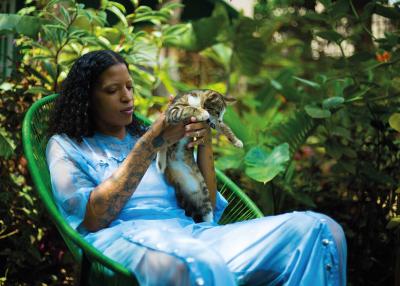
“Taking Care of God” is the title of a hybrid performance project by Kampala-based artist Soraya Lutangu alias Bonaventure together with collaborators such as fashion and costume designer Bobby Kolade, dramaturge and choreographer Jeremy Nedd, and the Kingdom Gospel Club, a Congolese six-person-choir also based in Kampala. The following conversation between Lutangu and Kolade took place in Kampala, and which contains questions by zweikommasieben editor Mathis Neuhaus, is a polyphonic approach towards elaborating on decisive factors in the genesis of “Taking Care of God.” It’s a meandering conversation that spans myriad questions of identity, different perceptions of belonging, and the question how to constructively approach different belief- and reference-systems via a shared practice. And while “Taking Care of God” is the artistic core of the conversation for the time being, it becomes apparent that for Lutangu, it’s only one aspect of an ever-expanding set of influences “growing from the same soil.”
This interview was originally published in issue #24.
Bobby Kolade
We are meeting halfway between your house and my house.
Soraya Lutangu Bonaventure
You have witnessed me moving, you have witnessed me breaking up, and you have also witnessed me going through the ring of fire of what it means to commit to a city like Kampala.
Bobby Kolade
A rite of passage. How many years has it been now?
Soraya Lutangu Bonaventure
Two years. I moved just before the lockdown, but mentally I was already in the mindset of re-centering a little before that. I don’t think the rite of passage is done because I think that Kampala will always resist me. It’s a city that you have to earn. It is an environment that you have to build with, and there is this energy of chaos. It’s a bit of destruction, but it’s also a lot of creation. For me to see the end of the rite of passage is probably going to be more about changing my mind about chaos rather than the end of chaotic stuff happening to me. The question is: How do I position myself towards chaos?
Bobby Kolade
When talking about settling into Kampala, it’s important to mention that you grew up in Lausanne, then moved to Berlin and lived in Portugal. So, where is home?
Soraya Lutangu Bonaventure
The feeling of home I have in Kampala. I miss the city when I am away and, in a weird way, I also feel like the city misses me. Coming back to Kampala is different to coming back to any other city.
Bobby Kolade
I notice that every time if I get back to a restaurant or supermarket I haven’t been to in a long time—and when I say a long time, I mean like four weeks—I am greeted with such warmth and almost like an auntie culture of, “Oh my God, you were lost! Where have you been?” No one in a supermarket in Berlin has ever greeted or welcomed me back. There is always this distance. It’s like they feel like they would break away from their professionalism if they brought in something casual or warm. So, you are absolutely right: Kampala missed you.
Soraya Lutangu Bonaventure
To be home sick while I was back in Switzerland didn’t surprise me, but the feeling to be missed when I wasn’t here did.
Bobby Kolade
There is way more communication required to live your life here. In Berlin, you can live a week without speaking to anyone. Even if you leave your house you don’t talk to anybody. You can go to the supermarket, pick up your groceries, go back home, go on a train, put your earphones on, and you don’t have to talk to anybody. Whereas in Kampala to get anything done you need to talk to at least a few people. There is something connected to that I wanted to talk to you about: language and belonging. You are walking around Kampala and you speak English with a Swiss-French-accent, right? Did you have difficulties understanding people?
Soraya Lutangu Bonaventure
I’m still learning to understand. It’s funny with languages, because of course it carries so much of a culture and so much of a collective imagination that I feel like a lot of things are kept hidden from my understanding: the kind of understanding that is not only intellectual and happening on a neurological level, but is informed by a sense of belonging and identity. These are much larger questions.
Bobby Kolade
Language will always be tied to identity.
Soraya Lutangu Bonaventure
Luckily it is not the only thing, because otherwise I would not feel as good about it.
Bobby Kolade
We are lucky in Uganda because English is the national language, and you can assume that most people speak English. We have a history of accommodating foreignness.
Soraya Lutangu Bonaventure
It’s also not badly perceived that I don’t speak Luganda. No one here is surprised that I don’t speak Luganda, whereas in Germany…
Bobby Kolade
As a matter of fact, every time I do speak Luganda, people are surprised: “Where did a white person like you learn Luganda?”
Soraya Lutangu Bonaventure
Language doesn’t feel instrumental for me to get a sense of belonging here. For me, it’s important to take this step and learn Luganda with a local person. And to do it gently. But it’s more a wish than a need. In Berlin, it was a need more than a wish. In Kampala, in regards to my own identity, I started asking myself questions that where not really part of the picture in Europe. Just because our environments transform the ways we are thinking about ourselves. Kampala is very powerful in everything that is unsaid and unseen. Relationships hit different here, but capitalism hits different as well. Gender hits different. Identity hits different.
Bobby Kolade
In Kampala, how does it feel for you to be perceived as white for the first time in your life?
Soraya Lutangu Bonaventure
I think my intellect is taking over because it makes the connection of why and how. Maybe it’s a coping mechanism, because somehow somewhere it hurts. Somebody’s got to pay for colonialism, and I know that I am part of the people that has to pay. Somehow, there are ways for me to make peace with it, and there are ways for me to also allow myself the anger. Because I don’t want to internalize things like alienation and gaslighting about who I am again. It is tiring to have people tell you what and who you are.
Bobby Kolade
There is this quote: “You get on a plane from Berlin to Kampala and within those eight hours you change from being Black to white.” And the reverse happens when you are leaving Kampala and go to Berlin. All of the sudden you are Black.
Soraya Lutangu Bonaventure
We are in the gray area and full of nuances. And nuances are very difficult to grasp because it requires to mindfully listen to whatever someone has to say. I think the States are very good at not listening; the institutions are very good at gaslighting based on identities and perception. I am never tired of doing the work of learning our identities and how they can change depending on where we are. As you said: in Berlin we are Black, and in Kampala we are white. I don’t feel mindfucked by that because I actually think we are constantly a step ahead because of this, in a weird and isolating way. Because we are the ones that hold both perspectives. Most people have no idea how it is to choose to be a minority. You and me, we have chosen, but usually it’s the opposite and no choice is involved when people forcefully put something on to you. The disbelief, for example, we are encountering when we mention towards someone in Kampala that we are local. There is a program that makes us white here, as there is another type of program in Europe. Being aware of that allows me to somehow calm down my nerves when people are touching the sensitive topic of identity. With William, I have the most interesting and dry conversations about this. He says: “You will always be a Mzungu. You can marry a Ugandan man, you can have Ugandan children, you can live your whole life here, but for us you will always be a Mzungu.” [The term “Mzungu” is currently used in predominantly Swahili speaking nations to refer to white people. Ed.] I think it’s so interesting for someone like him to say this, who has seven kids and a wife and an ex-wife as well. We have different lifestyles, of course, but to see how deeply he is programmed, it makes apparent that not only we in Europe have to deconstruct things, but there is also a deconstruction to do here. But the tools are different.
Bobby Kolade
There is a lot of collective trauma, a lot of collective aggression and I think as a country we are still in the process of healing and finding an identity that’s transgressing what has been put on us by borders and somebody else.
Soraya Lutangu Bonaventure
I spent a lot of my time with you, a person that is also very hybrid in their identity, and another part of my time I spent with the Kingdom Gospel Club. They are also part of the African diaspora. This thing of moving or being moved—by choice or by force. We share an understanding and we are able to reinforce each other. I can see myself very intentionally choosing people like you or Kingdom, people that are also holding this hybrid identity that can’t be summarized in one sentence. Why are we drawn towards each other? Is it maybe a sense of comfort? I have an easier and smoother flow with people that travel a lot. With people that sometimes choose to be a minority.
Bobby Kolade
Minority is the word here, I guess.
Soraya Lutangu Bonaventure
For you and me, minority means something very different to what it means to someone who is born and raised in Geneva. The word minority is so different for Kingdom, as Congolese people, living in Kampala and touring Switzerland soon. They are signed to work on a project where, for the first time in their life, they will be a minority.
Bobby Kolade
There is a big Congolese community in Kampala and through the different churches there is a bigger sense of community because they don’t necessarily feel like a minority. Visually, they are not a minority. They are not perceived as such.
Soraya Lutangu Bonaventure
Throughout the last month the tour became so much more concrete, and the conversation about race became a little bit more frequent. Now I have this thought, which I did not have in mind two years ago when I embarked on this project: “Hey, those people are going to experience for the first time in their life what being a minority encompasses.” It’s a huge word, minority. But they are going to step into a white space.*
Bobby Kolade
Over the course of the last year, I had many conversations with you about how to guarantee their comfort. I really respect you for that. Of course, there will always be a certain degree of discomfort, but you still have the responsibility of taking these artists from this city to a place where they might encounter racism. They might encounter feelings of homesickness or estrangement or alienation. They might also fall in love with that or with the space. Why don’t we talk about this: you are half-Congolese, and you meet a group of people from Congo, living in Kampala. It is their home and yours; it’s something that ties you together. When was the moment you felt a bond with the Kingdom choir? It’s inevitable that in this conversation we talk about the choir as a group of people, but they are also six individuals, so obviously your relationship to each one is different.
Soraya Lutangu Bonaventure
I think the first time I really bonded with them happened without their knowledge because I went to their church without them knowing that I am in the audience. I had the time to see three performances. I was aware of them before they were aware of me.
Bobby Kolade
Sorry to interrupt, but I like that you use the word “performance” in the context of church because it is never perceived as a performance even though it’s always a fucking performance.
Soraya Lutangu Bonaventure
Are we clear? To me, there is such a trauma that I am holding in regards to language and to the language of my dad that each time I hear Lingala, I am getting emotional because of my own family triggers and my own unresolved questions and traumas. That’s when my identity as a displaced person really plays into how I choose my people. Being conscious that there were so many Congolese refugees in Uganda. Even though I don’t claim their experiences in my story, I know that it’s very easy for me to recognize father and mother figures in these people. Because of the language and displacement that my dad is also talking about in regards to his displacement in Switzerland. Having met Kingdom in a church, it fixes things about my own relationship to my dad’s spiritualty. It’s complex, as his spiritual background is in voodooism. Traditional Congolese cosmology slash science and ritualistic practices.*
Bobby Kolade
Tell us about the church. People reading this might be thinking about a stone structure, painted windows and an altar and wooden pews. But is that the church you saw them in?
Soraya Lutangu Bonaventure
It’s a Congolese church. When I am thinking about it the first thought I have is: “This is too much fabric. Too much gold. Too much swag. Too much rave energy. Too much theatre.” But too much doesn’t mean anything negative. It’s actually called the Kingdom Church. It’s a permanent structure that has been there for twelve years or so. When Kingdom arrived here, it wasn’t there yet. They were some of the first attendees of this church. They have known this community straight up from the very first weeks they were here. I never asked them, but they also never told me that they ever felt alone. In the choir, everyone is celebrating each other so much as people, it’s mad. You have to see that they are friends when you see them performing on stage. There are so many looks, so much body language and muscle memory between them that you really understand the connection to be borderline family.
Bobby Kolade
The next question I wanted to ask you all along and it might be problematic. Church and club. For many people, it’s blasphemy to compare them. But with “Taking Care of God” there is this marriage happening of the two. It comes together via a very pure form of love and respect for each other that you have developed. They are embracing your club background, and you are very respectful and embracing of their church background. At the heart of it, you created a piece together. What do you think somebody in Congo, like a relative of theirs, would think of this? That’s one question and the other one is: how do you think people in Switzerland will perceive this? How do these two things come together in your brain?
Soraya Lutangu Bonaventure
It’s the first time that I am doing this, so I might have a lot of projections that could very well be unfounded. Some fears and some phantasies. I think both my fears and phantasies are real driving forces for leaving my comfort zone of the club. There are things that we have addressed as a collective and that we keep on coming back to. One thing, coming from certain individuals of the choir, is that Jesus was only hanging out with sinners. They have the vision of me as a sinner because of my tattoos. I think they also have some hints about my sexuality, and about my queerness. My lifestyle… “Taking Care of God” is a project that I consider a gateway or liminal space of sorts.*
We are different persons in the beginning and at the end of it. It’s affecting us beyond our skill sets and belief systems. And I know, for example, that they respect my crystals a bit more now than two years ago when we started out.*
And I respect their prayer time more than when we started. Because we have experienced each other and our differences, and we have also experienced the magic of each other.*
The magic of believing in something, imagining something and then manifesting it into a tour, into an album, into costumes, into collaborations.*
This abundance of what we bring to each other. As for the second part of your question: Whiteness holds an important space in “Taking Care of God.” I think I am the one most conscious about it because I am also the one most worried, obviously. And I think that there is no way for me to not come prepared. I have to come prepared in terms of being able to protect if at any moment there is a need for protection, being able to protect and create spaces where whiteness is not allowed. Meeting white people in Kampala is one thing, but meeting white people in Switzerland where the world is their oyster is really something else.
Footnotes
When asking Lutangu if she is concerned with connecting the personal with something more universal and broad in “Taking Care of God,” parts of her answer lead back to what she and Kolade are also talking about here: “This answer is eternally going to change, I can tell already. But mostly, I am not concerned. I am supposed to be here. For me, even in feelings, affairs, and emotions that are universal and broad, there is always a Black, V.I.P., and flamboyant section for our experience. Like, there is love, then, there is Black love. There is anxiety, then, there is Black anxiety. There is celebration, then, there is Black celebration. There is culture, then, there is Black Culture. When I am saying ‘Feelings Matter,’ I am saying Black feelings matter the most, even though white feelings are ruling the world. Thinking of the impact of showing a piece such as ‘Taking Care of God,’ which was written in Africa by people of African descent to a Swiss audience is somewhere near the forefront of my mind, but first, there is us. How this impacts us, to take this space and celebrate our individual identities amplifying one another. How it feels on stage to rest, to heal. Because there is only us here, defining what intimacy, freedom, mourning, laughter, art is to us. Without a care for being spectacular. Like so many other people belonging to groups that are oppressed, I am constantly thinking of the white gaze, the levels of humanity, the gaps and lacks within. As an Afropean belonging somehow in Switzerland, but not being fully claimed by it, I am thinking of security differently, I am thinking of care differently, of hospitality differently now that I am about to introduce the Kingdom Gospel Choir to a level of ‘minority’ they have never experienced before. Our communal goal is to create experiences that enhance the strength of our communities and re-enforce the value of our stories. ‘Taking Care of God’ is doing this. We want our people to feel whatever they want to feel during the show, we want them to know this is for them, and that all we are is valid, important and beautiful.” ↵
At a later point, Lutangu elaborates on her relationship to spiritualty and how different belief-systems co-existed and, consequently, influenced her via various members of her family: “I recognize that we are all coming from some kind of higher source, and in the past years, I have been working more intentionally on connecting with it. I grew up with a fair dose of spiritualism, and it was experienced and presented in many different ways by the members of my family and close circle. The concept of choice around belief-systems was always present, as many contrasting influences and strong energies were running in my family. My white grandmother was working with holistic forces and magnetism, to hypnotize, to heal, to communicate with the dead. (…) My dad comes from a family of spiritually active people, and his own practice has been growing, mutating, evolving a lot since my childhood. I have memories of him preparing rituals I could sense the secrecy of, I have memories of him dragging us to the Congolese church on Sundays, I have memories of him trying to learn Arab to recite the Quoran, I have memories of him praying. My mother, too, was speaking in tongue and searching for trance in different churches; our guardians were from all sides born again and again, and I assume my siblings and I are somehow still inspired by this freedom, and non-sense.” ↵
Lutangu doubles down on this statement via mail: “I came to Uganda with the wish to connect with Congolese gospel artists, and it was clear from the start that this intention would be manifesting if I would take action, and actually go to church. So, I did. I needed to create a possibility that would allow me to question, criticize but also fully live ‘spirituality/ies.’ I needed to make room for both my social identity, and my spiritual identity to meet each other. I see my practice as an ambiguous sphere of comfort and disorientation where rites are forever unfolding, embracing each other, contradicting each other. Initiating a dance and theatre piece that bridges the gap between ‘club music’ and ‘church music’ is directly answering to the binary systems I had to deal with from childhood. It starts with a very Black and/or white idea. Growing out of it, and appreciating the nuances I am called to live in, allows me to build new protocols of reconciliations that in turns offers new meanings to truths. You are a part of source and energy—you are a part of God—and ultimately, taking care of you means taking care of God.” ↵
In the right hands, crystals can be a powerful tool: “My grandmother was the first person to introduce me to crystals and their properties, and she could get rid of my headaches for me without even touching me.” ↵
I asked Lutangu if there is, in current times, really any other way than to collaborate and her answer really moved me: “Everything I share as a ‘solo project’ is in fact never experienced as such. Not only right now, also for Free Lutangu, and before I even was composing music. I was always willing to be open and inspired by my communities, by my ancestors. Navigating spheres where the white gaze determines who deserves access and who doesn’t, I am experiencing collaborations as a transformative force, a way to block gaslight, and to offer and be offered the comfort of being seen. The ‘current times’ bit of the question is really interesting to me, because I know we have such a different experience of what that is. Would you agree collective ownership is more of a Black thing?” ↵
In regards to collaborations, I asked Lutangu how much it’s about leading and following for her, but also questioned already if these are even the right terms for describing a shared process. I also asked how to know when it’s time to collectively move on and her answer makes apparent a more nuanced understanding of collaborations then my dialectic question indicated: “One of my favorite proverbs is: ‘It takes a village to raise a child.’ We are all interconnected and swim in a collective pool of memories and inspiration. The water of this pool is charged by the energy all of us individually release as we dive. This water cleanses us of some energies but also blesses us with new ones, light and dark. A lot of this energy is concentrated in our bellies where the sacral chakra is located, which is associated with water and with the moon. It’s the center of creation and confidence, and it is also where fears live. In this water, we co-create ideas, we exchange impressions, we bond, we learn from each other’s energy releases, we share timelines, and stream each other’s dreams and fears. It doesn’t mean we all ‘see’ each other when we dip out of the waters, or remember why our thoughts are damp, but it means everything changes everything (God is change, says Auntie Octavia E. Butler.) When I am the village I am the child too, and in this pool of hyper-empathy, it’s like both realities can exist simultaneously. When it comes to projects, I don’t move on. It all grows from the same soil, at the same time. I love the feeling of freedom that limitless collaborations create. Working with Hannah [Black], with Korakrit [Arunanondchai], with Alfatih, with the Kingdom Gospel Choir, is more about living with them than it is about releasing a project. Everything is durational and ever-growing. I never try to create something new, and I don’t think I ever did. It all feels so old, so grounded and shared.” ↵