You’ll Find Your Props in the Basement Price
Price
Photography
Flavio Karrer
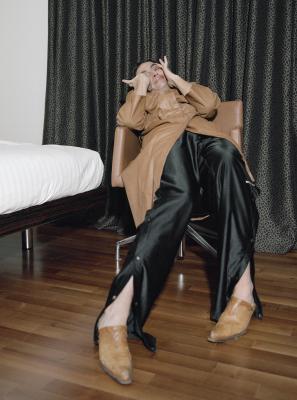
What’s the price you pay? In his work, the artist Price keeps returning to the examination of the mechanisms of pop, which has led him to discover borders—borders of choice, not necessity. Price is a character, a brand, a hybrid entity used by Mathias Ringgenberg in various formats since 2015. Price also is a construct: an idea in which the contradictory nature of the present does not dissolve but is affirmed as a real emotion. At the end of 2021, Sequences (True Sentiments) was released on the Parisian label Latency. It marks the first occasion on which Ringgenberg officially presented his music. His voice forms the core of the album, at times naked and alone, at others artfully embedded in harmonic melodies—up close and private, but distanced at the same time. In the text accompanying the release, Steva Govaart describes the album and the presence of Ringgenberg’s voice as follows: “Price is a child phonetically repeating what it doesn’t understand. But the child isn’t innocent, it is contaminated from the start.”
Ringgenberg’s step with Sequences (True Sentiments) in the direction of commercial music does not come as a surprise if one considers his background: the artist, who was born in Rio de Janeiro in 1986 and grew up in Biel in Switzerland, has been moving between different worlds and spaces from the beginning of his career. Anna Froelicher spoke to Ringgenberg for zweikommasieben—from Zurich to Sao Paolo. The resulting conversation explores the significance of language, the sense of feeling obligated to justify oneself, passing through institutions, and how pop continually manages to challenge the implicit borders formulated by such institutions.
This interview was originally published in issue #25.
Anna Froelicher
Where are you right now, and what are you doing?
Price
I just arrived in Sao Paolo for my Pivo residency. I’m staying in Edificio Copan designed by Oscar Niemeyer. My studio is also in the building, as are many apartments occupied by other artists. Occasionally I run into someone in the corridor: “Ah, yes, you’re here too!” I spent the beginning of the year in the Palazzo Trevisan degli Ulivi in Venice for a research residency, together with the perfumer Niklaus Mettler [see zweikommasieben #24]. Our research was guided by the question how we could transform smell into performance—specifically that of the rose, an iconic flower overdetermined by gender stereotypes—and layer it into sound. We were also interested in how the interplay between the two media could be presented in performance. After the residence, I went straight to the Arsenic in Lausanne, where I developed the performance series Untitled (sequences) with Ivan Cheng, Tamara Alegre, Thibault Lac, and Tiran, as well as the musicians Tobias Koch , Modulaw, Sebastian Hirsig, Cecile Believe, and Federico Capon. Each of the four shows has a new title and focusses on different things, although all are based on the songs of the album Sequences (True Sentiments). The performances are deconstructions of the same image, like examining the constituent elements of a smell for its parts, taken apart particle by particle.
Anna Froelicher
Was that an organic process for you, to let your music pass through different media? Or was everything planned from the very beginning?
Price
For me, working with different media and dimensions is simply a condition. But, sometimes, it goes in directions I could not have foreseen. For example, it wasn’t the plan to release an album; that simply happened. The already mentioned Cecile Believe approached me with the suggestion, she’s a musician living in Los Angeles, with whom I’d worked in the past. At first I thought I was somehow too old for that, and I live in Switzerland; why should I release an album? [laughs]
Anna Froelicher
What’s the commercial aspect of this kind of musical release?
Price
I have the freedom to try things and experiment with formats. For me, commercial success, or to produce music that is pop in this sense of the word, is not the main goal. I’m interested first and foremost in the working of pop, the surrounding hubbub, and to play with the definition of what it is and can do. It does not have to be market friendly because I’m dependent on completely different financial support structures.
Anna Froelicher
You work collaboratively, not only in your performances but also in music production. How do you see your role when working with others?
Price
I bring along the basic idea. I produce the demos, give them a color, a melody, and then we pass around the material. It’s important to me that everyone involved can get their hands on every song. Everyone has their own practice outside of Price and brings different perspectives to the table. I love giving space to a collective dynamic. Sometimes the entire song changes, or your favorite tracks are turned upside down. I don’t want everything to sound like it’s coming from one person. It’s meant to be a dialogue. It’s the same in contemporary pop productions, where you’ve got 15 or more people in the credits of a song.
Anna Froelicher
That means you really have to trust the people you work with…
Price
Yes, that’s also very important to me, and I know everyone I collaborate with personally. We spend time with each other. I appreciate their work, and they appreciate mine.
Anna Froelicher
How important are emotions in your collaborations?
Price
I have a method I like to use, particularly if there’s not the opportunity to spend time together in the same place. If we have to be quick and efficient in finding out what atmosphere or vibe a song is meant to have, I work with so-called “emotional charts.” These contain different sectors and colors representing different emotions. It always surprises me what a difference it makes for a melody to be played “jealously” or “longingly.” It’s a reliable tool to quickly get to different shades of rhythm, touch, and timing and kindle conversations about emotional aspects.
Anna Froelicher
Does it make a difference whether the instruments are acoustic or digital?
Price
On Sequences (True Sentiments) almost all instruments have been digitally manipulated, or the source material is already digital: the imitation of a harp or a guitar played over Midi. What I find interesting is that you can play notes that a guitar could not, just because of the frequency spectrum. In spite of that we still hear a guitar. The same principle applies to my own voice. Price sings and lets the sound of his voice and language unfold its effect. But if you listen closely, you realize that you cannot make out any words that make sense the way we usually expect them to. All the lyrics on the album are purely phonetic; still, it’s somehow clear to everyone that they’re imitating English.
Anna Froelicher
Before I learned this, I actually thought that the lyrics were in English but in words I didn’t really understand…
Price
I get a lot of different feedback about the language of Price. Some people feel that I don’t speak clearly, that I mumble…Others concentrate on the lyrics from the beginning, because that’s what they always do, and they fail miserably in trying to make sense of them. It’s part of my job to challenge the way music and language is “consumed.” For many people language is something that gives them direction; they look for it everywhere. Personally, I don’t feel like giving my work direction with words, to carve up the world into texts, into news, politics, goals, messages, beliefs. I consider that vertical, top-down, masculine.
For me rhetoric and affect are in the foreground, a feeling I can communicate. It’s an aspect of softness, intuition, speculation. I’m rather distrustful of language and look for places where it can recede into background to give me more space for my own thinking. Price likes to stifle the expectation that it will guide listeners through a show. Price opens up a space in which you can, and have to, find your own way. Of course Price also wants to seduce, satisfy, and entertain, but he also takes the liberty to turn away from the audience and to become private.
Anna Froelicher
Does Price have its own history?
Price
Price, for me, is a kind of brand, a word consisting of letters that look nice next to each other. In the beginning, Price was more of a persona, a fictional character from the ether of our information age, who appealed to some while others only saw narcissism and superficiality. It was important to me to make a clear distinction between this character and myself. All this has changed. Now Price simply is a version of Mathias Ringgenberg, a shift into a different, more public reality. Perhaps the name will separate completely from its body at some point and become a pure brand object.
Anna Froelicher
What do you consider the function of the audience in your performances?
Price
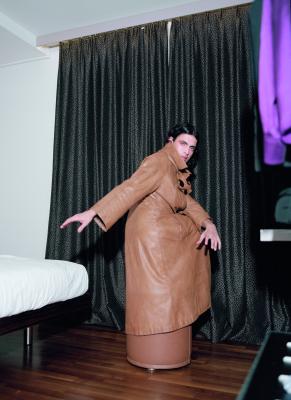
Price only exists in relation to the audience, who often stand in the lighted part of the room. I should have the chance to look at them, and they should have the chance to look at each other. Price likes to stare back. But only because he’s a human does not mean he should be in the center. There often are other things on stage, like textiles, the fashion of Victor Barragán, with whom I work, and other art objects.
Anna Froelicher
Does your work sometimes encounter resistance because it is difficult to categorize it in terms of a specific discipline?
Price
I tend to think long-term, and I want to do the things I love doing. I’m pretty open in regard to working with different institutions. I’m interested in the variety of dialogues and value systems. In an institution like a gallery, the textile I use for curtains in my new performance series are read as art objects—including the inevitable question about the sales price. In a theater, in contrast, the same textile is a costume or even a prop that’s stored in the basement. That’s difficult to accept given what they mean to me. It also says a lot about how deeply institutions are stuck in their traditions and structures, still mostly, and regrettably, heteronormative and patriarchal ones. Although you do by now find more queer positions in the limelight, behind the scenes a lot could use a shake-up. That also goes for financial support that is tied to specific disciplines. Is it art or theater or music?
It often happens that my work is received rather narrowly and that important aspects are completely overlooked. During an awards ceremony organized by an art institution in a white cube—which is to say, in a space where everything screams “art”—the curator kept referring to me as “the singer.” My voice was not really recognized as part of the artwork. In the context of this so-called high-culture institution, the pop-inspired nature of my singing and my character probably was too “mass culture.”
Anna Froelicher
How would you deal with such a situation today?
Price
I’ve reached the point where I’m thinking about finding a new way to name my work. I don’t want to be as dependent on institutions, but to transform the friction, which will be there no matter what, into something productive. It’s becoming increasingly clear to me that my work functions as a kind of institutional critique solely through its unstable form, even if that hadn’t been my explicit intention before. Maybe from now on, I have to call everything I do performance or a sequence of something larger. If I claim that everything is gold, then maybe everything will actually turn into gold.
Anna Froelicher
What about pop fascinates you? The contradiction that something can be produced and authentic at the same time? Or is it the economic aspect of pop?
Price
I like that pop and pop music is always about some kind of seduction. It’s accessible for the largest possible and most diverse group of people. Pop can be whenever someone says: “I claim this image popular.” For me pop primarily is a symptom of our time, a form of behavior, an image that excessively relates to the human and human sensuousness. You can wreck institutions with pop. Pop has a strong energy, and it keeps on getting access to spaces where pop did not have a place before.
Anna Froelicher
You’re talking about pop as subversion?
Price
I’m talking about the effect that happens when artworks with pop references are exhibited in high-culture institutions. That’s when there’s a discrepancy because pop clearly comes from a different space and is attributed to the mainstream, from which such institutions seek to distance themselves, also in relation to class. Because pop is so seductive, everyone suddenly thinks it’s sexy and appealing, even if it explodes the predetermined institutional frame. I find that dynamic interesting. It’s like a negotiation: a constant vacillation between being inside and outside the innermost circle.
Comments
1 An interview with Tobias Koch was published in this magazine as well.
2 It’s stimulating to assess the differences between this statement and JJJJJerome Ellis’ approach to language and how its applied.
3 Further reflections and practices around personas, brands, characters, and on- and off-stage identities can be found in the work of Poser.
4 To read more about the resonance and meaning of pop music in interdisciplinary practices, have a look at the work of Alexandra Bachzetsis.