A Band is a Band is a Band Poser
Poser
Photography
Kasia Zacharko
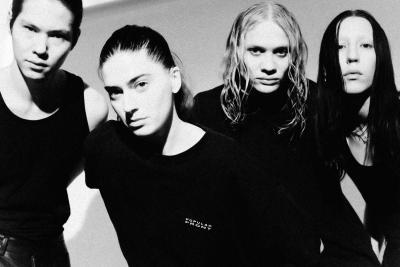
The term “experimental music” generally refers to an artist's approach to their compositional practice and to the sound itself. However, a new and diffuse group of artists calling themselves Poser seems to aim an experimental attitude at every faucet of music other than the sound itself. How a song gets produced, how promotional images are made and distributed, what constitutes a concert, are just some of the facets under interrogation in what might be thought of as an ongoing artwork taking on popular music as its subject. And while they might claim their music is a prop, Reece Cox finds out more about planned releases on Paris-based label Latency, the act of performance, and the essence and ethos of punk.
This interview was originally published in issue #29.
Reece Cox
When I wrote your agent for an interview they replied with some rules: the interview must be in person, that I was to take no photographs, that no editing of the transcription would be allowed, that no one’s real name be used, and if a real name is used by accident it marks the end of the interview.
Poser
Correct
Reece Cox
So why all the rules? And does capturing our whole conversation, mistakes and all, have something to do with authenticity?
Poser
At the risk of sounding cliché, we like to test the elasticity of rules. We made them up I guess because we hoped you’d break them, or try to. Rules create opportunities to contradict oneself.
Reece Cox
Am I supposed to break the rules?
Poser
If we told you to break our rules they would be pointless.
Poser
They’re both arbitrary and not. If we ever get interviewed again maybe we won’t have any rules, or perhaps different rules. It has nothing to do with authenticity. It’s hard to talk about authenticity by now anyways, I mean there have been whole genres and movements dedicated to sincerity, authenticity, backlashes against irony, post-irony… To have a conversation about authenticity at this point would have to be a conversation with history, and then you’re already lost in the weeds about being “authentic.”
Poser
We might do a lot with facade and facsimile, a lot of staging and acting, but we put in hours in the studio just like anyone else who takes their work seriously.
Reece Cox
But doesn’t the name of the group, project, or whatever you call this, “Poser”, speak about authenticity? Or rather, inauthenticity—a person who tries and fails to be authentic? How did that come to be the name?
Poser
Yes, very much so. None of us can really remember when the name came up. It was suddenly just there and it stuck. Never any question. The figure of the “poser” is fascinating to us, someone who is almost trapped as an outsider, made more of one by their desire to fit an image of something beyond themselves. I guess “image” is the operative word here. To be a poser is to lust after an image—to try to become an idea, or to become an image of someone else. It’s a position everyone has been in at some point in their lives. It’s a pain of youth, primarily. As painful as it might be to fall short of being a desire or ideal, it is a gift to desire something so strongly if one has the wherewithal to recognize it. It can be liberating to play the fool.
Poser
Yeah, it speaks about a failure of acquiescence or becoming—both of which we’re interested in. To aspire to be a band without hope of succeeding is to be in such a position. To desire the status and qualities of a group, to acquiesce, even if we’re more or less built to fail. We felt that might be something interesting to play with. Everyone knows what a band looks like, it’s a familiar, maybe even exhausted cultural form. So why not make one that’s an empty vessel? Build the body but never give it organs.
Reece Cox
We’re in the same room but you’re all behind a curtain. How many people are actually back there? Are all the members of Poser present? I can see your shadows as though you’re backlit. This feels like some weird asymmetrical chess game I’ve wandered into.
Poser
That probably says more about you than it does say about us.
Poser
At least you’re aware that you’re in the cave.
Reece Cox
Sorry, I forgot all of this is on the record—let’s stick to the questions. You’re about to release music for the first time with Latency. A single, correct?
Poser
Yes, a single with three versions of the same song. Two versions with countertenor Steve Katona, who has been wonderful to work with. We worked with Caleb Salgado on bass and Chris Shields on guitar for the B-side, which might become the A-side. And we worked with Frankie who produced a cover of our cover. They’ve all been fantastic to work with.
Reece Cox
The cover you mentioned is of “Simple Gifts” which is a Shaker song from 1848 about Shaker values and spiritual practice. The version you’ve produced is a far departure from the original and I’m curious how this song came to be of interest.
Poser
Yeah, good question. Well, the first Poser performance was produced when our friend—artist Liza Lacroix—invited us to produce a performance for a show she was doing at Galerie Gisela Capitain in Cologne two summers ago. We had some vague idea of a band that doesn’t move or play instruments and we asked Miriam Kongstad and Steve [Katona] to be in the band, so of course we needed something for them to sing. At the time I was reading a lot about Dan Graham, his early theater works, and was watching his film “Rock My Religion” on repeat, which deals heavily with the Shakers. At least initially the song was a sort of informal homage to Graham but since then we’ve become obsessed with the Shakers. There’s so much we could say on this. There are only two living Shakers today, the possible end of a beautiful communal way of life feels like a tragic metaphor against the dismal backdrop of rising technocratic feudalism. But maybe the technocratic doomsday conversation is better saved for another interview.
Poser
So far most of what we have done, the song, the collaborators, have come about through improvising and exquisite-corpse style collaboration and decision making. We can’t claim to know what we’re doing or what it will come to mean. We simply take our interests and questions seriously and see them through as far as we can. And for actually making a real release, it’s exciting but a bit odd for us because when we started we didn’t actually have any plans for the music. It was sort of a prop but people liked it so much that we now get to release it. Latency seemed to understand what we were doing from the first conversation we had with them, so it felt appropriate. I guess we’ll be a real band once we have an official release.
Reece Cox
Frankie and Steve Katona are in the press photos you shared with us. Are they not behind the curtain with you all now? Are they in the band?
Poser
Not directly. They’re affiliates, collaborators? Who knows.
Reece Cox
So no one in the photos you sent is in the band?
Poser
No. We just needed convincing press photos. Steve, Franziska [Frankie], Iida Jonsson, and Ssi Saarinen are all friends, as is Kasia Zacharko who took the photos. They were kind enough to lend their likenesses for the feature. Poser is extremely porous.
Reece Cox
Backing up a little, what do you mean you didn’t have any plans for the music? Isn’t that why one forms a band at all?
Poser
Well, Initially the purpose of the band was to produce images, or rather, pretending to be a band and having concerts was a fail-safe way to have people take photos of us without needing to ask them to. So music was necessary if we were going to call it a concert. If we were to silently pose as a band without sound or movement it would be too sculptural, and too serious.
Poser
And we certainly wouldn’t get invited to play anywhere.
Poser
Adding music lets everyone relax into the familiar behaviors and expectations of a concert, whatever that music is. It clears up any ambiguities and signals to an audience that even if we’re not doing much on stage that it’s still a concert, because there’s sound and at least one person might be wearing a guitar. A concert is a spectacle that invites audiences to take and post photos. We’re all artists or musicians, but oddly not one of us is a photographer. We came up with Poser to outsource that task to anonymous audience members.
Reece Cox
Hold up, what do you mean by wearing a guitar?
Poser
Well, no one has actually played a guitar during a performance yet. But we’ve had actors wear them at concerts so, yeah, it sends a message that a concert is happening. And so far, we’ve only performed in galleries and have an upcoming gig at a museum—spaces already designated for looking, so having something to hear helps. Perhaps if we play in an actual music venue we could do a silent concert.
Poser
Are they even concerts? We still haven’t decided to call them concerts or performances.
Reece Cox
So by “dressing” an actor in a guitar they help complete the image of a band without needing to be one.
Poser
Precisely.
Poser
I guess…
Reece Cox
You said Poser is a means of making images, not music. Can you say more about that?
Poser
Yeah, before any kind of music project we were thinking a lot about how to make an image. It’s an extremely loaded question that gets more complex over time. I think a lot about this Walter Benjamin quote from A Brief History of Photography: “In the future the illiterate man is not he who cannot read, but he who cannot decipher a photograph.”
Reece Cox
Deep fakes come to mind…
Poser
I mean yeah, but for now let’s stay out of the AI weeds. We’re not really dealing with AI images, nor are we necessarily concerned with doing something “new” per se… That said, we’re just as rinsed in it as everyone else, for better or worse. What we are doing though is playing with some ideas that have been around for some time, and only become more relevant now at the dawn of mass AI usage. Already in the 1980s, Vilém Flusser pointed out how photography, or cameras, rather, reflect an industrial and economic reality which cannot be divorced from images themselves. And we are all subject to the interests of the industrialists behind these new consumer products. This is even more true now with AI, yet the physical reality of these technologies is even more abstract. So on the one hand we have the evermore pervasive unreality of images, where ideas and entities can come into being and have substantial influence independent of any material reality whatsoever. And on the other, there is the economic, infrastructural, industrial, and technological reality of images, along with the will of technocrats, which generally all remains out of sight, out of mind. That’s all pretty macro. For us, Poser is an idea we can utilize to play in the shadows, trying to understand how images work bearing all that in mind while having full license to be intuitive and unpredictable. We’re artists, after all. It’s about gestalt, a popular music group that requires no coherent human or material reality in order to exist. It may enter a popular consciousness as a complete entity through images and images only.
Poser
So, how to make an image today? Or even, what is an image today? We realized that one approach might be to make something photogenic and familiar for an audience—to sort of hijack the relatively new instinct we all possess now to document and share everything online en masse. All of us love music, and some of us make it, so we decided to adopt the format of a popular band as a vessel to kind of load ideas into and see what works in trying to make a successful spectacle—and one that we just, you know, like. We’ve had this ongoing discussion about how the history of popular music is as much a history of images as it is one of music itself. So we’ve taken this idea on as our own sort of challenge but I can’t pretend like any of us really knows what we’re doing or what it means.
Poser
None of this was premeditated, really, but after we had the first Poser gig it started to come into focus. We were really just improvising—and riffing on groups like Bernadette Corporation or Artclub2000, this idea that you could borrow from familiar cultural forms and do something else with them. We’re also obsessed with Dan Graham. Also Rodney Graham, Anna Daems’ street photos, Wade Guyton, Anne Collier, Seth Price, Nile Koetting, Marina Rosenfeld, Kristin Oppenheim, relational aesthetics—too many to name. We try to rhyme with those who we feel a deep affinity for or pick up on questions or problems they were (are) dealing with that speak to us. We steal a lot of ideas.
Poser
I guess we’re Posers.
Poser
Mike Kelley had this thing about his work that the audience would tell him what it meant, not something for him to decide, or prescribe. It’s a difficult place to get to, but a liberating one. There’s a lot that we didn’t understand until we were already well into this project. There is a lot we still don’t understand. As a kid, my dad used to tell me: “You don’t know the list of things you don’t know.” I hated hearing it when I was 12 but now it thrills me. People come up with amazing ideas of what it means when they see us perform. Dimensions totally inaccessible to us alone. We’ve made quite a lot of work from the performance images, which was actually the point initially—that all of this would amount to artworks, not music.
Poser
Yeah, there’s a lot still to come. Our questions so far lead only to more questions—it’s a good thing.
Poser
We love not knowing.
Poser
We love being idiots.
Reece Cox
So the band doesn’t exist, the instruments are props for photographs. Is the music itself a prop? I mean, it sounds like real music.
Poser
At first, yes, very much so, but it grew over time. Now we put a lot of time and effort into it. It’s okay if things go off course from time to time—probably better that they do, actually. After all, how cohesive can a loosely affiliated group of bohemian layabouts be?
Reece Cox
So far you’ve mentioned a handful of visual artists but what about the music itself? Are there particular artists you’re listening to?
Poser
It’s completely all over the place. For a couple months now we’ve been listening almost exclusively to grindcore and opera. Finding a balance between extreme violence and beauty is interesting to us now, but the drive always changes. Ideas are fluid and we’re full of holes. We leak. One day we’ll be obsessed with trying to find a sound between Electric Wizard and Jürg Frey but a week later we’ll have written something that sounds more like Underworld. Who knows how it happens… We mostly aim for sounds we want to hear that we can’t find out in the world, and that’s usually something between known points of influence.
Reece Cox
You’re working with real musicians but it’s rather diffuse. I’m thinking of Crass and how they existed as a sort of collective more than a band…
Poser
Yeah, I love Crass. I hadn’t really made that connection. I mean, they’re categorically punk, canonically, really. It would be impossible to make something like that now though and I’m not sure how salient that comparison is.
Poser
I forgot who said it but I once heard someone say: “When I see punks—like young street punks in full regalia—I think of them as historical re-enactors.” Punk came about in a different world than the one we live in today. Media distribution, money, rent, culture—it’s all changed since 50, 30 years ago, and [punk] now exists as a kind of calcified gestalt of sounds and styles. Decades ago forming a punk or hardcore band used to be one of the most effective ways to get a message out as a young person—or an aesthetic for that matter, political or otherwise. Instruments and rehearsal space were cheap in the seventies and still were for decades after. There was no internet to post on, so you created a spectacle to gather rooms full of people willing to hear you out. You could sell anarchist literature or zines at shows to get radical ideas out. Bands used to have banter between songs, not so much anymore. That isn’t how it works now—today people go for texture, not meaning. That’s not why anyone starts a band today; not if they want to be effective with their messaging. If we’re talking effective messaging to a mass audience someone will just start posting whatever it is they have to say online.
Poser
I saw Napalm Death recently and they had incredible banter between songs—political, enraged, hopeful stuff they’ve probably been shouting to rooms full of fans since the 1980s. The younger grind bands that played before them said nothing between songs. Just texture.
Poser
From this viewpoint, a band is arguably a vestigial cultural form. For us, this offers a great deal of creative freedom, like a vehicle to carjack and use it as practically, or impractically, as we like.
Poser
Or to drive off a cliff.