In the Eye of the Beholder Lyra Pramuk
Lyra Pramuk
Photography
Henrik Alm
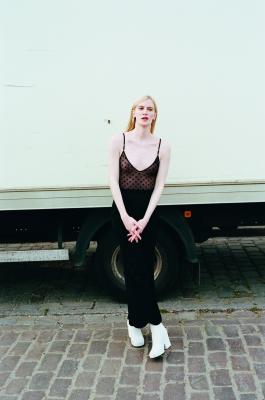
Kara-Lis Coverdale and Lyra Pramuk both occupy their very own and distinct sonic worlds. The former is known for her piano, organ, and keyboard work that morphs the gravitas of sacred music with digitally processed elements, looking backwards and onwards alike. Her LP Aftertouches, which came out on Sacred Phrases in 2015, is an excursion in serenity that does not shy away from spirituality, while still being firmly rooted in contemporary music production practice. The same is true for Lyra Pramuk, who just put out her debut album Fountains via Bedroom Community. The seven tracks on Pramuk’s LP, however, entirely consist of her own voice, which she sampled, processed, morphed and assembled anew. The results deny any certainty, which does not mean that there is an agenda missing. It’s a crystalline snapshot of an artist in flux.
For zweikommasieben, Kara-Lis Coverdale and Lyra Pramuk found each other for an extensive iMessage conversation. On there, the two musicians touch means of performance, questions of beauty, composing as a diagnostic process, and culture as something that can and should be reassessed, molded, and shaped constantly. The exchange gives subjective perspectives of what drives the artistic practice of two singular voices. Without claiming completeness or without dictating what one should think or do. It is fragile, but it does not break.
This interview was originally published in issue #21.
Kara-Lis Coverdale
Lyra, I am very happy to talk to you today! Sunday is my favorite day for music, so I am glad to music with you verbally today. I hope this doesn’t come off to formulaic to start off, the pressure of format is always looming somewhere in my hippocampus. Watching text unfold before me can feel a little bit stone-like in the sense that the written word can hold a lot of pressure and authority, so I hope we can keep it as immediate as possible and balance it out with fully-formed articulation.
Lyra Pramuk
i understand that totally—if it’s ok with you, i would use lowercase as much as possible as it helps me to do exactly that!
Kara-Lis Coverdale
It’s beautiful how we have come together. We spoke about this idea of musical connectivity between us briefly, when I first wrote you about Fountain—which I have since heard in full and congratulations! It is a spectacular album. I am very happy to have located you through your music. How are you feeling now that Fountain is out in the spheres? I say spheres, because I hear that this work will move beyond and through many circles.
Lyra Pramuk
i really appreciate that. my musical and artistic process has been one of building such an intimacy with myself and my recorded voice, and as with everyone’s first release to some degree it always feels extremely vulnerable. but i guess my music is especially vulnerable. i love the reference to spheres, thinking now of Kepler and music of the spheres and generally planetary bodies all around us!
Kara-Lis Coverdale
I believe this self-intimacy you describe is immediately audible in Fountain. I felt it within the first signatures of “Tendril” , which brings across an overwhelming sense of what I would describe as interior harmony. I love this piece because it has the harmonic requirements of full flight. It objectively soars and lifts. Affectively, the music reminds me of the idea of “Media Naranja,” which means half an orange in Spanish and is used for describing a soulmate. Except “Tendril” actually feels more like a full orange.
Lyra Pramuk
that’s sweet! my process in building a song is usually extremely intuitive; it’s usually not until many months later that i begin to be able to piece together a sense of what a thing is. in the case of “Tendril,” emotionally i think there was a core human emotion to confront, maybe you could say feeling only “half.” the song itself arose from a melody i sang into my phone while travelling one summer. one which had a central chord progression attached to it which i then developed further. and in the end, the harmonic progression carried it to this sense of flight and love, it was all coded there in an instant, one day at the piano.
Kara-Lis Coverdale
Would you say your approach to writing music helps you to locate a sense of self-wholeness? Because there is a sense of autonomous power in the harmony you weave. It is distinctly from one source and at the same time of many. You seem to hold in one hand yourself, and in the other the world, and they seem equally weighted. I hope that isn’t too vague or semantic.
Lyra Pramuk
i find it really relevant, actually. i think i can be emotionally quite detached, so i am always thinking about the world as much as i am thinking about my personal life. as my life is not detached from the world, it is embedded within its complexity. to the detriment of so many, our society does not acknowledge and nurture a sense of wholeness which is already always there, within each of us. i think i am starting from a place of acknowledging that our society is broken and projects onto us feelings of brokenness, but my true belief is that everyone is whole. i try to foster a great sense of empathy with all people and life.
Kara-Lis Coverdale
In your writing and your public being you are very present and active in many social issues. I wonder about the preconditions of such comportments. So if I may just sort of rewind, I’d like to ask you about your origins, to counter nostalgia in a sense, and to get an idea of what your early life was like in Pennsylvania where you grew up. I read you led quite a solitary upbringing. Do you believe this sense of isolationism at an early age is something you continue to carry forward, and that contributes to your sense of reasoning and being?
Lyra Pramuk
i think so. growing up in a small town in rural pennsylvania, especially as a queer child, isolation is not only inherent to the place. often, i chose to avoid conflict; to hide out in the music rehearsals spaces or isolate myself further at home and in a kind of virtual life on the internet, trying to build a sense of safety for myself. so i could thrive without being directly confronted with conflict, homophobia, or hatred. in some ways, i shied away from expressing myself in those days. i was smart, so i performed in a way that could appease my bullies. i wore masculinity as an armor, which began to feel very heavy after many years. further i think, solitude is an essential aspect of spiritual experience in many cultures. i’ve read a lot of spiritual and mystical poetry over the years, and all leads to solitude, and the rich mystery that one can find within oneself. it has been very affirming to practice solitude, to practice meditation through my artistic practice, as a mode of continuous becoming.
Kara-Lis Coverdale
But is music something you always “performed” for others as a way to cope with the lack of social acceptance of queerness? In Fountain, I don’t hear any sense of masking; instead there is benevolent individualism, something that is almost formed under the ocean and rises to meet the world.
Lyra Pramuk
i did perform a lot as a way of experimenting with and presenting myself. playing with my body and presentation in theater, for example. at the same time, i was singing in many choirs and playing in orchestras and found my own sense of sonic spirituality in those spaces, which felt entirely my own. a similar kind of sensual spirituality, which you can also feel throughout fountain. by the time i decided to study music at university, i was long gone in the music spiral haha. but as it is, i think i spent most of my life masking to appease others. what the “others” wanted, who knows, i didn’t really know who i was in that basic impulse. it was a form of self-preservation. and so, in my artistic and compositional practice of the last years, i’ve really been trying to build something that is, yes, still performative, but something that feels intimately my own, something that feels like me. a message that i feel i can get behind broadcasting to a public. i think also part of this (sometimes) lonely, personal, and compositional process has been to try to build musical materials and affects which ask more questions rather than posing answers.
Kara-Lis Coverdale
Performance art can be a form of “acting out,” an edifice that can destabilize structures through various symbiologies. In that sense, in my own practice, I have certainly engaged in battle and war. “Masculinity as armor,” as you put it, is something that is a piece of this act. Perhaps it is art or behavior as survival. In performance, I notice more violent behaviors tend to surface when I feel the need to communicate the effect of injustices, moments of pain, the affects of hate and non-understanding; to re-perform and show the wounds I accumulate. I wonder if you have experienced the same sort of choice in your musical career where you can choose between articulating one’s own inner peace (which for me often occurs in states of isolation), or the harmonic struggle of fitting in? I think it’s sort of cute that you wanted to appease others. Do you remember a time from your earlier days where you felt that for the first time you publicly and successfully negated the apparatus of musical convention and instead expressed your own truth? A form of resistance, if you will?
Lyra Pramuk
i’ve spent many of the last six or seven or so years performing my own wounds. before that also performing the wounds of others in a more classical context. i’ve been really interested in exploring the darker aspects of human emotion, because i think it’s important to be able to process and understand and move beyond such emotions.
Kara-Lis Coverdale
There was a time I thought my eyes and ears actually became wounds.
Lyra Pramuk
in terms of musical resistance, i was fairly straight-laced in my teens, but i began to express musical resistance in listening to harder electronic music or female punk musicians. eventually also in my music conservatory, by performing pop and experimental music by living composers that was more challenging than the main repertoire i was expected to sing. when one is expressing painful things, it can feel really embodied and visceral, it’s not a joke to express traumatic stuff.
Kara-Lis Coverdale
Have you ever thought of your compositions as a form of diagnostic?
Lyra Pramuk
diagnosing what, exactly, in that sense?
Kara-Lis Coverdale
There are so many parameters of articulation in digital composition, that often I feel I am able to articulate highly precise physical and emotive information that I arrive at in sound before I have verbal articulation. Sometimes I think of my studio as a form of monitor or a testing station. But I use “diagnostic” in particular, because I have come to think of music as a form of health recently. With artists that have a highly symbiotic and individualized connection between themselves and their music and harbor less conventions or a pre-existing aesthetic, there is a high degree of immediate diagnostic information in those sonics. If I am ill, for instance, I find it a form of dishonesty to produce music that does not reflect this state—it is a form of communicative dissonance.
Lyra Pramuk
this all resonates with me. i think it’s so important to find language, reasons, and analogues for what it is we are doing when we show up to create. i am very interested in cultivating and deepening my sense of intention. as you’ve just expressed, i often arrive at physical or emotive truths in my musical work that i may still never come up with in words. i really have a great respect for musical language as its own coherence, its own bundle of rational articulations. i don’t necessarily feel that that emotive musical information intends to find its best life in written language; i wonder what is gained by allowing music its own such agency. words are helpful to get closer to it, but words ultimately always fail me as far as music is concerned. that’s why the idea of improvisation is very close to me as well. so many times, i put that state or that immediacy into a recording, so i don’t lose that connection to the state i am in. in a way the collected body of recordings, the assembled tracks, become for me a kind of curated multiplicity of states.
Kara-Lis Coverdale
There is a strong sense of person in Fountain. I’m sure all of these concerns are somehow distilled into the work. While I hear that it is electronically produced and arranged or facilitated, I will say it does feel sort of outside the machine, almost as if you have chosen to render the web of its existence feel invisible. In that sense, the recording could be described as veridic, like a clever and modern wink ;) to high fidelity recording aesthetics.
Lyra Pramuk
haha, yes! aesthetically, i was thinking a lot about those hi-fi aesthetics, but i think there’s also many different types of lo-fi material produced and scattered throughout, so i really feel this kind of “high-low” interplay in the aesthetics of it. for this project, i was really interested to see how much i could blur the fleshiness of the voice with very specific kinds of processing, which would hit my ear in a way that supports ambiguity or even invisibility. when it comes down to it, a lot of the recordings you hear were made on the fly or in diy-environments with practically no regard to acoustics or recording practice. in that way, i feel my process as something messy, or punk, or somehow aligning with folk music. and then mixing those bits with more carefully recorded audio and sampled material. i think i was very conservative in a way when considering processing, and in some other ways threw in some bits of electronic processing which are not conservative at all :)
Kara-Lis Coverdale
It is interesting to think about sound treatment as being a “conservative” or “progressive” act, but I don’t think of this as being linear at all. For instance, more processing does not necessarily mean more progressive.
Lyra Pramuk
i use that word in quite a personal way. i think sometimes we hear newer digital tools as more progressive and less localized, whereas methods and tools coming from the 20th century, from pre-digital formats and genres, can offer a sense of nostalgia or geographical place. not to be reductive, but those are just some associations that come to me.
Kara-Lis Coverdale
Yes, and when done just right, both become meaningless. I think you have achieved that sense of transparency beautifully. On Fountain, I hear a form of musical engagement that is considering and capable across a very wide time continuum of musical production. Almost sort of floating above it all.
Lyra Pramuk
i feel when i perform these songs almost like it’s wind whirling around me, howling, bubbling up. water and wind. it feels very airy!
Kara-Lis Coverdale
Lyra Pramuk
oh wow, that’s a whole world. are you talking about skin or make-up or clothes or anything?
Kara-Lis Coverdale
I am talking of a sphere that contains many spheres if you will.
Lyra Pramuk
i have a more conceptual, over-arching kind of idea. i’m in a relationship with beauty and it’s complicated.
Kara-Lis Coverdale
Around five years ago, I used to get incredibly upset when journalists would ask me about beauty, because I found it to be female stereotyping and sexist, and I guess, ultimately, in retrospect, maybe I didn’t feel I identified as woman at that time, or at least not with the common ideal of female beauty.
Lyra Pramuk
beauty is one of those words that carries neoliberal, capitalistic, philosophical, cultural…so many different connotations. as you mentioned: spheres within spheres. i find beauty in everything. which is to say, i don’t want to carry around a limited, instagrammable, face-filtered, vacationified, greco-roman, western and anthropocentric understanding of beauty. we technologically-enmeshed cybernetic humans are arguing for social equity and a redefinition of beauty within human culture at the same time. Laboria Cuboniks Xenofeminist Maifesto says “let 100 genders bloom” and i feel the same way about beauty. I want to eat ugly vegetables that the supermarket doesn’t want to sell me. beauty secret: it’s in your perception and it’s an opportunity unfolding for you! right! now!
Kara-Lis Coverdale
This idea of eating the ugly, or embracing it, reminds me of this mole I have been managing on my back. It feels like this mole is talking to me. It is ugly and it grew very fast. It is not cancerous, but it’s also not normal. I don’t like it and it’s not because anyone tells me it is ugly. I actually like moles. But ugly growth it is a philosophical quandary, ultimately—these worrisome spots (that can surface as points of concern on the beauty scale) that arise as expressions of our physical composition, and as byproducts of environment or life or choice or even sheer DNA.
Lyra Pramuk
beauty is sculpted by culture and i think we need to be actively changing the culture.
Kara-Lis Coverdale
I agree. In my case, in a strictly health sense, letting ugly things “bloom” without proper labeling or treatment can be detrimental, and I don’t mean this poetically at all.
Lyra Pramuk
well of course if you have cancerous moles have them removed and don’t let them kill you. i actually have a lot of moles too and as long as they aren’t killing me, i really like them.
Kara-Lis Coverdale
Yeah, I am just thinking about extensions of this into musical practice—pieces made entirely out of diminished 7ths, etc. [addendum], in cases where “music” are symptomatic or diagnostic tools. I pontificate deeply on beauty now as I did operate outside my body several years and I look back at it now as a period of negation.
Lyra Pramuk
i do not believe that biology is our destiny. it’s a lot for an iMessage thread, but we don’t just produce technology we sort of “are” technology and design. whatever becomes possible becomes us. that has always been the story and this isn’t new. there is no “natural human body”—we are strange miracles.
Kara-Lis Coverdale
I do feel altered multiple times a day; nature is kind of a flux.
Lyra Pramuk
access to cosmetics, fashion, medical procedures, etc. is an intersectional and class issue. not everyone has access to the same resources obviously. but we all have desires and wishes and dreams and that is the primal urge of our being—to sculpt, change, adapt, present ourselves. all of us want that freedom. but to answer your question, i love to spray rose water on my face and neck.
Comments
1 Beauty, as a concept, is important to Lateena Plummer, too. Find out about that in her conversation with Anna Froelicher.