Ceremonious Rebellion Krista Papista
Krista Papista
Photography
Bahar Kaygusuz
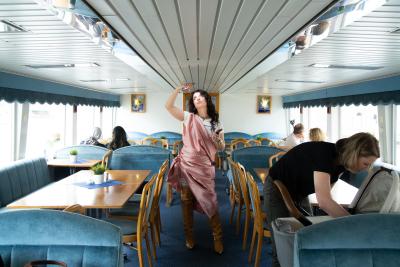
Krista Papista's latest album, Fucklore (2022), is a provocative exploration into the pockets of anarchy, mourning, and exuberance. She finds inspiration within traditional musical styles, sonic elements, and folk ceremonies emerging out of the Mediterranean, Middle Eastern, and Balkan regions. During the peak of her international tour, Krista Papista spoke with Jazmina Figueroa about the present social and political landscapes that fuel the oppositional stances she takes in her work, a landscape that she describes as “existentially worn-out.” The title itself, Fucklore, encapsulates her skepticism around established narratives shaping national identities. The album touches on significant topics, such as the murders of migrant women in Cyprus, which Papista addresses as a tribute to their lives and a condemnation of their mistreatment. It is an engagement that underlines her commitment to shedding light on critical social issues and creating awareness through her works.
The digital and vinyl release of her Fucklore LP merges elements of folk traditions, including Dabke (a Levantine Arab folk dance) and Greek Balkan melodies, with a punk-infused electronic resonance. These diverse musical influences form a sonic landscape that mirrors her own identity, locality, and the cultural amalgamation of the regions she draws inspiration from. Through her music, she aims to disrupt tradition, pay homage to marginalized voices, and challenge the norms, all while embracing her background as a queer woman from Cyprus.
This interview was originally published in issue #28.
Jazmina Figueroa
In your work you have developed politicized and reinvented versions of the narratives that constitute a national Cypriot identity. Who and what has inspired that?
Krista Papista
I grew up in Cyprus in the nineties and always had a sense of skepticism about the way Cypriot history was presented. Especially as a queer woman, these historical portrayals became very suspect to me. Cyprus was invaded multiple times and fucked by everyone and is still politically divided. Yet, the national narratives that have been cemented in books, public events, and movies are specific stories and rituals that are not necessarily connected to the personal narratives which are told by my family or through emerging historical retellings. The art history and the verbal and nonverbal history of an island that geographically borders Turkey, the Middle East, and North Africa is a collage of re-invented narratives, adapted according to one’s political stance, background, mood, and taste. This complexity is what I often observe in my work.
Jazmina Figueroa
How do you envision the fusion of contemporary Mediterranean, Middle Eastern, and Balkan folklore with punk music? Can it serve as a provocative counterpoint to the prevailing nationalist narratives of Cyprus?
Krista Papista
The poetics and psychedelia of Mediterranean, Middle Eastern, and Balkan folklore are a part of me; they are intrinsic to my identity. My manners and spirit have been formed and influenced by these regions and cultures. Traditionally, folkloristic projects have aimed to portray a romanticized and homogenous nationalism that I enjoy dismantling and re-inventing with my work.
Jazmina Figueroa
Could you provide insights into your latest album Fucklore and its thematic exploration of anarchy, mourning, and exuberance against the background of traditional folk music and ceremonies?
Krista Papista
Fucklore was an experiment; It was an attempt to create my version of my culture’s folklore in an LP. I also played a tribute to the lives of Livia, Elena, Maricar, Mary Rose, Sierra, Arian, and Asmita who were brutally murdered by an army officer in Cyprus a few years ago. An army officer in Cyprus would meet these migrant women on the dating app Bumble, have sex with them, then kill them (including two of their daughters) and throw them in a lake. The friends of these women would report them missing to the police, but the police in Cyprus never bothered to make a proper investigation into their cases, claiming that these women just crossed the border and went to North Cyprus which is the Turkish-occupied side. He got away with the murders for a while as the police are too racist to acknowledge the lives of these women. The songs on this album were written to pay tribute to these women and the anger we have felt for their mistreatment and misfortune. The album cover is a photo I took of the contaminated lake that has turned orange, near a mining area, where their bodies were found inside suitcases. I invited my friend, artist altifah to do an intervention using artificial intelligence tools. We created this image which looks kind of like a giant wound, or a psychedelic hunted oasis that pretty accurately resembles the Mediterranean amalgam I grew up in and know.
Jazmina Figueroa
What do you aim to convey through your music on this issue?
Krista Papista
What happened to these women was covered by the media for a very short time frame. There is a severe issue with racism and femicide in Cyprus and throughout the Mediterranean in general. The way migrant workers and women are treated is highly problematic and inhumane. As a white Cypriot girl, it’s not my position to speak on their behalf. I wanted to devote this album to the lives of Livia, Elena, Maricar, Mary Rose, Sierra, Arian, and Asmita. I wanted to carve out what happened in my time frame. These tragedies should not be forgotten, they should be talked about, and we have to put in the effort to create better conditions, protection, and opportunities for these women.
Jazmina Figueroa
Your work often delves into micro-histories while embracing folk genres. Could you elaborate on how you connect the fight against nationalism with the reinterpretations of folklore, through a queer lens?
Krista Papista
My process involves subverting, queering, and twisting the macho Mediterranean poetics and narratives, through sampling Dabke, Greek, and Balkan melodies, which allows me to channel a sense of hedonism fused with revulsion and chaos. Collaging these effects with my punk-infused computerized production is what went down with Fucklore. I think the idea of anarchy resonates strongly when you’re a queer woman with a Cypriot background.
Jazmina Figueroa
Being an artist based in Berlin, how have interactions in this artistic locality influenced your music and the themes you explore in your work, for example, when we listen to the older sordid pop anthem “I Love the Smell of My Pussy”? [This video was produced in collaboration with performance artist Florentina Holzinger. Another example is the Dabke-influenced track titled “Sonnenallee” , featuring one of the founding members of the band Chicks On Speed, musician Kiki Moorse.]
Krista Papista
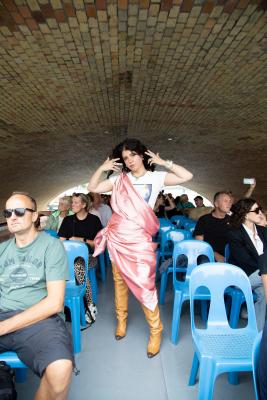
Ironically, Berlin has given me peace. It gave me opportunities, and it brought me close to different people that have contributed to my work. Berlin is a great place if you’re an artist, queer, and have a permanent rental contract. I loved working with Florentina for the video of the track “I Love the Smell of My Pussy”. I was talking with Florentina for a while, we wanted to make a music video but she was always on tour. It was kind of hard to sync up but then she finally came to Berlin with her performers, for her show at Sophiensaele in 2019. She told me to come to the theater and shoot the video within the setup of her show Apollon. We had to shoot it real quick, in just a few hours, so we decided to integrate me into the visual poems of her show. I asked my friends Ouroboros to film it, and the final production was iconic. Living parallel to Sonnenallee has inspired me to make tracks like “Balkan Dabke” and “Sonnenallee”. I just shot the video of “Sonnenallee” with my friend, photographer Isotta Acquati, featuring my friends Jan Verwoert and Kanella Petropoulou, who have also joined me on tour as stage performers. Kiki Moorse wrote the lyrics of the song and in the video, she sings the song with me while running down Sonnenallee. We are wearing these costumes made of shepherd’s bells, creating a ceremonial shit show of a bronze polyphony, each bell ringing a different note. We captured all of that on film and tape. Last winter, in Athens, I was doing some research for Fucklore and I came across these shepherd’s bells which were used in strange carnival rituals on several Aegean islands. I decided to make costumes with them for my tour. The costumes are made with stylist, Charlotte Gindreau, and they are the loudest instrument I have ever used on stage.
Jazmina Figueroa
In the context of queering history and challenging dominant beliefs within the Cypriot social-political landscape, how do you approach these tasks?
Krista Papista
When I say nationalistic ideology, I am referring to the more contemporary right-wing people, which have xenophobic and homophobic attitudes. They support the myth of a Greek-Hellenistic Cypriot identity. In the past, these people would preach and support the idea of Cyprus and Greece uniting. Now they just support the Greek Cypriots controlling the state with a closer association with Greece’s political concerns underlined by strong anti-immigration laws. These people are delusional; the Greeks like us but they couldn’t give a rat’s ass about our country’s politics. Half of Cyprus is currently occupied by the Turks and the only people we should be negotiating and establishing close relationships with are the Turkish Cypriots and the Turks.
Jazmina Figueroa
“Existentially worn-out” is the term you use to describe the oppositional stance you take in Fucklore. What are some examples of the things that you associate with being existentially worn out?
Krista Papista
Greek and Turkish Cypriot traditional dances performed to British tourists in hotels and restaurants during the summer. Bouzouki and baglamas macho aesthetics. And fucking someone you were in love with two years ago.
Comments
1 An approach that draws parallels to what bela is doing. In a different way, of course, but also stemming from folkloristic traditions.
2 Oh, Berlin…also read what Steven Warwick have to say about the city.