Something I Really Wanted for Reggaeton Kelman Duran
Kelman Duran
Photography
Martina Lussi
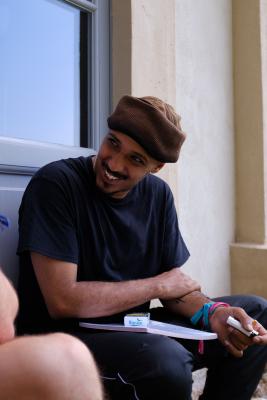
Even though it is over 30°C in the lush gardens of the Villa Arconati outside of Milan on this slow Sunday afternoon in July 2019, Kelman Duran doesn’t shy away from heating things up even more. The Los Angeles-based artist and musician, who came to attention with two albums, 1804 Kids and 13th Month released on Hundebiss in 2017 and on Apocalipsis in 2018, respectively, is playing the sixth edition of Terraforma Festival. On stage, as well as on his records, he blends vocal and instrumental samples from various sources into something that Boomkat celebrated as “reggaeton’s answer to Burial.”
After a set informed by ambient sounds, dancehall beats played at every single tempo one can think of, and melancholic voices, Duran met Remo Bitzi to discuss art school’s influence on his work, the joys and troubles his sampling-heavy practice has brought him, keeping politics out of his work, and how his “reggaeton” is received by different crowds. Martina Lussi took photos of the musician on the same occasion.
This interview was originally published in issue #20.
Remo Bitzi
Terraforma, the festival where you played a show earlier today, asked designer and Memphis Group co-founder Nathalie Du Pasquier to create a font, or rather, an alphabet of its own for this year’s visual appearance of the festival. The goal for the festival organizers was to give the festival its own language, as they claim. Applying this idea to your music, I’d say that you’ve already created your own language. Would you agree? And if so, has that been a conscious decision?
Kelman Duran
To be honest I only thought of it once someone mentioned it to me. When I’ve first started making music, there was not much to it. I guess people took me overly seriously because I went to art school.
Remo Bitzi
Who told you that what you do actually is something of its own?
Kelman Duran
It was during a radio show at Mixpak. Wildlife! [see zweikommasieben #6] told me, “Hey, I really like the stuff you are doing—dancehall and ambient.” And I was like, “Yeah, I do listen to a lot of ambient music…” I consciously applied that idea in the second album, 13th Month. The last track of the first album, “Introductions,” was the start actually—I put it in 1804 Kids at the last minute.
Remo Bitzi
Can you guess why you did this in the first place?
Kelman Duran
Maybe it was because I wanted to listen to the lyrics of those songs more, to avoid having drums in the foreground. But I wasn’t scheming to formulate it… Maybe it has to do with the fact that I did go to art school. I think for my music I wanted to resist using philosophical language to justify what I do. This language is great I think, and eventually it is important. But I didn’t think of it when I made the first album. Neither the second. And I won’t even think of it when I make the third. Maybe much later it will be relevant for my music.
Remo Bitzi
Are you fed up with conceptualizing your work in an art-school manner?
Kelman Duran
No, I’m not fed up with it. It’s just that I didn’t want it attached to the making of my music. I really like art school but it takes the poetry out of everything—at least Kyle Art did, the school I went to. You have to have a reason for every single decision. And you have to be able to justify that reason and write really well about it. Which is a good skill to have, but I wasn’t doing that with music. I didn’t have much to do at that time. I didn’t wanna work. So I just made music in my room.
Remo Bitzi
That sounds very liberated—free from the art context, free from any conceptual ideas, free from everything basically. At the same time you refer to the Haitian Revolution in the title…
Kelman Duran
Yeah. I remember a journalist in New York City came up to me and said, “Your album title is terrible, because it makes the music conceptual.” He was screaming at me that high-pitched voices have nothing to do with the Haitian Revolution. And you know what? I think he was right to a certain extent. So for the second album, I took a year. I said to myself, “maybe then think harder!” I tried to think more about it, even if I think there is still a problem applying a conceptual framework to an album because there are just too many variables to account for. And I don’t know if I actually can physically or mentally account for every sample that’s in there. But at least I felt like I had given it enough thought.
Remo Bitzi
You said you wanted to hear the lyrics more. Is this how you choose your samples—the vocals for the listener to contemplate and the instrumentals to provide a context for that? Or do you just appreciate the samples and this is your way of honoring the material?
Kelman Duran
For the first album, I was rediscovering the genre of reggaeton. Have you ever been on radiomusic.com? It’s a crazy website—there are thousands of people rating your music. It’s really nerdy. They categorize me as plunderphonics. I read an essay—I think it’s by a sound philosopher from the eighties* —and it says plunderphonics is when you take popular music and change the content a bit. When I read it, I was like, “oh yeah that makes sense.” Anyway, I grew up listening to reggaeton, but then I was really into different music. I think art school made me listen only to specific people. When I left art school I realized that I actually really liked reggaeton—a kind of music people say does not have much to it. For 13th Month, I’ve actually thought a lot about what I would sample. I consciously choose artists that are form the dancehall scene, and choirs from Europe that sing in minor, and then just a lot of things that I can’t account for—the last song has a Damian Marley sample for example. I took it because he sampled Ella Fitzgerald—and because that sample was already there, it made sense to me to use it.
Remo Bitzi
Artists who sample frequently often face legal troubles at one point in their careers. Have you ever been reconsidering using samples in your work because of that?
Kelman Duran
I am not really reconsidering. I just wanna have a deeper connection to the people behind the tracks. I want to meet them. Some people I have reached out to actually—Masicka for example, who is a dancehall artist. I think now he’s really famous. I should be careful. But I also don’t know how the record industry in Jamaica works. So if I’m gonna sample him again, I want somebody to send me there.
Remo Bitzi
I assume that you’ve actually met some of the people you are sampling.
Kelman Duran
Yes, some of them I have met, which can be surprising. I recently got to know Bamba Pana, a group from Tanzania. The music they do is so fast—faster than I play it actually. But they are the most low energy people I’ve ever met. Makaveli, the guy who raps on it, is really high-energy when he gets on stage, but the producer is like [acting slow]… I’ve also been to Portugal recently and when I played their stuff, they were so happy. Instead of being like, “don’t play my music, don’t edit my stuff,” they gave me more. Someone told me that my favorite producer from there, Anderson TxiGa, is a truck driver and that he does music for a hobby. I couldn’t believe it—the guy has hundreds of songs. It’s really minimal, as if he makes them for people to sample.
Remo Bitzi
What’s interesting in your music is that you combine a lot of different material. So in a way you are producing complexity. At the same time you reduce complexity by keeping things minimal. Would you agree?
Kelman Duran
Yeah. And lot of my favorite artists and film makers are minimalist. I actually like when things are simple. That I definitely took from art school. I get sensory overload by a lot of things. I can’t have too much going on—it confuses me. So I take a couple of sentences and a couple of elements even though they could be totally unrelated, cause it helps me to focus. That may have something to do with the pathological impact of social media—I have noticed me being less patient with certain things. I feel like I used to look at things a lot longer. Even if I didn’t like it. Recently, I went to the Biennale in Venice and at a certain point it was just too much—I wasn’t able to separate the politics from the art anymore, and I got angry about the market stuff. The explanatory tags for the artworks seemed so lofty. But I try to be more tolerant…
Remo Bitzi
Are you attaching politics to your art?
Kelman Duran
I know that making music has very little agency, except for myself—the furthest it goes is that sometimes people say that I changed how they listen to music. Which is a nice compliment. But I’m not changing anything and I’m not gonna act like it’s a political thing that I’m doing. The older I get, I realize that I just wanna be happy. But even that has become difficult. I read the news every day and I have to tell myself that I can’t get sad over it because then I’m gonna be apathetic. Some people criticize me for that: “Oh you should be posting more on social media about these things.”
Remo Bitzi
So you think leaving politics out of your work is the way to go?
Kelman Duran
One of my favorite artists is James Benning. He made a film called 13 Lakes, and it’s about 13 lakes. A lot of people are like, “Oh man, you care about landscape, you care about nature, you have all these politics.” But from what I understand, he is political, but not in his art. He is very honest about it. But there is pieces of art, that are able to make a connection. The Swiss pavilion in Venice* I actually really liked. It tells you right away what the show is about. They were like, “We do not feel represented by our governments and do not agree with decisions taken in our name. […] People stop using gender neutral language and move from their polyamorous groups into traditional families. Hate speech not only seems acceptable, but becomes a motor of aggressively arresting us into what is considered a normal life.”* Which is very true. I don’t agree with all the concepts they were talking about, though. They proposed to become this global unity, for example. I don’t necessarily agree with that. I think it’s important for people to have their own communities. Me for example, I grew up as a cis male, and if I can’t be allowed into something that’s fine.
Remo Bitzi
That sounds pretty prudent.
Kelman Duran
I feel like I have to be self-reflexive about myself and about what I do. I don’t wanna be a sociopath. And a lot of DJs turn into sociopaths. I also don’t wanna quit, because I hate the culture. A lot of DJs are like, “I’m so done with this. It’s so fake.” I don’t wanna let that get to me. So I wanna keep myself grounded and be like, “This is great, I’m having fun. I feel really privileged to be doing this.” And I decided that I’m going to be hard-headed about it. At a certain point, if I was starving and I wasn’t making money, then I would just quit and do something else. Just like a “normal” person. …I think it’s not my destiny to sign with a label, open up for famous people, or DJ in the Hollywood Hills. That’s not even worth my rent. I think I’m a bit romantic or nostalgic or whatever it is.
Remo Bitzi
Your music has been put out on “art-y” labels in Milan and New York. Here in Europe, you’re playing to a crowd listening to experimental music. Within this context your music is received very well. How is it received outside of that—in the Dominican Republic, where you were born, for example? Is your music considered “reggaeton?”
Kelman Duran
I really wanna be accepted by that crowd, too. It’s important for me to play in Puerto Rico at one point, and to have a good show in the Dominican Republic. But to them I am not Dominican enough. For some people, it goes even further than that. They say, “oh, you’re just a hipster who makes reggaeton for other hipsters.” Some of my friends from the Dominican Republic, who produce real dembow, understand it however, because they get the references. Cromo X, for example, he’s like, “Oh yes, you did what Playero did.”
Remo Bitzi
Do you agree with him?
Kelman Duran
Yeah, it’s basically what I did. I started out making mixtapes. But Playero wasn’t conceptualizing and thinking, “oh I’m making edits.” He obviously wasn’t sampling ambient music either, but he edited, he used vocals. It’s really nice to see him being rediscovered now by young people. He is a hero. But to answer your question from before: in my Boiler Room set people had comments like, “I bet he won’t play this in Puerto Rico”—stuff like this. But I also get comments like, “I never took reggaeton seriously until I heard this guy.”
Remo Bitzi
So your music is considered as being not reggaeton enough?
Kelman Duran
I think at this point there are so many of us that the genre is so vast. I love Dinamarca, but his reggaeton sounds way different than mine. Rosa Pistola’s reggaeton is totally different too. All these people have their own vocabulary, as you said. And that’s something I really wanted for reggaeton.
Footnotes
Canadian composer, saxophonist, and media artist John Oswald coined the term in his essay Plunderphonics, or Audio Piracy as a Compositional Prerogative, that was published in 1985. ↵
Pauline Boudry and Renate Lorenz presented their work Moving Backwards. ↵
See the newspaper published on the occasion of the exhibition for reference. ↵