“Ok, What Else You Got?” Hieroglyphic Being
hieroglyphic Being
Photography
Lendita Kashtanjeva
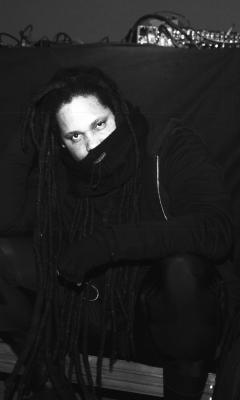
There’s a huge range of conversation topics to cover with the Chicago DJ, producer, and label owner Jamal Moss: his own productions under the pseudonyms Hieroglyphic Being, I.B.M, or Africans With Mainframes*; his label Mathematics Recordings, which releases music from under-the-radar artists*; the jazz alien Sun Ra and his Arkestra, a reference point central to Moss’s work; the performances of the legendary Chicago DJ Ron Hardy in the city’s school disco scene.
In an extensive talk with zweikommasieben contributor Guy Schwegler, Moss discussed all of these topics, but the segments printed below cover mostly other territory. The two met at Haus der Elektronischen Künste in Basel, where the former had been booked for a live set. After the conversation, Lendita Kashtanjeva took photographs
This interview was originally published in issue #11.
Guy Schwegler
I’m a huge fan of your Medusa Reflection Series*. How did these edits of industrial, EBM, and wave songs come about?
Jamal Moss
Thanks. They’re kind of a result of the fact that I went to school for cultural anthropology and ethnographic film studies. I try not to mix my research or studies with my music, but it has crept through. I thought this was a part of Chicago culture that needed to be heard globally.
So when I was younger I used to listen to radio stations called WKKC and WBMX. Herb Kent* played on Sundays. In Detroit they had the Electrified Mojo*, who would play all this eclectic stuff—in Chicago we had Herb Kent. He played stuff like the B-52’s, Italo Disco, and Brian Eno. A lot of electronic stuff. And I was like, “ok, I’ll write this stuff down.” And then I’d go to a neighborhood record shop where I lived—there were like eight of them in the neighborhood. So you could go wherever. If you didn’t find something here, you’d walk three blocks up and go to another record shop, and if you couldn’t find something there, you’d walk another two blocks to another record shop. And if you didn’t have luck there, you’d go to somebody who was selling records out of their house. I used to buy stuff from a dude who sold records out of his car trunk in front of the deli as well.
And I’d learn from them about all the stuff that was more divergent—not the commercial, basic stuff. So I got more into Larry Heard and Adonis and Steve Poindexter. Or as far as industrial stuff goes, I started learning about Liaison Dangereuse, DAF, Throbbing Gristle, Chris & Cosey, Siouxsie and the Banshees, Einstürzende Neubauten, Laibach… stuff like that. So I started to get more into that, and that felt more raw and genuine—coming from a different place. So I started hanging out at industrial clubs like Limelight, Off-the-Alley, Future-Shock, and Medusa’s.
Basically, the Medusa series is kind of like a music archive, like the Members Only series*—just from a different cultural perspective. My perspective is that of the people on the dance floor rather than of the DJ or someone else high up in the house culture hierarchy. And my edits reflect what the music sounded like to me as one of the dancers on the floor. When most people do their edits they have the clean, polished versions of the originals, whereas in the Medusa and Members Only series you’ll hear a drop in the midrange or a boost in the bass, because when a DJ was playing that particular tune that’s what it sounded like to me as I was moving and dancing on the floor.
Everybody talks just about one cultural perspective of Chicago. But I always felt like that was unfairly biased, because a lot of different kinds of music from other cultures was influencing the sound of Chicago—you know, Latin or Caucasian or European or Asian; it was all mixed. So I thought, “ok, rather than complaining about it and waiting for somebody else to do it, just sit down and put a series together to open up that door and get people more interested in this part of Chicago musical culture.” And I think it might have worked, at least as far as the industrial/EBM/wave part of the scene goes, because over time Medusa’s got some coverage in the media—people started to reach out to the DJs who played there and do interviews with them*. So I’m glad it helped to open up that door. And hopefully there will be other people who will start mentioning that stuff too instead of only talking about the soul classics.
Guy Schwegler
What differences do you see between those influences and house music or jazz?
Jamal Moss
There aren’t really any differences—it’s only about perception. Industrial music was kind of like a Caucasian version of working class music. I looked at it as I heard the sounds. It was raw and genuine. The artists were coming from a very different perspective, politically or however. It was intuitive and spoke for a certain culture in America—a culture that I didn’t grow up around. But other than that, industrial wasn’t, in my eyes, any different from house or jazz.
Unless you really comprehend the thing that you wish to be involved in, there’s always the possibility that you might run into a brick wall or a crossroads—that you get stuck and can’t see beyond what’s being manufactured and propagated to you. You’ve got to break through those barriers to figure out how they all coalesce. These different genres actually have more in common than not.
For example, when you hear house music, especially stuff from the early days, you can hear some sophistication in the drum programming and in the way the base line and the strings and the chords were arranged with such a minimal setup. There was a jazz influence. But even all of the industrial artists knew about Sun Ra and his Arkestra. I just like to stay open. How many times you can go to Europe and be from Chicago and just play soul, disco and house all day long? People will get over it, so you gotta mix it up somehow. Just like when I was growing up—you couldn’t listen just one kind of music all day long because eventually you’d be like, “ok, what else you got?”
That’s what was so perfect about Ron Hardy—he played lots of different stuff. And if he brought something everybody was familiar with, he would chop it up and edit it and give it a different spin, because he knew people were familiar with it. That was what kept the energy going. So I try to do that, in a way, when I mess around and experiment with different sounds—either in the edit format or experimental sound format or the “techno” format or the “house” format (which I never, to this day, claimed I ever covered). I experiment in sound—that’s it. And if I happen to experiment with something and it comes out sounding like acid or techno or ambient, that’s all marketing ploy. That’s what the distributor has to say to get the record shops to do their little categorization process and one-sheets and put things online. But when some of my friends asked me, I say I do synth expressionism and rhythmic Cubism—that’s it.
Guy Schwegler
I saw you’d referred to those two terms in another interview*. In that interview you also described yourself as a soldier. I found that point really interesting: the term fits very well with the aesthetic of the Medusa series.
Jamal Moss
The whole soldier thing… When I said I was a soldier, I meant in the sense that there are a lot of people who aren’t around today, not alive, that used to party with me back in the day. When I go out, I’m not a soldier in the sense that I’m violent or try to push propaganda on someone; I’m a soldier representing the people who have fallen and aren’t here. Some have to work, some are locked up in jail. There are people who passed away because of health problems, people who’ve been murdered—who are not alive because of their situation. They can’t carry on the culture or carry the banner. I see myself a survivor of life’s circumstances. I’m a soldier in the sense that I still carry on past experiences and bring them out to the world under the guise of art expressionism.
Hopefully one day other people will see what I do and be inspired to carry the banner as a soldier—to keep things going forward. Because the reason I’m doing what I’m doing now is because other people are bullshitting. That’s it. If other people were doing what I do for Chicago, but better, I wouldn’t be on the road. Other people could carry the banner.
Guy Schwegler
So is there an aspect of “sonic warfare” to your approach? In the sense that your music sets the story straight?
Jamal Moss
Put it this way: a lot of people have selective amnesia in Chicago. Like, their muscle memory* and their memory memory form experiences, form the past, and keep them from dealing with true Chicago culture. That scene itself has been erased—people have been through some weird kind of traumatic experience in which they don’t want to remember or identify with their culture. They would embrace everything but the stuff that actually happened in Chicago. I want to know why that is. I’m not speaking hatefully about Chicago—there’s a lot of talent there. But they’re misguided and misdirected in believing in themselves. And from my perspective they don’t truly believe themselves. They believe in what is being marketed, and that this marketed culture is better than the culture that’s actually from Chicago. There’s a lot of press and media hype re-appropriating house music from Chicago. But the newer Chicago artists haven’t even bought or absorbed the Chicago stuff. They try to sound like somebody from London or Germany, but they don’t wanna sound like themselves. And I don’t think they get what the world expects of Chicago. So when they see somebody from London get upset when they see that girl Mary J. Blidge go around to London to do a house record* and get offended, like, “what, why does she go to London to do a house record?” Because they handlin’ their business!
Guy Schwegler
And what do you think of the whole footwork and juke scene in Chicago right now?
Jamal Moss
That’s a different generation—I can’t knock it. That’s what they built for themselves. Like I said, the older generation had to do what they had to do. They had to go eat, they had to go make a living, they were all in Europe doing whatever. And I’m not saying they didn’t go back and mentor the youth—some probably did—but the kids had to design their own culture. Because when there’s nobody around to mentor, to carry on the banner, then they have to go and do their own thing. And it’s funny when they build their own scenes, and then all these older cats who were basically slowly fading away want to come back and re-inject themselves, saying “I was doing this before you,” knowing damn well it’s not the same shit. They want to make themselves like, “oh, if it hadn’t been for me you wouldn’t be doing this now.” And I think that’s wrong of them.
So with footwork, I applaud them—they built their own thing. It might evolve into something else. I have no idea. But I don’t really interject myself into that because that’s their thing. I’m a 41-year-old man, I don’t want to sit around 19, 20 year olds, be all up in their shit. It’s their moment.
Footnotes
Africans With Mainframes is a collaboration between Jamal Moss and his cousin Noleian Reusse. ↵
Bruno and Hansruedi Schnueriger aka Echo 106, two brothers from Central Switzerland who took some snapshots for zweikommasieben #8 would be an example; John Heckle yet another. ↵
Medusa Edits, ME-001 through ME-007, (2008–2009) ↵
Aside from his role as eclectic music curator, Herb Kent was known for his involvement in the civil rights movement in the sixties. http://www.thehistorymakers.com/biography/herb-kent-39 (05.02.15). ↵
The Electrifying Mojo aka Charles Johnson and his radio show has been credited for its influence on the emergence and establishment of techno in Detroit. ↵
The Members Only series is Jamals Moss’s collection of mostly disco edits. ↵
In “Medusa’s: Chicago’s Missing Link” (Arnold, 2013), Resident Advisor wrote a long report about the club. Another article, and also coverage of other clubs mentioned by Moss in the interview, can be found in the Chicago online magazine Gapers Block. ↵
Martin, Lauren (2014): “Meet Hieroglyphic Being, the Sun Ra of the Sequencer.” Wondering Sound. http://www.wonderingsound.com/feature/hieroglyphic-being-the-seer-of-cosmic-visions-planet-mu-interview/ (05.02.15). ↵
Moss has mentioned the term “muscle memory” several times, for example in an interview with The Quietus (Gibb, 2012), or in his essay for XLR8R (2014). ↵
Mary J. Blige (2014): The London Sessions. Capitol Records. ↵