Introspection, Externalized Grand River
Grand River
Photography
Marie Haefner
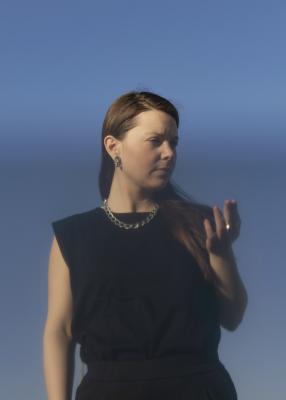
The Dutch-Italian composer Aimée Portioli produces music as Grand River, an alias that describes her musical output well. Take, for example, the two LPs Pineapple and Blink A Few Times to Clear Your Eyes she put out in 2018 and 2020 on Spazio Disponibile and Editions Mego, respectively. They ebb and flow, sometimes majestically, sometimes cautiously, and travel great lengths inbetween. Grand River’s music can be profoundly emotional, evoking an easy to embrace tenderness.
In the following conversation, Portioli spoke to Swiss artist Martina Lussi about different ways of working, the creative process, being a woman in the music industry, and Portioli’s label One Instrument. The label represents one point of intersection between Portioli and Lussi—the former asked the latter for a potential contribution to its catalogue back in 2018. Even though that plan did not come to fruition (at least not yet), three years later, the two artists talked to each other in depth, finding another means of expression in order to connect.
This interview was originally published in issue #23.
Martina Lussi
I see you are surrounded by a lot of plants. Are you in your studio?
Grand River
No, I’m in my living room. I wanted to use my acoustic piano for a recent project, so I moved some other instruments here. It became a temporary studio for that period.
Martina Lussi
How long have you been playing the piano? I feel like it helps in producing music because it gives a better overview compared to the guitar. I learned to play guitar first and just now started to play the piano a little. To me, it feels more structured.
Grand River
The guitar was the first instrument I learned to play, the piano came second. I was about 13 years old when I started to take piano lessons, but I have been singing in choirs since I was six. Having a visual approach to the piano is certainly interesting since the instrument actually is right in front of you, and this influences the way I compose. With a guitar, you get creative in other ways. I know that you play the guitar quite well because I remember hearing it on your album Selected Ambient [Hallow Ground, 2017], which I really liked.
Martina Lussi
I have to return that compliment: I think your recent album Blink a Few Times to Clear Your Eyes [Editions Mego, 2020] is a really nice piece of music. It is funny that we are talking right now because we were in touch a while ago about a possible release on your label. It took me a second to connect the dots after becoming aware of the album and listening to it. What was the process of working on the album like?
Grand River
I made the compositions for the album two and a half years before it was released. I did not have a strict deadline, so I worked on the tracks as long as was necessary for finishing them. Dedicating time to my music has always been a priority because it is difficult to give creativity a timeframe. I started to work on the album shortly after I released my first album Pineapple [Spazio Disponibile, 2018] and tried to balance it against my travelling. Even now, when I am not travelling, I try to find a balance in my practice by working on a new live show and composing. These are two completely different things, at least in terms of working methods, and I take the organization that goes into both seriously.
Martina Lussi
And how do you actually start with a piece?
Grand River
Sometimes I have a clear idea or concept beforehand. Other times, I just want to explore a synthesizer that I was thinking about, or try a particular method or module, or just play the piano or my cello. The tracks from my latest album are mostly created by starting with one instrument and expanding from there. It’s a bit like building a house from scratch. The foundation comes first, then the walls and the windows, followed by the furniture and all the little details.
Martina Lussi
Everything else comes in the end, after reflecting on what you made? I am thinking about the sequencing of the album, track titles, and so on.
Grand River
I find it important to make a body of work that is part of a specific period in my life. Everything happening around me and influencing me emotionally for a certain period of time seeps into the music I make. I would not want to work on an emotion from the past; I want to capture something closer to where I am in the present. For the track names, I usually start to compose and then at some point, when I have to save my project, I make a decision. I might have been thinking about a reference or a concept before, but when the moment comes to save the composition, I try to make the call. If I make a composition and that piece is communicating a particular emotion, I want to keep that emotion remembered and stored. And having this initial process of naming a track helps.
Martina Lussi
The way I structure my music is always A, B, C, D, … I want to wait until the very end to name it. Before it’s just something I work on. Something where I still have to find out what it is. I wonder: what is it that you do when you are stuck creatively?
Grand River
When I feel stuck, I try to regain some distance from the project I’m working on. A friend of mine once did a sound healing session with me, and he told me that basically everything can be broken down into the concept of inhaling and exhaling. That resonated with me because we can apply this process to how we absorb and how we externalize things. There are moments in which I have to inhale; where I am not able to create output. I might be creative, but I can’t necessarily externalize it.
Martina Lussi
I feel like the last few steps are always the hardest. I’m sometimes afraid to open a project again because I get lost in details. There is a mantra here in my studio, it’s a message from a fortune cookie: “The secret of getting ahead is getting started.”
Grand River
Sometimes, when I don’t feel creative or when I don’t like what I am doing, I try to get into something technical or do research. I would analyze a synthesizer and its functions in depth, read, watch tutorials, or listen to music of other artists. Sampling sounds also works well for me.
Martina Lussi
Would you say your approach to music is introspective?
Grand River
I’d say, it is an externalization of my introspection.
Martina Lussi
I have a difficult question now that I once got asked in an interview: do you think it’s possible to hear in your music that you are a woman?
Grand River
If I am listening to music, then I am listening to it without thinking about who is behind that composition. There are many different gender identities and everyone has their own sensibility. I don’t believe that emotion is correlated with gender, and the stereotyping of which gender makes which kind of music feels out of date to me.
Martina Lussi
That is true, but when I am making mixes, for example, I always try to find a balanced ratio between different genders. In a way, it does matter. It is important to be aware of it, but I also wouldn’t say that it is possible to know just from my music. We are surrounded by a lot of male power in terms of labels run by men, reviews written by men, and so on. I am sometimes wondering if we are adapting certain things, since everything around us is so male-dominated, and what our real and original language as female artists could be?
Grand River
What matters the most is believing in equality for all and fighting for that. I never tried to obscure or hide my gender or sexuality. I never really think about myself as a woman or as a queer person in the music industry, but I consider myself a musician and try to focus on that. I hope I can lead by example for younger musicians who aren’t so readily recognized to feel empowered and not feel held back by their identity. I never wanted to put myself in a position where I have to state the fact that I am a woman for someone to want to listen to my music. What is important to me is the audible content with which we will leave our mark. Holding back just because we are surrounded by male power is the opposite of what we should be doing. I also never had doubts about starting a label. I just wanted to do it, and then I did it. And things are slowly changing. There are more women and gender non-conforming people making music now than 20 years ago.
Martina Lussi
What’s the story behind your label, One Instrument?
Grand River
Noteworthy is, that in the beginning it wasn’t a label. It was and still is a platform for musical experimentation. One day, I was in the studio and I noticed that I was switching quickly between one instrument and another. Hopping to the next after not being satisfied with what I did before or immediately starting to add effects. I realized that this wasn’t fruitful and wanted to tackle it. I thought that I should try to be more selective with myself by applying some simple rules to my compositional practice. I chose the original Korg MS-20 from 1978 that I had in my studio and made a composition only with this instrument. Afterwards, I started to ask some friends if they wanted to do the same and that’s actually how it started. In the beginning, I was just uploading tracks on Soundcloud and that was it.
Martina Lussi
I can remember when you approached me for a possible release that I liked the initial idea a lot. Limitations can be important to dig deeper.
Grand River
My offer still stands! What I like about the concept is that you don’t need an analog synthesizer, you could play a pen or a pot or whatever you’d like. After the initial stage, One Instrument slowly started to grow. I started receiving demos and people asked me where they could buy the tracks. At the time, they were not for sale. They were just for sharing. Eventually, I released a record, also to have it available on vinyl, and One Instrument took a different shape. But the initial idea of experimentation is still there. I still upload material on Soundcloud and Bandcamp. And some will make their way to a tape or a vinyl and some of the material just continues to exist digitally.
Martina Lussi
Bandcamp now starts this trial where they are asking labels to release something digitally and if enough people buy it, they will produce a vinyl. I work in a library and therefore think a lot about how we collect and provide content. What could be criticized about Bandcamp’s approach is that it has some characteristics of a popularity contest. This seems to contradict what’s important for the experimental field.
Grand River
My initial reaction to Bandcamp’s print-on-demand concept was positive. But then I thought about the consequences. If I’d want to make use of it, then this means that the records will only be available on Bandcamp. They will not go through my distribution channels as they usually do. And my distributor makes sure that the records end up in shops. Maybe in the future there can be ways for finding a hybrid solution, doing a batch through Bandcamp and a batch through other channels. To me, it is important that the music that I release through the label is heard by as many people as possible. Especially with artists that are unknown. I am aware that One Instrument has quite a particular concept. It is kind of nerdy and niche. But it is gaining more interest and that’s great.
Martina Lussi
Having a label as an artist is a nice way of exchanging ideas with people who are interested in similar things.
Grand River
I learned so much regarding the production phase of a record and regarding instruments, because people send me demos of instruments that I never heard of or sometimes even self-built ones. I always try to dig deeper and understand what the message of the artist is. You start to have a dialogue about the compositions and slowly get to know each other through a shared practice. It also has to be said that running a label takes quite some time. I reply to everyone who writes to me, I listen to all the demos. When we talked earlier about what I am doing when I am not composing, this is also something I do. I dedicate my time to the label, which is very stimulating in a completely different way.
Martina Lussi
What would you tell a young person who reads this magazine and thinks about starting a label?
Grand River
If you have an idea that you believe in and you feel strongly that you want to start a project, do it. In my opinion, a label makes sense if it has continuity and it’s easier to keep it going if you know what you want to achieve with it. Ask yourself what the purpose behind starting a label is and then give it all your best. Putting out music is something very special and you get to know people who are grateful for having the possibility to do so. It’s a great feeling to be in a position to put something meaningful out into the world. It can make a difference for people, so I always try to be respectful towards the music and the people involved.