Transformation Don’t DJ
Don’t DJ
Photography
Thomas Baldischwyler
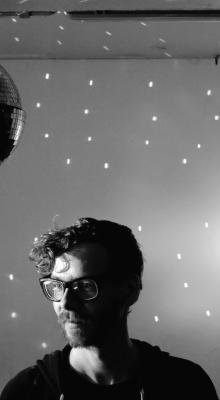
For many artists, slow and constant creative transformation results in comprehensive, multifaceted output. Is Don’t DJ, by contrast, some kind of “man who fell to Earth?” The German producer and (…ahem…) DJ’s until-now negligible discography has grown exponentially over the past year—among other things, he’s released the EPs Hexentric on Berceuse Heroique and Metasepia on Travel By Goods (the label of Thomas Baldischwyler, who also took the photos for this article). The man hiding behind the Don’t DJ alias, however, is anything but a rookie—before his studies from 2005 to 2013 in Karlsruhe, Florian Meyer was already working together with Marc Matter [see zweikommasieben #23] as Institut Für Feinmotorik , and he still nurtures a strong connection to the art and music scene around Düsseldorf’s Salon Des Amateurs. In the meantime, he’s moved—via several other places—to Berlin.
Kevin Goonewardena spoke with Meyer about worldwide connections and about the processes behind the development of his music.
This interview was originally published in issue #13.
Kevin Goonewardena
Where are you actually from, Florian? I’m kind of confused—I couldn’t find anything decisive online.
Florian Meyer
I’ve been living in Berlin for a year. I moved there because I was presented with a good opportunity to, and also because the cost of living is so low.
Kevin Goonewardena
Your email address led me to believe you were living in Karlsruhe. But I was also thinking maybe Düsseldorf…
Florian Meyer
To a certain extent I’m responsible for the confusion, because the Diskant label I founded together with Marc Matter and Stefan Schwander [aka Harmonious Thelonious—see the zweikommasieben special edition for CTM Festival 2012] had a strong Düsseldorf connection. Many of the things that came out of that were associated with Düsseldorf. For example, I had a pretty close relationship with Salon Des Amateurs there. The connection dates back to the early days of the Salon and came about mostly through our project Institut Für Feinmotorik. We actually played the first concert that ever happened in the Salon. Since then I’ve been DJing there a couple times each year. As has Marc. Then we also do our Diskant events there three times a year or so.
Kevin Goonewardena
But that wasn’t all just because of one single gig…
Florian Meyer
No. First of all, I’d known Detlef [Weinrich, aka Tolouse Low Trax, see zweikommasieben #15] for a while—he wrote us a letter back then after we’d released our first album. Also, Marc worked there for a couple of years and organized an ambitious program with films and readings, which, in my opinion, contributed significantly to the venue’s reputation. Marc doesn’t live in Düsseldorf anymore, but Stefan and many other friends from over the years still do.
Kevin Goonewardena
So this connection to Düsseldorf and the music/art scene there wasn’t a result of your studies at the Hochschule für Gestaltung [Univeristy of Arts and Design] in Karlsruhe?
Florian Meyer
Right—you could say that. But it’s mostly Marc and the Institut Für Feinmotorik that are responsible. Stefan and Marc were living in Düsseldorf when we started with The Durian Brothers , and it made sense to meet there for rehearsals and recordings. We met mostly at the Salon during the hours when it was closed. We recorded the entirety of the first Durian album there.
Kevin Goonewardena
What did you actually study? And do you earn your money today in a related career?
Florian Meyer
First I studied sociology, philosophy, and cognitive science in Freiburg. After disappointedly discontinuing my degree there, I organized independent seminars together with friends and acquaintances. That was still before I went to Karlsruhe. At a certain point, I realized that it’s a pretty cool thing to have student status, since you have to work less and can save more energy for other things. By then I’d been a part of the Institut Für Feinmotorik for a while already. We were invited to do something at the ZKM [Zentrum für Kunst und Medientechnologie Karlsruhe]—a kind of dance performance. It was through that that I first came in contact with the Hochschule für Gestaltung, because it was in the same building. I also found out that Boris Groys taught there. I’d already known him. That’s a pretty bizarre story…
Kevin Goonewardena
Let’s hear it!
Florian Meyer
I once played in a city where I knew no one . I spent the night there in an apartment that had been offered to me—actually I’d only been given an address, some keys, and told that I shouldn’t touch anything. The apartment was completely empty apart from a mattress, a coffee machine, a pistol, a pile of cash—I’m not talking about a couple of bundles…this was an entire square meter of bills—, an architectural model, and a book by Boris Groys. By the next morning I’d read most of the book. So I knew the name from that evening and I applied to study media art at the Hochschule. During my studies, I mostly took advantage of the philosophy seminars and various workshops. To come back to your question: I earn my money today not much differently than I did during my studies—I do a little of this and a little of that. Sometimes it’s a collaboration, or a release, which don’t bring in much money, but do bring performances—or other musical projects involving remixing or mastering. Sometimes I’m also invited to give lectures at the university. But I mostly make money with music, in the broadest sense.
Kevin Goonewardena
After your time in Karlsruhe and before you moved to Berlin, you lived for several years in Japan. How did that come about?
Florian Meyer
That’s right. I lived in Japan for about three years. I moved there after doing some research about opportunities I could still take advantage of with my student status. I found out that my university had a partner school in Japan that would otherwise be really expensive to attend, so I signed up. Then I stayed longer than I’d originally intended.
Kevin Goonewardena
Did you think about staying in Japan?
Florian Meyer
Yes, I was thinking about staying, not least because I fell in love. Japanese society, though, doesn’t make integration very easy, and its neurotic undertones become increasingly visible with careful observation. I was happy to be able to leave, although I still often miss it there. I hadn’t planned to wind up in Berlin—I actually hadn’t had a German city in mind at all.
Kevin Goonewardena
You also obviously worked in Japan—to what extent did the country have an influence on your work, and how did the projects you did there come about, apart from through the partner university?
Florian Meyer
I was really lucky to have met the people I did—Matoba Hiroshi, for example, who picked me up from the airport the day I arrived. We quickly figured out that we had lots of interests in common, and after my first semester we submitted a grant application for a project that ended up allowing me to stay for another year. We developed a circular sequencer for android tablets [TORUKU, supported by the MFG Stiftung and Kyushu University]. But to get back to your question about how Japan influenced me: only really in the sense that I met people there with whom I could deepen certain interests I’d already had. In my experience, it’s more about the people with whom you interact in a place than about the place itself.
Kevin Goonewardena
The people are important, as are the amount of time you have available, the financial support, and, of course, the priorities you set.
Florian Meyer
Right, exactly. With both the Durian Brothers and the Institut Für Feinmotorik, we spent a ton of time controlling virtually all aspects of the releases and examining and reexamining every step of the process. When you take such an approach, there’s easily a year that passes between the recording and the release. This way of working has both advantages and disadvantages. For one thing, it has kind of a limiting, cramped quality to it. It doesn’t get any easier from project to project, even when you think it should. With Don’t DJ, in contrast, I’ve approached things more playfully from the beginning. I never had the feeling it was an identity constructing vehicle par excellence in which everything would be exactly as I’d imagined it in my narcissistic fantasies.
Kevin Goonewardena
What exactly does this more playful approach look like? How does your working style as Don’t DJ compare to your working style as Florian Meyer the band member or project organizer?
Florian Meyer
The beginning of a pieces is always established really quickly for me—within a half an hour or so. The challenge isn’t laying down the groundwork. That groundwork, though, once it’s in place, has to fascinate me so much that I’m drawn in—almost like a video game you don’t want to stop playing. The existing material then demands this or that addition or change. It’s actually always clear what I need to do next—or better, what I want to do next. It’s extremely satisfying to be surprised as a result of this working process.
Kevin Goonewardena
How did you discover that this way of working was right for you? I’m assuming it took a while.
Florian Meyer
I actually began making music on a computer, because I was interested and wanted to try it out. Before that I’d only made music with record players or didgeridoos. When I began making stuff on my computer, I first tried to become familiar with the operating principles of the DAWs—the linear notation, for example. I started out in the most obvious way: with beat number 1 on one and beat number 2 on two. After that, I started to transform things, and it was through my insufficient knowledge that something idiosyncratic developed. Nothing has really survived from that period of time. When I finished a project, it wasn’t usually too much later that a hard drive would crash and everything would be lost.
Kevin Goonewardena
And over the years you’ve expanded on this way of working?
Florian Meyer
With Don’t DJ, I use a method that works slightly differently and also contains the potential to function efficiently on its own. It isn’t a completely new method, though—it resembles an approach we used in the past with the Institut Für Feinmotorik. We would set up empty record players—that is, record players without records in them. When you let the needle slide across the spinning turntable, the sound loops itself. Whatever the process is, exactly, a short loop begins to repeat and get into a groove after about a minute. The devices communicate with you, in a way, so that you think “that would fit here or this would fit there…”. The record players introduce something you can then build on and develop further. The whole thing has the character of a jam session in which the machines also play a certain role. I am fascinated by this interface with machines.
Kevin Goonewardena
So this is a kind of free, controlled employment of machines. Both your musical output and your working style as you describe it reinforce this impression: things seemed to occur haphazardly, but one suspects there’s more behind it all. I don’t mean that the result sounds planned or forced—to the contrary. But it does seem controlled.
Florian Meyer
I’ve never really thought about my creative process on such a meta level. But I will say that I try to provide a frame within which the machines can run wild. I allow them freedom and then let myself be surprised by how they make use of this freedom. If the output is appealing, I begin to play along. If not, then I say “stop” and change the parameters or the direction. We obviously aren’t equally balanced partners—I don’t make the “ideological music” that might be ascribed to John Cage or the schools influenced by him. I’m more of a benevolent, playful dictator—when I find that a machine becomes too unruly, it’s simply deleted [laughs]. This is as opposed to Cage’s school, which is about realizing social utopias in music. For me, it’s more about deriving attempts at utopia from good music.
Kevin Goonewardena
So you only intervene correctively when you feel it’s necessary?
Florian Meyer
Something like that. Although I wouldn’t say “I only intervene…”—that makes it sound like I work less than I actually do. At the same time, I don’t see myself as the only one responsible. The interaction of the machines is not only an important part of my work process—it’s also important to me personally. The machines can’t and shouldn’t carry out everything. They play with me as well as with each other. As I see it, they make their own wishes known and communicate to me what’s missing—a clap, for example. So I put the clap in, not where I choose but rather where the machines want it to be. Of course the machines don’t actually “want” the clap, but they are actually the ones making suggestions. When, I’m of the opinion that none of their suggestions work well, though, then the clap comes on two and four and the machines accept that without objections.
Kevin Goonewardena
After getting a glimpse into your work process and the intellectual framework behind it, I’d like to know in conclusion which results of your work might soon manifest themselves as releases. If I’ve understood correctly, your first album on vinyl will come out this summer?
Florian Meyer
Yeah, exactly. My first album with more than five tracks—until now I’ve only done EPs. There are nine pieces on the upcoming release, and it really functions as a whole. It isn’t simply a compilation of singles as many pop albums are today, but rather an approach toward an album in the classic sense. Its title, Musique Acéphale, is important. Whether the music is worthy of the title is another question. But for me it’s more about the concept, which I’ve been fascinated with for a long time—in fact, since the days of Institut Für Feinmotorik.
Kevin Goonewardena
What is the meaning behind the name and analogous concept?
Florian Meyer
I’ve found that when a measure isn’t clearly recognizable as being in 4/4—that is, with a hi-hat on one, a snare on two and four, and a beat on every quarter note—it’s still possible to distinguish the downbeats. When you let the needle of a record player run over the label of a record, turn the volume down at any given moment and shortly thereafter turn it back up again, the listener interprets a new downbeat at the point when the volume is turned up again. This is assuming that the underlying loop is diverse enough. And then the whole thing sounds completely different. Are you following?
Kevin Goonewardena
Yes.
Florian Meyer
Ok. Then I wondered if there could be music that shifts all the time and in which you’re never sure where the one is—music that constantly resets its emphasis and therefore presents a myriad of rhythmic interpretations and variations in time signature. This music wouldn’t reveal any clear beginning or any strict frame. On the contrary—it would allow for many different perspectives rather than a single predefined one. This music or this idea of music could be identified as “Musique Acéphale”.
Kevin Goonewardena
Is this explained somewhere—in the liner notes, for example?
Florian Meyer
No.
Kevin Goonewardena
So people would have to ask you about it.
Florian Meyer
Exactly. It’s one of the many secrets that flow into productions like this and await discovery there. In the end, the music either speaks to you or it doesn’t. Of course you can try to find out what the producer was concerned with, but for the understanding of the music itself, that information is irrelevant. It could be that I myself don’t even quite understand it correctly…
Kevin Goonewardena
The album will most likely come out in the first half of the year, right? It seems like it’s pretty far along in its development.
Florian Meyer
Yup—it should appear in May or June, via Berceuse Heroique.
Kevin Goonewardena
And aside from that release?
Florian Meyer
Before that, Stefan, Marc, and I will release a triple split EP. Stefan and I appear as our aliases Harmonious Thelonious and Don’t DJ, and then together with Marc as The Durian Brothers. The record will have eight tracks and will come out on Emotional Response. We’ll also put out a collaboration with High Wolf as the Durian Brothers, on our own label Diskant. Yonghi Yum, a Korean artist living in Brussels, designed a mind-blowing cover for that. What’s most important to me, though, is the EP Authentic Exoticism, which will appear on the new label SEXES. It takes a very idiosyncratic approach in associating music and theory. It’s a kind of intellectual experiment on musical, graphic, and textual levels simultaneously. It deals with the concepts of exoticism, hybridity, and authenticity. For me it ties in with old times—I remember being sixteen and hearing a Crass record and simultaneously reading the long texts, looking at the collages, and puzzling over the concepts behind the album. This multidimensional engagement with abstract concepts was always very advantageous for me. It doesn’t have to be the case that everything is contained exclusively in the music or in the text or in the artwork—there’s so much that hides in the overlap.
Comments
1 This way for a portrait about former Salon des Amateurs resident Lena Willikens.
2 This anecdote brings to mind a story by Helena Hauff about djing in Schwerin once.
3 Terre Thaemlitz, Yung Beef, Oneohtrix Point Never all have their own stories to tell about Japan.