Precise Reactions Christian Marclay
Christian Marclay
Photography
Dan Burn-Forti
Axel Crettenand
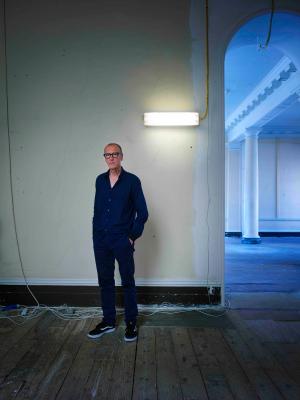
Over the past 40 years, the artist Christian Marclay has been actively fusing fine arts and audio cultures in his artistic practice. Through performances with turntables, collages, sculptures, installations, photography, and video, he has continuously transformed sound and music into tangible forms. Marclay is a true legacy artist, winning the Golden Lion at the Venice Bienniale for his iconic piece “The Clock” from 2010, and exhibiting in institutions worldwide like the Tate Modern in London, Walker Art Centre in Minneapolis, and Centre Pompidou in Paris.
In the following interview, conducted by Michael Eby, Marclay recounts early performances in the 1980s in downtown New York, collaborations which included dancer Yoshiko Chuma, choreographer Merce Cunningham, and artist John Armleder. On top of that, he makes the case for dilettantism, ponders the pros and cons of improvisation and preparation, and touches on myriad projects and pieces he created over the years of his career.
This interview was originally published in issue #27.
Michael Eby
I recently watched an interview you did where you said something to the effect of, “I want to be a dilettante for the rest of my life.” To what extent has dilettantism informed your practice up to this point? Do you see that as a device or tool that has allowed for your fluidity between all the different mediums you’ve worked with?
Christian Marclay
I meant dilettantism in contrast to specialization, or working in one medium only. I can’t imagine a life of doing only one type of art . The market-driven art world is encouraging artist to repeat themselves, to professionalize. I want to remain curious, experimental, and try different things. Early in my career, in fact when I was still an art student, I was attracted to both art and music. From the start, these two poles have kept me interested and engaged. I started studying sculpture, working with space and installation, reacting to found architectural situations. Integrating sound and performance felt like a natural continuation of this trajectory. My hybrid interests started early. The word dilettante has a negative connotation, but I believe artists should almost be required to be dilettantes.
Michael Eby
Right, so there’s a positive dimension to dilettantism, in that it allows for freedom from specialization. Do you find that this tendency toward hybridity emerged out of your experience with punk, during your time playing with the band The Bachelors, Even? It seems to me that there’s some resonance between the punk ethos and your approach to making work, in that both challenge the hegemony of specialization in art and music.
Christian Marclay
Punk bands were created mostly by people who had no musical training. It was certainly the case for me. I started a band without knowing how to play an instrument . That’s why I used records and turntable, I made them my instruments. I also used my voice, singing my own lyrics. The Bachelors, Even was a duo with guitarist Kurt Henry and I learned by performing. The more you perform, the better you get at it, but it’s a different way of learning a skill. You have to accept that you may fail, and in a way, the learning becomes a spectacle in itself. Punk was exciting because it was raw and unpolished. Risk taking is still part of my way of working. It’s important to be willing to fail, otherwise how do you make any progress?
Michael Eby
You started wearing the turntable as a guitar—the “phonoguitar.” Was there a conscious effort there to emphasize your lack of formal musical training? In a way that was maybe even a bit humorous?
Christian Marclay
Everybody wanted to be a guitar player. It was my commentary on that fad. I played Jimmy Hendrix LPs on my phonoguitar, abusing the records like he had abused his guitar. I first made this instrument so that I could move around during a performance with dancer Yoshiko Chuma. I had accompanied several of her choreographies with live music, mixing records on multiple turntables. But when we decided to do a duet together, I wanted to be able to move with her, not be stuck behind my turntables. We premiered the piece in 1982 at The Kitchen. She would dance around me, bump into me to make the record skip. it was very loud and destructive. At the end of the performance we got a spontaneous booing from the audience, we were stunned. It was surprising because the downtown scene was very blasé about being shocked. But Edwin Denby and Rudy Burckhardt were in the audience and came back stage to congratulate us. That was the best endorsement we could ever get. Rudy was making films with Yoshiko, and I even appeared in a couple of their films. At the time, I was very interested in contemporary dance, and saw a lot of it in New York. Dancers and musicians often collaborated, painters and sculptors made sets, these crossovers were very natural.
Michael Eby
Were those collaborations with Yoshiko your only foray into dance?
Christian Marclay
I made music for several dancers, such as Christine Brodbeck, a Swiss dancer, the group Kinematic, Charles Dennis, and Robert Kovich. I also designed costumes for Karole Armitage, who used to be one of the main dancers of Merce Cunningham. When I first came to New York in the late 1970s I was taking contact improvisation classes with Simone Forti. I had no ambition to be a dancer, it was simply a way to stay fit and hang out with a nice group of people. And much later, in the 1990s, I made music for Merce, for his “Events”, where I got to collaborate with Takehisa Kosugi, Christian Wolf, and many others. During these “Events”, the music was improvised and completely disconnected from the dance. The dance was a collage of excerpts from the repertory, and the music was created independently, so that the two came together for the first time during the performance. Dancers were not dancing to the music, and we didn’t even have to look at the dancers. The music and the dance blended only in the mind of the audience. It was an amazing experience of two parallel activities existing at the same time, for the duration of the performance, often the connections where perfect—yet always unintentional.
Michael Eby
Christian Marclay
It took me several years to feel comfortable going to a gig with a selection of records not knowing what I was going to do with them. I thought about who I was going to play with and selected records and chose sounds that would be compatible with the other musician or group. That was so liberating, because I used to practice a lot for my solo performances, and mark and number the records—but records are very fragile, therefore too much rehearsing would damage the records. I was going against the fragile nature of the records and at some point, I realized that the records are the perfect medium for improvisation because they are so fragile and unpredictable. I embraced that fragility. I was never sure where in the groove the needle would fall. I had to react instantly, work in the moment. It creates a nice tension and keeps you on your toes. When I make visual art, I try to apply what I learned in musical improvisation. But it’s not always possible. Certain things require time, for trial and error. Instead of reacting in the split second during a performance, I have more time to think about solutions. But I learned to listen to errors and think of them as potential solutions. Frankly, I tend to be very precise, and sometimes obsess about details. It’s in my nature, I fuss a lot. Improvisation is a good model but it’s not always possible to follow. When I edit video, I can’t improvise. Every edit has to work precisely. It takes days, months, years. But ideas can be improvised, or making unexpected connections, finding footage that I didn’t expect would work. I always try to stay very attentive to the material that I find, sound or image, look or listen to it, and allow it to express itself. I rarely know exactly what I am going to do before I find something. It’s that chance encounter that will dictate what I can do with it.
Michael Eby
You used the word “find” several times when referring to your working method. Do you see your role as an artist as principally a selector or manipulator of preexisting material? Regardless of that material’s medium, source, or origin?
Christian Marclay
My work is always a reaction to my environment, to what surrounds me. We all interact with so many objects in our daily life, powerful things abound, even if they may look insignificant at first, like a bottle cap on the sidewalk. It’s what you do with it that gives it meaning, or simply forces you to look at the world differently. I can’t imagine carving a piece of marble to make it look like something else. I start with what’s there, right in front of me.
Michael Eby
Does that sensibility stem from your interest in John Cage’s work? You and John Armleder performed a “duo” of Cage’s “4:33" at the Kitchen back in 2017, as well as a couple of other pieces by artists associated with Fluxus. Were you influenced by Cage and Fluxus from the outset of your career?
Christian Marclay
Cage was of course an important influence, but even before that Marcel Duchamp. When I was in art school in Geneva I met John Armleder who made me discover Fluxus. My belief in the potential for the everyday to be a catalyst for art making, as well as the acceptance of chance, comes from these artists’ influence. More recently John Armleder has been a collaborator and we have recreated Fluxus performances by artists such as George Brecht, La Monte Young, Yasunao Tone, as well as doing our own. These are very humorous small sketches and it’s interesting to imagine how different the public reaction is today compared to the 1960s. Surprisingly we got a lot of interest from young people who never even heard of Fluxus. I’m still learning from John Armleder’s way of doing things. He may appear indifferent, yet it comes from a very thoughtful attitude towards life, almost Zen in its detachment. Similarly, Duchamp and Cage lived their life like it was an artwork. That’s what I aspire to. Art as life, and life as art.
Comments
1 And many other artists couldn’t neither. See, for example, conversations with Crystallmess, Nicolás Jaar, or a visual contribution by Kate NV.
2 Hello, Poser?
3 This is a question that reappears again and again, see conversations with Suzanne Ciani or Anna Homler.