Opposing Energies bela
bela
Photography
Hyesoo Chung
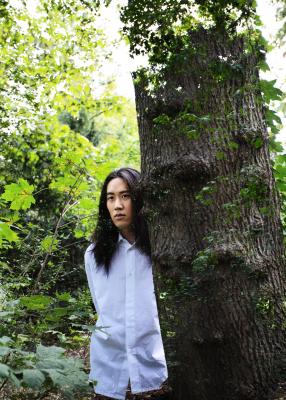
It’s not a stretch to describe bela as an ideal interviewee for zweikommasieben—their artistic practice is firmly set in the present and their output sounds like nothing else. As the conversation below illustrates—which took place on a sunny afternoon in July overlooking Berlin’s Oranienplatz—bela’s oeuvre is distinctively shaped by their upbringing in the midst of South Korean traditions and their consequent move to Berlin. The result is a practice that does not shy away from its heritage, but openly embraces it as an initiation for something new.
The conversation with Dounia Biedermann is a candid recap of their socialization in South Korea, an upbringing which was marked by rage and sadness towards the political institutions as much as it was marked by the comfort of finding community in Seoul’s tight-knit queer party scene. bela’s story is the story of an artist finding their voice and they tell it openly and with nuance: how the move to Berlin came about, what led to their distinct live performance (which anyone who has the chance should go and see), and what’s behind all that growling noise.
This interview was originally published in issue #28.
Dounia Biedermann
Let’s start from the beginning: How did you start to produce music and perform live?
bela
An important moment was choosing my name bela and then starting to upload things under that name on SoundCloud. This was back in 2016 to 2017. That was a very transformative time for me because I had just gotten into university in Seoul and joined its computer music club. Turns out it was more of a band club: You can’t make computer music when they are playing drums in the room. I was just a nerd doing computer music in the computer music club and there were some other nerds in there who guided me, thankfully. I then started making some edits and remixes, and I had already been DJing some experimental stuff by 2017. I was labelled “experimental” mostly because I would mix everything up. Eventually, I played my first gig at Cakeshop in Seoul and was later invited to play in Shanghai with Genome 6.66Mbp in 2018 when I was still in the mandatory military service in Korea.
Dounia Biedermann
A little while later you became a member of Sorrow Club Seoul, bringing club and experimental music together alike. How did you come to curate music under this particular theme?
bela
The first Sorrow Club Party was a farewell party. That was when I was still in the military back in 2019. It was the first ambient party in Seoul. It was more focused on—some people would consider it chill—goth undertones and sadness and not just chill-on-the-beach-vibes. We had this display with candles and black cloth hanging from the ceiling in every venue. It was more experimental in that sense if you will. By the third Sorrow Club, I was discharged from the military and joined the team permanently. You know how club music producers turn to ambient music once in a while? We wanted to connect the scenes: the essence of Sorrow Club is to embrace alternative takes.
Dounia Biedermann
Do you consider curating music as a part of your artistic work and something to pursue further?
bela
Oh yes, of course! I developed the principle that, whenever I’m organizing an event, as many different people as possible should come together. That’s what’s exciting to me. Ideally, this principle creates a slightly awkward room that enables listening. If you are friends with everybody, events tend to become vehicles for socializing, but if you don’t know anybody in the room you get to sit down and listen to what any given artist is playing. That’s my definition of an enjoyable event. I love the feeling when I don’t know what I am listening to. I enjoy the feeling of not having to say “hi” to everyone all the time, [even] though I enjoy a space with a welcoming energy. But the music can be something different. I’m not going to say experimental, I’m going to find a word: opposed to the energy of space.
Dounia Biedermann
How did your move to Berlin came about?
bela
Back in May 2022, Nick Klein [who has been a contributor to zweikommasieben for many years and was also featured in issue #13 of our print magazine], now my dear friend who runs the label Psychic Liberation, had his first label night at Arkaoda. That’s when I performed in Berlin for the first time. A friend had released music on Psychic Liberation and that’s how I got to perform. And it all worked out from then on. John Twells recommended me to the curatorial team of Unsound in Krakow and they booked me last-minute in June. I had to go back to Korea by the end of June because I had already spent almost 90 days in the EU. I wanted to enjoy being in Europe to the very last second. I initially thought there was no way to ever move here, but my friend told me that it’s quite easy for someone with a South Korean passport. It gave me courage to start working on a visa: visa letters, emailing thousands of people for invitations and so on. I got a residence permit for two years in November 2022. In September, I came back to Berlin, had my registration early October, and the visa a month later. I bought the flight back to Berlin with the fee I got from my Unsound appearance and then I just thought: “Let’s move.” The move made sense because musicians are paid much better here. Back in South Korea I wouldn’t even dare moving into Seoul, because the living costs are way too high for artists like me.
Dounia Biedermann
As a musician in South Korea who has been called “experimental“, how did you come to include rather traditional and “mainstream“ 풍물 [pungmul] rhythms in your music? Has this music always interested you or was part of your life in any form?
bela
Basically every Korean kid gets to learn 장구 [janggu] in one way or the other. It’s a two-sided drum that sounds different on both sides. The right side sounds light like a slap and the left side has a more resonant ring. I actually learned playing 장구 [janggu] when I was little alongside my friend whose father was a teacher in traditional Korean music. In a way, it was something that I chose early in life. Also, it’s a common thing to see on TV. When there is a celebration, people would play 장구 [janggu]. It’s basically the same instrument they use for everything except for the royal ritual music. But for folk music, 장구 [janggu] is the norm and everybody knows at least one line in 장구 [janggu]. We have a way of pronouncing the different hits in 장구 [janggu] because each technique sounds different: 덩 [Deong] describes both sides together because it rings really resonant; it makes a “덩Deong”-sound And 쿵 [Kung]’would be just the left hand and 따 [Tta] would be the right hand; 따 [Tta] is more light. For example there is a line called 별달거리 Byeoldalgeori: and it repeats 덩 덩 쿵 따쿵 Deong Deong Kung Tta Kung [according to Korean rules of romanization].
Dounia Biedermann
Being able to voice an instrument, even with rules about its spelling and its specific rhythmic lines, speaks very much for its traditional importance and just how common it is. Using these sounds as instrumentals, distorting them, and then—thinking about your live-performance—pairing these with urgent, heavy metal-affiliated voice distortions, reflects very much your wish for opposed energies, and also proves how well this works for you.
bela
I didn’t expect it either. Early 2020, I made some tracks with Korean traditional music as a base layer. I didn’t really think about performing them at all and it was just produced music. Eventually I sent the demos over to Éditions Appærent in Montréal, a new label at the time, and they decided to put them out as an album: the Guidelines EP. The tape got nice attention and then Rewire festival reached out. That’s when I first started thinking about a performance, because I was invited as a musician not as a DJ. What I didn’t want to do was push buttons in MIDI controllers. I couldn’t afford them anyways. That was when the idea to growl over the instrumentals came about. For Rewire, I developed my first extreme metal inspired vocal performance. I listened to some metal when I was growing up. I thought what if I combine extreme metal vocals with 풍물 [pungmul], but in electronic music? In my mind it was better to grab a microphone than start getting into buying controllers that I don’t like.
Dounia Biedermann
Although it might superficially appear aggressive, one can sense something else between the layers while you perform, a deep calmness. Especially as the words you perform are read from something that I interpret as a diary. Tell me if I’m mistaken here.
bela
The diary… I never liked artworks that involved diaries. But in a performance, I thought I could make it work: I’ve been using that notebook as a diary and I needed a lyrics book also, so now it serves a double-purpose. There are parts in my live show that are mostly empty of beats, that’s when I read the diary part and try different vocal techniques to create this live audio-chunk. Having something to read from makes a big difference in a performance, because you can choose where you read from and improvise in a certain way.
Dounia Biedermann
The words you read do play a role for us—and for yourself?
bela
Emotionally, they transport me to different places. It helps me to perform them, because I could never release the content publicly, let alone read it. I am choosing all kinds of different voices other than a recognizable speaking voice: whispering, growling, screeching, inhaling. It helps me bring up the emotions that I had when I was making this music. The performance needs a catalyst. I want to show people where it all came from. So, when you said deep calmness…that’s what I have in here [points to head]. It’s a 한풀이 [hanpuri]: 한 [Han] is a very strong Korean emotion. That’s where you might sense calmness from, because it is rage-turned-sadness turned into this weird calmness in people. 풀이 [Puri] is untangling it. Untangling that emotion… We say that emotions 응어리지다 [Eungeorijida]—응어리 [eungeori] is not just accumulation, it’s more like coagulation of substance. So 한풀이 [hanpuri] is untangling this sorrow or rage. For every performance that’s also where the diary brings me: 한풀이 [hanpuri].
Dounia Biedermann
Where does the rage that needs untangling come from? It’s been kind of an ongoing subject of our conversation: Sorrow Club, sadness and rage. There’s a lot to rage about on this planet in general, but what are you raging about? Or more precisely what is your 한풀이 [hanpuri] about?
bela
I think this one is going to be a similar issue for a lot of the younger generations and female and queer people around the world. South Korea is a conservative country and the gap between rich and poor is palpable. I am not going to get into details with the post-war Korean economy and social history, but there’s a wide consensus that South Korea is a doomed country, regardless of your political stance. Not to state here that anybody gave up or anything, but the fight to live through this falling sensation is such a vivid sight. Old people in poverty who can still vote are often extremely conservative and they adore the rich. The younger male generation is bred online to be ruthless and extremely right wing. We call him a unicorn if one turns out decent. In the midst of all that, working class and queer youths suffer the most. Suicide is a national topic. So many of us die. It is sometimes the only option in front of our eyes. Not a single sign for a life lived happily ever after, and the fight is too stressful, so we just choose to let go. I was so close to joining them. We are sick of calling this a structural problem. Every single soul has heard that phrase before and nobody can afford to back up on it. All day, we learn things in the education system that do not matter to the real politics of our body, the working class, the queer, or what will make our lives better. We are discriminated against and boxed in until the end. It starts with frustration, but this emotion slowly takes another form. A kind of depression, not a feeling of loss or denial, but this blocked, clogged sensation where nothing gets resolved. I wanted to chase that and address that in a performance in a candid way. It’s not the rage against the vague structure or system, but complex emotions towards the actual people who are enabling the oppression right now… It’s that kind of awe that I want to inspire in my shows. But the rage shouldn’t end up being just madness, it needs to form a resolution to be sharp enough. My queerness, trauma, and introspection grounds me. My 한풀이 [hanpuri] is performed for those who have worked their ass off, still in the closet, who have faced dehumanization in isolation. I partly chose the name bela to stay in the closet…so that nobody from my family can hear about my music or activities. It’s so complicated, your own family, country, and society hating you without even realizing what it means. Back in Seoul, some people told me they cried during my show. I want to bring this performance back home someday—with plenty of context, without losing its meaning, and when I can afford it.
Dounia Biedermann
Finding a way to stand up against an ever-surrounding existential struggle is brave…And maybe the only option to survival. Empowering. A real 한풀이 [hanpuri].
bela
As soon as you detect what’s making you suffer, you’re able to turn it around.