“… But I Can Give You a Feeling” Anna Homler
Anna Homler
Photography
Susan Einstein
Randy Tischler
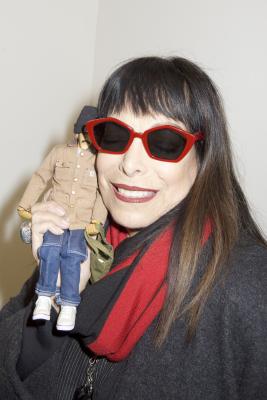
It’s shortly after 10 o’clock in the morning on a cloudy autumn day, inside the Chez Marion bistro in Zurich Niederdorf. A few regulars are engrossed in their newspapers while other pairs or small groups chat about daily news and banalities in muted voices. Moments later, the idyll is interrupted by the appearance of a quirky American named Anna Homler, who has spent a few weeks in a hotel across the street. She immediately greets one of the employees with “Hi darling” and orders an extensive breakfast.
Homler is a performance and improv artist whose early work as Breadwoman was re-released on an eponymous album by the New York label RVNG Intl. in 2016. On the record, Homler sings in a strange language, accompanied by the sounds of composer Steve Moshier. The album, which originally appeared as a cassette on Homler’s label, Pharmacia Poetica, in 1985, documents a performance piece she developed and performed in the mid-eighties. In the piece, Homler became “Breadwoman,” a mysterious being who carries bread all over her body.
Remo Bitzi awaits Homler in the Zurich bistro where she regularly breakfasts during her stays. What follows is a conversation about Homler’s current practice: her vocals, her diverse collaborators, and the toys and objects she uses during concerts. The meeting took place one day after the artist performed at Moods Zurich with bassist Christian Weber upon the invitation of Maria Micciche (aka lokoi).
This interview was originally published in issue #17.
Remo Bitzi
You arrived in Europe three weeks ago and Zurich has been your base since. Why Zurich?
Anna Homler
I have been coming to Zurich through the years for different projects… But not often enough.
Remo Bitzi
In recent interviews you have been talking about musical and linguistic influences*, but not much about the influences from (performance) art. I was wondering if Dada might be a reason for choosing Zurich as a base—after all Cabaret Voltaire is just around the corner.
Anna Homler
I know. I finally got there. Somehow, Zurich is my spiritual home.
Remo Bitzi
So was Dada one of your influences?—I’m thinking of the language you are using, but also the way you performed in the early days.
Anna Homler
A bit. But mainly the way this language came to me was from a completely different route. It came more from the interior and more spontaneously. It didn’t have an intellectual component. Later I would find an intellectual component; I did research afterwards. Actually, Surrealism was a big influence and inspiration on my early work.
Remo Bitzi
Did it take a long time till the language made sense from an intellectual perspective?
Anna Homler
No, it was so intimate and authentic, I trusted it. It came as chants and melodies. I recorded them on cassettes and soon I had drawers full of tapes with song fragments in this language. Later, I met a composer, Steve Moshier, who placed them with an electronic background, and producer/musician Ethan James, who did instrumentation for them. I recorded as I was driving in my car.
Remo Bitzi
Did you try to make sense out of the recordings at one point?
Anna Homler
With some of the melodies I could see images. For instance, in “Karu Karu,” I could see a white walled city in the desert where women were dancing in a line. That’s on my first CD, Do Ya Sa’di Do. “Karu Karu” is also a Maori song, but that is completely different from what I am singing. Only the name is the same. Ethan James did the instrumentation for my version. He had a studio called Radio Tokyo in Venice where all the LA punk bands and poets recorded.
Remo Bitzi
Is the language that you are using based on something?
Anna Homler
The language is a bit like Hawaiian. It has twelve syllables or letters. It’s not a large language. And it’s spontaneous.
Remo Bitzi
Do you speak Hawaiian?
Anna Homler
No, but I was in Hawaii and I knew a bit of the language, I knew that the alphabet only had twelve letters. Do you speak Hawaiian?
Remo Bitzi
Not at all. I think that is interesting: You say the language is something that came spontaneously and from the interior, yet it is related to something that is out there in the world.
Anna Homler
Oh yes …
Remo Bitzi
How comes?
Anna Homler
This may be a more philosophical answer to your question. Everyone has a different process. In my opinion you need to go down inside yourself to go out, a bit like the letter “L.” Jungian psychology appeals to me. What’s inside is reflected outside. Outside is a big mirror. After all, everything is connected on the quantum level.
Remo Bitzi
In today’s world people have problems understanding each other. It seems as if they don’t speak the same language—even if they actually do. Now you’ve introduced this new language—back in the 80s—which you still use today. Don’t you think it would be better—as an artist, but also as a human being—to reduce the amount of languages instead of adding another one?
Anna Homler
There is something Enzo Minarelli said to me years ago. He is a poet and was the organizer of a sound poetry festival I participated in. He said: “Don’t perform in English. English is the language of the rulers of the world, it’s the language of Nixon. Stick to the ‘chika chika.’” I always remember that.
So I think my language is on another level, I think it’s biological. It’s cellular. I cannot give you an analysis in my language, but I can give you a feeling. It’s really a different brain hemisphere.
I did one performance piece with Steve Moshier that was called Deliquium in C. It was about the dissolution of language and stages of alchemy. We called it an underwater sound poem. I’d like to present it again with a dancer.
Remo Bitzi
You mentioned the Surrealists as an influence and inspiration for your early work. Does some part of that remain in your work today?
Anna Homler
This is most obvious in my Pharmacia Poetica, which is an ongoing installation/performance project. The prescriptions are poetic: images, sounds, colors, and stories. These are perceptual shifts from the literal to the lyrical. It’s a manicure for the mind. A big part of the Pharmacia is a library of glass bottles containing an assortment of objects floating in liquid. The Pharmacia started as a radio play and then evolved into a storefront installation that travelled throughout the US and Europe. Right now it’s in my living room in Los Angeles and in my friend’s cellar in Cologne. Most recently the Pharmacia has found a new life as a film by Will Saunders and Hans Diernberger and will be presented at a conference on sound called “Fluidity” in San Diego.
Kyn Taniya [aka Luis Quintanilla] is a poet I just discovered. I read some of his texts in the performance with Christian yesterday. He was a Mexican surrealist, who started writing after translating avant-garde poetry into Spanish. In the past, I’ve bottled poems and will definitely bottle some of his. Eventually, all the words dissolve in the liquid and only the essence is left.
Remo Bitzi
You said in an interview that you don’t do solo performances anymore, because you don’t have time*. What did you mean by that?
Anna Homler
I didn’t have the time and the space to develop something new until now. I prefer to play with another person on stage. I like interacting with another person’s sounds and energy. It’s the magic of another person.
Remo Bitzi
Anna Homler
It’s mostly by Zufall.
Remo Bitzi
Yesterday you played with Christian Weber. How did you get in touch with him?
Anna Homler
We were introduced by a friend in Zurich about four years ago.
Remo Bitzi
Was it the first time you were on stage together?
Anna Homler
Yes, four years later.
Remo Bitzi
How did you go about that performance? Did you just go on stage and start improvising?
Anna Homler
Oh, we have played together before; I didn’t just get on stage with Christian and play. We spent a whole afternoon in Zurich jamming together. Christian had access to a big studio where we could play. It seemed like we would work well together.
I used to play with Peter Kowald, who died more than ten years ago. Since then I’ve been looking for a stand-up bass or cello player to work with. I really love the sound of the human voice with those deep strings. I was hoping it could be a possibility to work with Christian so I was happy to have a chance to play at Moods, thanks to Mara.
Remo Bitzi
Is that the reason why there is always a new collaborator: Because you are always looking for new possibilities?
Anna Homler
I like the energy of collaboration. It’s more interesting for me and new things come out of it.
Remo Bitzi
Anna Homler
I didn’t know his music before I played with him. The label that re-released Breadwoman, RVNG Intl., put us together. He is a road warrior and an art star. He’s really great to tour with and I’ve learned a lot from him.
Remo Bitzi
You worked on existing material with him. When was the last time that you developed something new, apart from the improvisations on stage?
Anna Homler
Steven and I didn’t use existing material for Breadwoman. We improvised and found some patterns we liked. I have some unreleased projects that are now just starting to be released in the UK. There’s a saying: “What’s old is new again.”
Sadly, I don’t have the quality of time and space that I used to have to create new work in LA. I probably need to go on a residency.
Remo Bitzi
Why is that?
Anna Homler
My father died and there was a lot of complicated administration. My life in LA is more administrative than poetic. To create new things, I need to be in Europe. All the people I work with are here. Also, like everyone, my mind is more free to dream without day-to-day responsibilities.
Remo Bitzi
Isn’t that frustrating?
Anna Homler
Yes, it is. [Laughs] Natürlich. [Laughs]
Last year I was able to perform a work in progress with the London Improvisers Orchestra called Probate Codes: An Exorcism. It combined layers of text in English: probate codes, poetic extractions from Bleak House and The Godfather. Adam Bohman and Sue Lynch read the codes, droning on and on. Steve Beresford conducted the orchestra and I read the text. It was very fulfilling.
Remo Bitzi
Let’s talk about the objects you’re using when performing: I wondered what the relationship is between your vocals and those objects?
Anna Homler
I’m a collector, first of all. I collect sounds, words, and images. I look for sonic objects that are visually interesting. For instance, I love wood devils—it’s this toy that makes a very dry, creaking sound. It’s an instrument that I always have with me. And because they don’t live very long I have to find one, no matter what country I am in. Anyway, I really know my toys, my objects. It looks like Krimskrams on the Tisch, not so organized, but I have a relationship with each one. Where somebody else might do a different setting on a device, I have an object that makes that one sound that I love. I like it like that, even though it’s hard to schlepp.
Remo Bitzi
Most of those objects are very common, one could get them everywhere…
Anna Homler
Like the Klebeband?
Remo Bitzi
Yeah exactly, that’s a perfect example. It’s easy to get those objects. On the other hand, your vocals are very special—only you can sing in that language. I wondered if you have these two elements for contrast?
Anna Homler
Mostly I have the toys so I can play with other people—they allow me to relate, sound-wise. Sometimes it is not possible to connect with the vocals to the sound. The toys can always do it.
Remo Bitzi
Why is that?
Anna Homler
Because I am a niche singer in another language.
Remo Bitzi
You said you’re a collector. Do you have a room at home where you store everything? Is there an order or a way that allows you to keep track of your collection?
Anna Homler
Yes, I have a room in my house entirely filled with toys and sound-making objects. Mostly the toys and objects are on shelves and in color-coded plastic tubs. Larger items are in trunks and smaller items are in drawers and baskets. They are grouped together by “families.” The things I use all the time are in a suitcase that gets re-packed before a trip.
Remo Bitzi
And how do you choose between those objects?
Anna Homler
Well some things come with me, always. I travel with some beautiful French bird whistles for example. Those always come, because they are portable. I have really great sounds at home, but it’s impossible to bring them, like a clock case, for instance. It looks beautiful and mysterious—but it’s too bulky. I have really large things that I could only use in LA. My toy suitcase is already really heavy and expensive—it’s always an extra EUR 100 to bring it.
Remo Bitzi
Have you ever thought of recording the sounds and bringing them as samples?
Footnotes
e.g. Jones, M. I. (2016, February 9). Breadwoman rises: The making of a modern mystic. Retrieved from http://www.factmag.com/2016/02/09/breadwoman-interview/ or Arnott, B. (2016, February 9). Breadwoman—Speaking in Tongues. Retrieved from https://www.junodownload.com/plus/2016/02/09/breadwoman-speaking-in-tongues/ ↵
Jones, M. I. (2016, February 9). Breadwoman rises: The making of a modern mystic. Retrieved from http://www.factmag.com/2016/02/09/breadwoman-interview/ ↵
Comments
1 It’s fascinating to find out more about the way language is applied, molded and bent by different artists, see conversations with JJJJJerome Ellis, Price, or bela.
2 Other artists who ponder how to approach collaborations are, e.g. Nicolás Jaar, Price, or The Haxan Cloak.
3 zweikommasieben spoke to Steven Warwick as well.
4 Similar sentiments are stated by Helena Hauff and Beatrice Dillon.