An Antagonistic Dialogue With the Self Alexandra Bachzetsis
Alexandra bachzetsis
Photography
Diana Pfammatter
Kristian Bengtsson
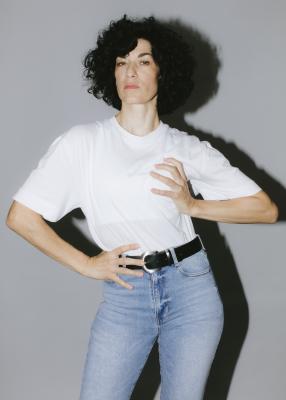
At her solo exhibition at the Kunst Halle Sankt Gallen in 2023, artist Alexandra Bachzetsis presented the performance and video installation Notebook, in which she attentively re-examines her own biography and the many roles she has taken on. Not only did she revisit the encounters that have influenced her practice as a choreographer and artist, but also reflected on her creative process and the methods she has gathered along the way. A few reoccurring themes have accompanied the work throughout the years: excess, innocence, transience, pain, identity, anger, persona, image, sexuality, and lust. To experience one, one must also experience the other: it is precisely by experiencing the full scope of human emotions that one can understand its depth. What is pain without ease, or vanity without modesty? Or a deconstruction without its construction? Bachzetsis intends to avoid stability and chooses a continuous transformation of the self.
This interview was originally published in issue #29.
Helena Julian
Alexandra, I mentioned we are loosely working around the topic of desire for this issue #29 of zweikommasieben. What does desire mean to you, now?
Alexandra Bachzetsis
I would say to aim at the impossible—but to make it possible through a process. It’s somehow more a practice than a theme. The act of trying to figure out different paths into the future. I’d like to think about desire as something that I produce in myself every day. And I try to include questions of a lustful kind of perspective into life. Including all your senses, all your wants and all your wishes, and all your impossible desires too.
I’d like to think that there will also be desires that remain unanswered through life. I see it more as an infinite chain of thought or a timeless arc. For me it’s really about the essence of creating. Not to fade to yourself, basically. Not to lose interest, not to lose touch with the contemporary, with what surrounds us.
Helena Julian
A sentence that circulates around your work is “production of desire”. It points to the ethics and labor of using desire as a force, too, if we look at Gilles Deleuze and Félix Guattari’s interpretation of desire. How does this play out in your work?
Alexandra Bachzetsis
I work with questions of sexuality and death. In a way, sexuality is the liveliest moment where we feel and create ourselves anew. And the play around that is crucial for feeling human and feeling agency as a body. But with these questions comes a huge history of representation of the body and sexuality, alongside the taboos. The tension between the impossible and the possible is very much what desire is about.
The question of desire in performance is also about reaching a state of belonging in your own body. I relate it to transformation. In the beginning, there is a sense of alienation, not feeling where your body begins and ends, in terms of gender identification, your perception of age, and physical state you are in. You then get to realize how your seemingly innermost feelings have been conditioned by your thoughts, and expectations of other people—or by what you imagine these expectations to be. Yet if you don’t give in to a normative idea of your body, you are in a way constantly in the production of desire about and in that body. It’s that realization which is interesting to me in the performative sense: what can you create with this? How can you transform through other bodies, through other contexts, through other cultural but also social-political contexts? How does that influence you as a human but also as a physical entity in space? You design it yourself. It’s a choice you make. But these choices, I feel they are fluid. They come and go, or they start to be intertwined. As the saying goes: “we are what we eat.” We can also say: we become what surrounds us.
Helena Julian
If we look at a work such as Perfect (2001), which was your first solo work, it’s intriguing to see that the reflection on physical standards was already present there.
Alexandra Bachzetsis
Yes, and that work was specifically about the irony of it too. It was a way of rejecting the standards, but also trying to approach them. A complex love and hate relationship. If I would simply reject them, that would be a dead end. It’s too dogmatic. I’m more interested in the moment where there is tension and transformation. It’s almost an antagonistic dialogue with the self. I mean, I’m always looking for contradicting energies that pull the body.
It also happens when I study the elements for performance. What do you need to move? For example, to jump, you need to push up from the ground. Or to turn, you must start from stillness. On the one hand, it’s about the body as a mechanical instrument. On the other, it’s about what you put into the movement and what are the other forms of movement—both every day and choreographed—your intention relates to. You must study what kind of movement you are talking about, what kind of gestures, what kind of vocabulary.
Helena Julian
And then the question becomes, do we use the same visual language? The garments and props you use are often very precise and minimal but carry many connotations. Such as a pair of classic blue washed jeans, or high heels with ankle straps. How do you build this vocabulary of props?
Alexandra Bachzetsis
In many ways, I try to strip things down to their basics. For example, with the use of the jeans trousers and white T-shirt in Perfect, I was exploring how to both elaborate on a language that we know, but also strip down the elements that make up the performance. I enjoy thinking around questions of archetypes of clothing, including corsets, underwear, jeans, high heels, sneakers—certain contradicting elements that are either shaping the body or precisely making it more gender neutral. Or the uniform of a hyper-sexualized body, such as the clothing of femme queens, in my work Gold (2004).
On the other hand, I also enjoy moments where I forgot about what the body means, and just think of actions, such as in my performance A Piece Danced Alone (2011). This piece is very much about the exchangeability and, at the same time, the uniqueness of the individual: we’re all replaceable if we follow a score, and yet you can never replace a person. It helps me to work with things or to think of the body as a thing as well sometimes. Not so much as a person with a lot of questions, but more of a body with a lot of possibilities.
Helena Julian
Once we’ve dressed the body, how do you relate to dressing the space?
Alexandra Bachzetsis
I often try to think about architecture first and then about the body within the space. These elements work together to construct or deconstruct a full picture, a full identity. I’m interested in understanding how space is felt, how movement functions within architecture. I tend to not change pieces whether they are presented in museums or theatres, and therefore it feels like they never really fit. I use this to think about normative spaces, why we find certain things normal in certain spaces and not outside of them, which quickly relates to power relations. My background is part Greek, and from childhood I learned the immediate and unquestionable response to music and dance. Everybody dances, everybody can move, everybody has a rhythm. It’s not something that’s ever questioned. It’s something that’s constantly produced, on a daily level. This is of course very different from living in a culture like for instance in Switzerland, in Zurich, or any other metropolis in the world. The inspiration from the Greek countryside is a very strong component of simplicity yet very complex construction of different elements that constantly lead up to sound, to music, to construction of rhythm or dance. Any floor can become your stage. Dance is produced from whatever is in front of you. You take it and you integrate it, you use it.
Helena Julian
It also brings subjectivity into dance, if we understand that everybody has a a rhythm. I’d like to discuss the different languages of movement we see in your works. You often show fragments, samples, iconic movements from several sources, from sports to fashion and everything in between.
Alexandra Bachzetsis
I think I’m truly interested in not belonging to one culture. I feel it’s more important to remind yourself that you are alive and that you can make choices. So, you don’t need to decide for only one language or style, you can choose many. When I choose gestures in my work, it is because they are connected to a larger world beyond that one gesture. And even then, you don’t need to always absolutely understand everything.
Honestly, I really have no inhibition about influences. I try to stay open to development of all kinds of codes and I’m actually very interested in how those change and develop in time. I would love to be able to remain open and curious in this way. It’s also why I really love to work with different generations, because I feel attached to the development of their own specific codes, how they move, dress and so on. But even if these codes are established, we can still question them. We can trace these codes back in time, or we can project them forward. These temporalities are interesting to study, and I like to create pieces that work anachronistically, against the linear history of codes. Such as wearing a big fur coat which would point to the seventies, but then having it with synthetic material. Or using latex to create a turtleneck dress. In Notebook, my recent piece, there is an image of cut out jeans showing the butt, but no face. There are contradictions while building an identity; what do you choose to reveal or hide, and how does it interact with others.
Helena Julian
In your recently published monograph, Show/Time/Book Book/Time/Show, we explicitly see the influence of music in your work: the front and back covers are filled with numerous song titles. It’s a formal way of showing how much music has been a part of your practice over time. How does music influence your process?
Alexandra Bachzetsis
Music has been always a strong and emotional point of reference. I want to be moved and move other people, so I’m interested in how certain songs can influence each of us in a different way. I am interested in investigating quotations culled from a variety of music genres. What are the messages that we learn from the lyrics, when do audiences use this or that song, what kinds of feelings and moods does it activate? When we included the song titles in my monograph, it was a way of structuring references, but the list of songs is also a game, an associative score. I have conversations with friends where we just send each other tracks, and we respond to each other’s moods and thoughts through songs. In that sense, a song stands for a certain moment in time. Music tends to work as a quotation, a memory. I really care about the messages coming from these songs; what these songs tell us, and how am I using it.
I also made works in which we would create a soundtrack to go with or against the movement. I would say it’s either about creating an almost cinematographic landscape through sound, quoting songs from films and other genres, or looking into historical pieces of music. An example is my performance Chasing a Ghost (2019), in which I worked with DJ Lies Vanborm, and we arranged well known hit songs like “Take On Me” by A-ha or “Pass This On” by The Knife for the piano.
My journey with sound is intuitive and constructed at the same time. Quotation is important because of its capacity to become a political statement about our contemporaneity, but the way I work with sound on stage doesn’t begin or end with concerns about the political mindset and pop cultural context, it’s much more of an emotional response to what we carry within us and to what surrounds us. In my work, the music composition moves from traditional songs to purely textural experience with sound. In the new piece I’m producing this year for Cullberg in Stockholm, titled Exposure, silence is very present. The choice of working with the naked body on questions of the nude as much as with the dressed body, brings new beginnings of thinking about sound for body to the stage. It’s more like thinking of the body in a naked setting, naked stage and naked sound. Together with composer and musician Alban Schelbert we are analyzing the juxtaposition of song, soundtrack and silence, working on a piece that is in constant becoming, a very slow but constant climax.