On Finding Quietude in an Unlikely Place
On Finding Quietude in an Unlikely Place
Photography
Vincent Yuen Ruiz
Jeff Rossi
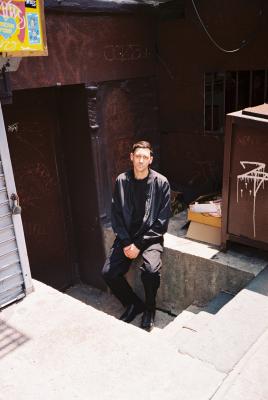
Samuel Reinhard is a Swiss composer based in New York City. For zweikommasieben, Reinhard reflects on the silence of his birthplace and the noise of his current hometown as it informs his work.
This essay was originally published in issue #31.
It is the rare artist who is born in exactly the right environment for their work. And only a truly lucky artist is born in exactly the oppositional environment that ultimately forges the work. I live in New York. As an artist this is hardly unique, nor is the fact that I’m not from here. I grew up in Bern, Switzerland, the tiny European country’s tiny capital—with a population size comparable to that of North Hollywood or New York’s Upper West Side. Bern is a quaint medieval town dating back to the 12th century. It is a designated UNESCO Cultural World Heritage Site beloved by tourists the world-over. The town does not rank amongst the world’s quietest cities. It is too unassuming. Zurich, Switzerland’s largest city and a clamorous metropolis in comparison, does however consistently rate amongst the global top contenders.
Nevertheless, Bern’s quietude is complete and persistent. The author Vincent O. Carter, who chronicled his life as the city’s first African American resident in the 1950s in his “Bern Book”, has described it duly: “no city silence is ever so still as that of the city of Bern at twelve o’clock and one o’clock, on a Monday, Tuesday or Wednesday night,”and to date I have yet to experience a more all-encompassing silence than in Bern once shops have closed and the activities of daily life have wound down. Which is to say any time after 7pm on a weekday, or 5pm on a Saturday. On Sundays, shops are generally not allowed to open at all. The unions are strong as is the lingering spirit of the once powerful protestant church.
Noise is a legal matter ruled by the iron fist of Swiss noise ordinances. Switzerland’s Civil Code (CC, Art. 684) stipulates that everyone is obligated to refrain from any excessive disturbance to their neighbors, includingany harmful and unjustified intrusion caused by noise. This silence is protected by law and monitored by the most ardent local enforcer, your next door neighbor. In the housing complexes where I grew up, there was a 10pm curfew for showers. The sound of water rushing through pipes buried deep inside solid concrete walls was considered an unacceptable disturbance during Nachtruhe—a German term that literally translates to “night quiet” and describes the time between 10pm and 7am where tenants are legally required to keep any noise to an absolute minimum. On weekdays, the same rules apply to lunch time, noon-1pm, Mittagsruhe—“midday quiet.” Sundays, as well as public holidays, are known as Ruhetage—“quiet days.”Not only are shops closed, even the noise of a chore such as lawn mowing, vacuuming, or often even doing laundry, is considered a violation of decorum. Of course it is not entirely surprising that a country whose wealth is primarily rooted in the practice of hiding the fortunes of the world’s most despicable dictators, despots, and ungodly corporations, deems unnecessary noise anathema. Silence is golden—in our case quite literally so.
For my part, I loathed the quiet. There was an inescapable quality to it. It was not so much an absence but a pressure system. An echo chamber where the dominating signal was the reverberation of your own self—your thoughts, your every activity—simply reflected back at you. And something else; in an environment so defined by lack, every perception is magnified a thousandfold. It is generally agreed that the quiet of nature is a beautiful thing, magnificent, healing even. The absence of man-made sounds in a city on the other hand is a completely different phenomenon. Here the absence is itself unnatural. For me, this incongruence resulted in anxiety, hypersensitivity, and insomnia. Without a baseline noise-floor that defines urban environments every sound is alarming. Every signal—no matter how insignificant—a threat.
The quiet made me too restless and vigilant to sleep. As a baby I was inconsolable. As a toddler I refused to still. At around age 3, I started making noise. Specifically, I began drumming. I did this with a relentlessness and dedication that alternately impressed and worried the adults around me. But when pans and pots were replaced with a drum kit and formal lessons, it became legible as a hobby, possibly a vocation. I was transfixed. Drumming dampened the silence, making it less loud. And I was dedicated to keeping the quiet at bay. Producing sound became a reprieve. I declared I was going to be a musician while still in kindergarten.
For the first fifteen years of my life I was devoted to drumming. Then I discovered clubs. Sacred places—where I could be immersed in even more sound. Eventually, I studied sound engineering and began producing music. The latter half of my 20s and early 30s were spent hunkered down in recording studios, before I veered off to pursue a degree in sound arts and composition. In short, I had dedicated my life to an unwavering devotion to sound—and a steadfast commitment to avoiding silence.
But the restlessness persisted and then seemed to worsen with each passing year. Until it became increasingly difficult to tell whether my ceaseless pursuit of sound was helping or if something had shifted and it had begun to contribute to my unease.
/\/\/_*..—(:) ° . …” –-–– //(—_..**\— ––°_).. -*
In 2015, at 35, I left Bern. I landed at New York’s John F. Kennedy airport around 4pm on a grey and slushy Groundhog Day. From the moment I stepped off the plane I was sucked into a spectacular vortex of all-encompassing sound. Every part of my nervous-system was instantaneously saturated with densely layered information. Noise. Immersed in a dense thicket, a buzzing cloud of vibration. The infinite strata of chatter supplied by the streaming crowds. The constant hum of traffic that subsumes the atmosphere day and night wherever you are. The full-body rush of trains entering subway stations. Sirens. Honking cars. Ice cream trucks. Halal carts. Construction sites. Yelling people and music blasting out of cars, stores, portable speakers. There was noise all around—and I didn’t have to produce any of it.
I had entered a sonic landscape of a continuous density and simultaneity that by any standard would be considered stressful; overwhelming. And yet, I instantly felt calm. Light. My first weeks were spent roaming through the city, wandering into galleries, museums, but mainly just bathing in the noise the town provided. People say New York is a maddening, neurosis-inducing place. Chaotic, hectic, loud, and oppressive. But in the city’s intricate labyrinthine soundscape, I found something akin to a stillness. My existence was all of a sudden marked by a deep seated baseline tranquility. As though I had moved into a giant white-noise machine, the entire city a soothing hallway of a therapist’s office. At night, I slept deeply. Unprecedentedly well. Cocooned in the city’s expansive drone, my life-long insomnia became a distant memory. With noise comfortably burrowed in my ear, the high-pitched whine of tinnitus that had been my persistent companion since I was 10 vanished. Or possibly I just couldn’t hear it anymore. In any case, it too was gone.
In another part of the “Bern Book”, Vincent O. Carter goes on to say: “in the city of Bern I have encountered a stillness which is as intense as the roar of the traffic of New York. There I could not hear for the noise; and here in Bern I could not hear for the silence.” True listening involves presence and surrender—putting aside your own thoughts and judgements. In the words of composer and Deep Lstening pioneer Pauline Oliveros: “we open [our ears] in order to listen to the world as a field of possibilities.”For so long I had my hackles up, gating to keep the silence at bay. But I would have never presumed I had any issues listening. If anything most of my difficulties had been that I was over-listening.
But finding myself in this completely new sonic environment, it dawned on me that there had never been possibility in my listening. My listening had always been active. Assertive. Marked by prescriptive intent and striving. A listening where you thrust yourself upon the sound. Aiming for it, preying on it. This was extractive listening. I had been vigilantly listening into the silence scouring it for threats and unpleasantries. Or in the studio I had been listening with calculation, with a fixed outcome in mind. A preconceived idea of how the sounds shouldsound. I realized that I was primarily concerned with molding sounds to my liking, rather than truly listening.
And all that changed in New York. No longer entrenched by silence, I engaged in a new kind of listening; not exactly passive—yielding maybe—accepting. Submitting. The veil of vigilance that so persistently besieged my senses lifted. The city softened my ears. Allowing me to simply notice. To receive. The composer Annea Lockwood [see zweikommasieben #29] distinguishes between listening to something and listening with something. She argues that “listening with implies an acknowledgment that you’re part of what you are listening to, you’re not separate from it.” It wasn’t until I relocated to New York that I came to know what it is to not feel separate from what I was listening to, to employ listening as a form of connection, as a way of being in the world.
_*..—(_..**:) ° . …”\\°/(—)*-––(—\°_)//.. -/\../\
Still, I found myself with a slew of new problems. The sounds I was making in the studio felt lifeless compared to the city’s rich acoustic landscape. Every sound around me teemed with vitality. The naturally emerging patterns and structures were infinitely more captivating than anything I could ever willfully compose. Above all, did my music even serve a function anymore in a world already so completely saturated with sound? My work’s sole purpose up to this point—escaping silence—had been rendered obsolete.
I began to fantasize about a quiet, weightless kind of music. Music that was sentient and self-propagating. I imagined a way of composing that allowed me to primarily become a listener and observer as a piece was taking shape. I sensed that this music would not only have to be quiet, but small. Modest. The underlying structures wouldn’t attempt to convince anyone of their intricacy and sophistication, but rather just hint at the inherent motility of the sounds themselves. I pictured pieces as mere traces of a process, as opposed to bold declarations of intent.
I set out to pursue these inklings during a residency in California. Returned to the silence of the desert this time, I found myself immediately falling back on the trappings of habit. I was forcefully shaping and molding sounds in ways I thought would feel quiet. Willfully pushing sounds into preconceived rhythmic, harmonic, and melodic structures. I was bullying sounds. Expunging them of any trace of intrinsic vitality before they even stood a chance to take on a life of their own.
I’d thought New York had cured me, had taught me to truly listen. But I’d been bitterly wrong. The music I was dreaming about wouldn’t be willed into existence. I’d envisioned a music liberated from striving, and this in and of itself became a kind of striving. I once again became debilitated by the crushing silence. Once again caught up in a ceaseless and frantic spiral of ambition. Of pursuit. Rattled by an unprecedented ramping up of my anxiety which turned into rolling panic attacks and complete and utter exhaustion, I found myself back in the city after just five days of what was supposed to be a month-long residency. Defeated, I was left with no other option than to concede. To cease all activity. To rest.
The work came to me then. It seems like an obvious solution. A tenet of physics too banal or obvious to describe but it felt miraculous. One morning—a few weeks after returning to the city—I pulled out my computer from sheer boredom. From honest curiosity. I opened a file of previously recorded piano improvisations, isolated a barely audible decaying tail-end of a single note and repeated it for a duration. Then I layered it with another, and yet another. What unfolded was a delicately animate structure—tiny collages built from layers of randomly shifting horizontal threads quietly dissolving, and reappearing in endlessly new formations. I had done almost nothing. I didn’t attempt to compose, to construct. I simply listened and gave a few individual notes a gentle push to begin their cycles.
The repetition created a sense of stillness, a kind of stability. And the iterating fragments of sound overlapping in intervals of various sizes created an ever-changing and unpredictable environment—more complex than anything I could ever contrive. This was a process not defined by determined pursuit, not defined by doingbut by receiving. Maybe most importantly, the layering of these quiet sounds that were well on their way to silence—essentially dying away—resulted in something that felt more akin to an accumulation of quiet rather than of sound. My role had shifted from being an organizer of noise to becoming someone whose function was to structure quietude, silence even.
Not long after, I began to experiment with translating this process for ensemble pieces. Music to be played on acoustic instruments by human bodies. This ensemble work is similarly organized around just a few notes or short motifs—each assigned to a performer—to be slowly repeated over the entire duration of a piece. Each player pursues their assigned music at their own pace, thereby creating loosely phasing structures very similar to my collages. And in these pieces too, the primary focus is quietude and silence. The performers are instructed to play as quietly as their instruments allow, while still producing a note. The results barely piercing the veil that separates silence from sound. Players are encouraged to take liberal breaks between each iteration of their assigned motif. To allow themselves to become listeners as the music shapes itself, and thereby structuring silence as much as they do sound.
**\— ––°_–! . …” –-/(—_…. -*))
The scholar Lisbeth Lipari writes that “our aversion to silence masks our failure to listen in the same way it disables our ability to listen.” Actual listening requires a slowing down. Noticing requires a pause. Receiving requires a break from sending. In order to access the subtleties of perception I’ve had to learn to be quiet and I’ve had to learn to be still.
With this, I’ve begun to understand that “the sound of music is not opposed, but rather parallel to silence,”as the Swiss writer and philosopher Max Picard beautifully puts it in his book The World of Silence. I realized that it was not so much the silence of my native environment that had been weighing me down, rather my inability to tolerate my own stillness.
Whenever I return to Switzerland these days, I find myself marveling at the quiet after sundown. I revel in the silence, which no longer feels like a threat, something in opposition to myself. But rather, like the natural extension of a stillness that I suspect resides somewhere in all of us. A potential for quiet that patiently waits, to be accessed whenever the circumstances are right.