LUFF 2026—Ghosts Everywhere
Ghosts everywhere
Photography
Zoé Geslin
Victor Kleyr
Thomas Vogel
Malik Beytrison
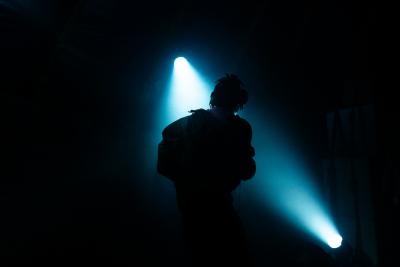
For its 25th edition, the Lausanne Underground Film & Music Festival was an affair as surprising and far-reaching as ever, with a line-up full of unfamiliar names. Good reasons to travel to Lausanne once more, to engage with a broad range of musical performances, from harsh noise to ghostly r’n’b, and trace what unites rather than separates them. Beyond genre associations, and very much in spirit.
A few days ago, Resident Advisor’s editor Gabriel Szatan, with equal parts enthusiasm and self-awareness, shared an essay by Joe Leonard-Walters on Instagram. The more than 5,000-word text is titled “Should we be more optimistic about the state of dance music?” and observes many pressing zeitgeist topics and their relation to one another. In my admittedly reductive reading: the state of music journalism as self-centered macro-trend discussers fighting for relevance and attention, the contemporary lack of unifying musical “movements,” “scenes,” and “genres”, and platform capitalism as the root of all evil and wrong; in electronic music and beyond. Most of what Leonard-Walters has to say seems fair and true, and this text is not a reply or close reading. Rather, it came to mind on the way back from Lausanne to Zurich, after spending some days at the Lausanne Underground Film & Music Festival (LUFF). The text’s—and by extension music journalism’s—obsession with classification and the implications of categorization seems like a good jumping-off point for some reflections on a festival which, for 25 years, has consciously worked against any defining style or perspective, opting for a cultivation of the unpredictable instead.
Last year, zweikommasieben’s Remo Bitzi described LUFF as a festival that “thrives on risk, friction, and change,” highlighting three qualities that actively work against being co-opted by classifiable, ultimately capitalist structures. This festival doesn’t have an artistic essence or focus, which is exactly the point. It’s unreliable, confusing, and weird, to add three more qualities to the mix. But it still operates within a clearly defined framework: for five days and four nights, various venues in the Swiss city of Lausanne are taken over by the festival to present movies (this year with a focus on the work of Robert Downey Sr.) and musical performances that cover the whole spectrum. Like, the whole spectrum: truly anything goes at LUFF, and the 2026 edition once again proved that musical experimentation worldwide is alive and well. The result might be a sonic fragmentation, with jarring contrasts between one performance and the next, but this shouldn’t be mistaken for the lack of a red thread, or, worse even, the lack of community. At LUFF, it can be surprisingly easy to find what connects, say, a harsh noise performance by Japanese noise artist Banetoriko with the muffled r’n’b of France-based young guns Buana4 and Saiba. In this essay, I’ll explain…
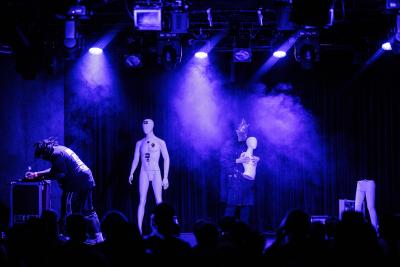
One charming fact about LUFF is that part of the program remains free and open to all. The first two musical performances every night take place in the Chapiteau, a tent-like structure outside Casino de Montbenon, and everyone is welcome. Generally, the pricing remains fair, considering all that’s on offer, with day passes going for CHF 40 and a full-week pass for CHF 120. The first artist I saw at the Chapiteau was Soumaya Pheline, who set the tone with a performance that used the tools and gestures of DJing to arrive at a sonic collage going well beyond the predictability of a straightforward DJ set. Quick movements, measured interventions, samples calling for political action. Like ghosts from a machine, seemingly summoned by a hundred hands.
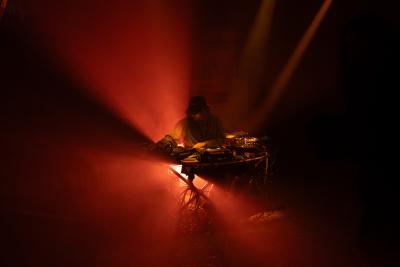
Afterwards, Buana4 and Saiba took the same stage, both wearing t-shirts that depicted the African continent upside down, a pan-African statement piece. And a clear indication of a connection in purpose with Soumaya Pheline, well beyond a unnecessarily simplifying genre association. The founders of the Unishainn label presented a chopped-up performance of the music they produce, layered with sung and rapped parts in dialogue, the bassline buried somewhere deep in the mix, voices drifting in and out from the netherworld.


This, likewise, seemed to be a guiding principle in Lauren Tosswill’s performance, which opened the Salle des Fêtes inside Casino de Montbenon on Thursday. The New York-based artist uses language and voice as a means to complicate and undermine comprehension, engaging in live, relational exchanges with collaborators and the audience. In Lausanne, she involved the audience by requesting voice and text memos via WhatsApp, and presented a “Score for Swallowing” in collaboration with a male choir present via Zoom. Ghosts, once again, made tangible.
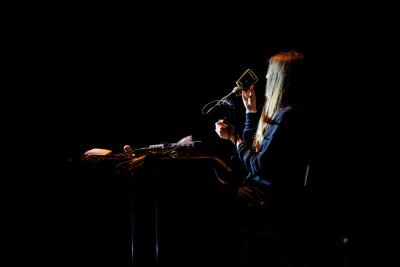
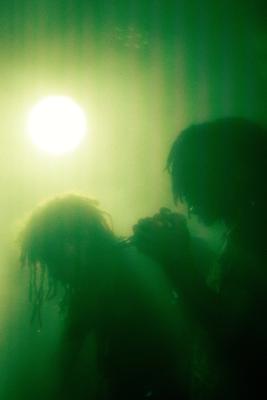
An unclassifiable presence, spiritual or not, was palpable in other performances at LUFF as well. On Friday night, Japanese artist Tamaki Ueda performed as Banetoriko, playing the so-called Banetek, “an indescribable hand-cranked metal contraption, found in a public dump around fifteen years ago,” as the program informed. The noise this instrument produced was screeching, disturbing, and beautiful. An exorcism, maybe, or a summoning of demons, ghosts, and spirits, interspersed with Ueda’s wailing voice.
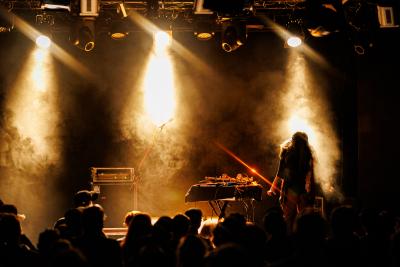
All these performances were musically singular, but united nonetheless. By an interest in the unexplainable, the voice as a carrier of information, a political intention. And this was only one of many red threads running through the programming. There was just as much of a focus on everything punk, not only as music but as attitude, with an obscure and confrontational performance by Everything is Psychedelic that felt very much connected to the show by Fribourg-based duo $RIP & VDOT , which announced itself as a rap-trap-punk-noise hybrid inside the Chapiteau. Two “bands” in their own right, and therefore adjacent to British trio Germ Lattice , who presented something as close to a rock show as is possible at a festival like LUFF.
On my way home from Lausanne, I kept thinking about the aforementioned essay: Leonard-Walters writes about the disappearance of the mediators, the record stores, radio shows, magazines (not us!), and local scenes that once tied music to a place and a context. LUFF is one of those increasingly rare mediators. And one that refuses to tell you what to think and insists that you show up and think for yourself.
One could conclude that LUFF simply does without categories, and that this is what keeps it free. That’s not wrong. But the connections are there, and they don’t require genre associations or algorithms. They emerge in the room. Here, harsh noise, fractured voice theater, and haunted r’n’b share a program, and the receptive audience gladly stays for all. The ghosts are everywhere, summoned by hands, voices, and scrap metal. For 25 years, LUFF has been making room for them, which is reason enough for optimism.
Comments
1 Don’t stop reading this now, but you can continue with last year’s LUFF review here.