X
Lonnie Holley
Photography
David Raccuglia
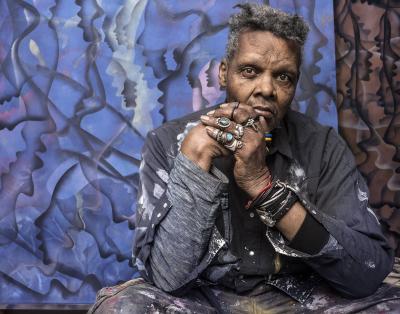
Lonnie Holley was born in 1950 in Birmingham, Alabama. Since the late 1970s, Holley has devoted his life to the practice of improvisational creativity. His art and music has manifested itself in drawing, painting, sculpture, photography, performance, music, and filmmaking. Holley’s sculptures are constructed from found materials in the oldest tradition of African-American sculpture. Objects, already imbued with cultural and artistic metaphor, are combined into narrative sculptures that commemorate places, people, and events.
The artist, writer, and media-theorist DeForrest Brown Jr. was born in 1990, and spent most of his formative years in Birmingham, too. Brown’s book, Assembling a Black Counter Culture was released in 2022. The book provides a Black theoretical perspective on techno, setting it apart from its cultural assimilation into predominantly white, European electronic music scenes of the 2000s and 2010s. In conversation, Lonnie Holley and DeForrest Brown Jr. connect over shared histories and personal memories, which lay the groundwork for the essay below. It’s a text that folds an individual narrative into a cumulative composition, with depth and purpose beyond a singular meaning. Its profound urgency is felt in every sentence.
This essay was originally published in issue #29.
Speaking with visual artist and musician Lonnie Holley is much like being in dialogue with time itself. Artefactual truths and futurological premonitions phase in and out of conversational focus, yet there is linearity and progress in Holley’s thoughts. He dissolves the abstract barrier of the fourth wall with ease, bringing the present moment into secular focus through a kind of otherworldly lens. “It’s been almost like you sitting where you are and actually being a reporter and a person that not only has grown up in the South in the city of mistreatment,” Holley begins. “We grew up in a city of total disrespect and abuse to our ancestors. Right in America’s face. In your face, America!”
Born in Birmingham, Alabama in 1950, Lonnie Holley was swiftly initiated into the state-sponsored and citizen-supported racial segregation of the Jim Crow laws. Much if not all of the legal structure of the post-Antebellum American Deep South was deeply affected by the emancipation of Negro slave-class agricultural workers, and the Jim Crow era worked as a means of reimagining a systematic exploitation of labor and everyday life. Prior to the Civil War, the agricultural Southern States existed as an aristocracy; but after the loss of that war to the industrialized Northern States, Birmingham emerged as a “Magic City” that would become known for its production of steel. “So, you got your record on, right?” Holley asks, leaning into the camera: “From one and a half until I was turning four years old, and then from four years old, I was right there at the same drive-in theater that was adjacent to the [Alabama State Fairgrounds], and then they had a Derby car track right behind that. So, all of that was the kind of central hub of entertainment. But if you couldn’t afford the entertainment, you didn’t get entertained in that manner.”
An infamous statue of Vulcan, the Roman mythic figure of fire and forgery, was originally displayed at the fairgrounds before being relocated atop Red Mountain where the white aristocracy had a complete overview of the city of Birmingham—“the valley of the furnaces”—as Holley puts it, from their homes that were built in the likeness of the Roman Pantheon. The gross, unfettered capitalism of the post-World War republic gave way to racial violence that would inform much of Lonnie Holley’s life. “I was actually the little boy that was up and down the ditches and the Village Creek. It really wasn’t even a whole block and a half from where I was laying my head.” He imagined the ditch that ran down to the creek and dumped off, and flushed to the other side of Third Avenue, all the way down through to the outer city of Bessemer. “If you look at the creek that means I was the child that was entertained by the hustle and bustle of entertainment, growth, everything.” The Alabama State Fairgrounds arose from the creek, turning swamp into industry. “That’s where your first basic stars was born, at the carnival and at the fairground. Now we got to put you into the minds of what? You mean the venues, the places that were showing all the places did not affiliate with a clown.”
While the area would host many events that would create the music that would go on to form the skeleton of the modern pop music industry, these same spaces for community gathering and commerce would also be the place where the protests of the Civil Rights Movement would take place. The same place where Black music would be created, the people who created and received that music would also be imprisoned by Police Commissioner Bull Connor. Holley speaks at length about growing up in what he called a “readjustment era” when many in the South did not have access to the mid-century modern amusement and entertainment technologies that would stimulate the beginnings of a nationwide individualist consumerism and define a newly emerging American culture. “You know in the 1950s you were stuck with hearing whatever you heard from the radio because didn’t that many people have TV sets.” He explains that he had to readjust his attitude while also readjusting the material sources that he was being introduced to. He saw modernism as a form of Biblical temptation. “Every comfortable thing that could matter was being advertised, through magazines. Those are the basic things that most of the people got their household products and materials from.” Holley refers to the Sears-Roebuck catalogs that would be delivered directly to a home’s doorstep, hoping to entice and encourage homeowners to purchase aesthetic goods that were at the time unfamiliar to a city that had only recently had been a plantation slave economy rather than a live-work-play urban environment.
In his 1990 book, Hammer and Hoe: Alabama Communists During the Great Depression, Robin D.G. Kelley describes the city of Birmingham to be “a cauldron of class conflict,” where the feudalism of the Old Deep South plantation economy rose out of the ruins of the Civil War into a mythic New Deep South industrial capitalism. The oligarchical rule of the land, its resources, the labor, and means of production of all of the above became a defining feature of Birmingham with its racial capitalism reified for yet another generation. Holley’s thoughts ricochet between the personal and political, unraveling into a story of the beginnings of the music industry and its relationship to the steel factories that gave rise to the city’s renaissance amid growing racial inequality. “From one and a half until I was turning four, I was actually raised by a burlesque dancer, and she traveled with the fair from State Fair to Carnival,” he recalls. “But everybody that wanted the fair to come to their county had to submit proposals of where the fairground was going to be, what was going to be held at the fairground or at the carnival. All of these things were a certain amount of paperwork that went along with the travel of these chauffeur, entertainment institutions.”
Holley describes his upbringing as being contained within a “crystal ball of entertainment.” He suggests that in another time he would probably had been called a musician or a magician because of what he learned from watching “the tricks of the trades, flims and the flams” of entertaining. “Sometimes the tongue was quicker than the eyes and was motivating and inspiring,” he says, painting a mental image of the carnival. “‘Step up! Everybody come here.’ Somebody was standing out in front of every one of the venues, attracting you in.” Though distant in form, Holley’s upbringing in the fairgrounds fed directly into the development of his improvisational performance style. This ability to create while analyzing his surroundings adds to his musical ability, which he attributes to an awareness of the laws of attraction: “I love the concept that the spirit gave me X, because a lot of the people that did not know how to read and write, they signed their name with an X.” The signified “X” amounted to an unknowable, unfalsifiable “X” amount of people that can be envisioned within a pre-computerized statistic. “You didn’t have to show how many actual tickets you sold because you were selling them to Mr. and Mrs. X.” Holley explains that the flow of people looking to be entertained could be imagined to be shuttled along a pre-algorithmic assembly led by vibes and desire. “If you wanted to eliminate some of the X’s, all you got to do is just pull the power of the X’s out.” He continues, “It was much, much easier for you to flimflam somebody back in the days. Companies and industries, all going with the signing of the X.”
Though the exploitative nature of the entertainment business and its binding contracts for both artists and audience weighs on Holley, especially as his creative star ascends in the 21st Century. “I don’t want to cry about it, and I know I’m a crybaby, because that’s the reason why my works are so emotionally felt. I was thinking all of these people [that] was continuing to be taken advantage of.” He refers to a manipulated readymade artwork he calls “Weight Down by the Hose” from 2008. “The water hose was not the only weight that our people had to carry in Birmingham, Alabama, for the water being turned loose on her,” he says, forging a connection between object, memory, and place. “The 16th Street Baptist Church bombing was not the only place that got bombed. And all of the material, everything without insurance. Without insurance, there were no insurance policies. There was no way for those people to retrieve anything from their personal losses.”
Solemnly, Holley refers to burning crosses and lynchings from the Ku Klux Klan to be “a sacred ceremony.” He explains, “If you look at all the ceremonies that was being attended, the meetings had a cross in it that was on fire. But it was a similarity to their personal beliefs.” Cross burnings bore from Scottish origins in a ritual used to proclaim a declaration of war. In the United States, the first recorded cross burning occurred on November 25, 1915, ten months after the debut of the film “The Birth of a Nation”, when a group of men led by William J. Simmons burned a cross atop Stone Mountain, Georgia, inaugurating the revival of the Ku Klux Klan.
Holley relates the act of cross burning to the law of thermodynamics, combustion, and even further into the valuation of capital. “Any generator is running off a friction to supply your power with its continuation,” Holley explains. “When you cut it off, you don’t get no damn power.” And without power, Holley claims that people are “stripped down to death” and powerless. “I did a song called ‘I Woke Up in a Fucked Up America’. And we are still waking up in that same fucked up America. My grandparents woke up in the same sharecrop field. They were fucked up.” In spite of this, Holley points to the power and depths of “your universal mental,” which he describes as being just as deep as space itself. “We have unlimited capabilities,” he reminds us, emphasizing the malleability of reality. Holley breaks a fourth wall that was never truly realized to him and speaks directly with an epigenetic precision. “We are the inheritors of [the Magic City]. I love what you’re doing. I love that now you’ve taken it to the point of taking it. To what? To the digital. Everybody don’t need to see you, but you need to bring them and recharacterize what you find and bring them.”
Comments
1 We’d like to recommend reading an essay by Space Afrika next. The artist duo speaks about the way their surroundings and upbringing in Manchester influenced their art. Different to Lonnie Holley, of course, but still connected.