Electro Revival
Dawn Richard
Photography
Petros Koy
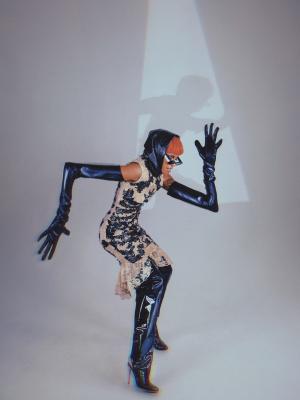
For the following text, zweikommasieben had the pleasure to invite the prolific writer DeForrest Brown Jr., known from his work as a media theorist, curatorial projects, and the “Make Techno Black Again” campaign, to delve into the body of work of singer and songwriter Dawn Richard. From her first appearance in the women-led band Danity Kane in 2005, to a wealth of releases in the subsequent 15 years, Dawn Richard has continued to expand a practice that is entirely her own.
This portrait was originally published in issue #25.
“I don’t need a genre,” Dawn Richard (pronounced “ree-shard”) declares in the intro of her sixth studio album, Second Line (2021). The multi-talented singer-songwriter, dancer, actress, and model quickly reformulates her resolve: “Fuck it! I am the genre.” Embodying King Creole, the golden-armored warrior illustrated in a holographic sheen on the album’s cover, Second Line attunes the listener to a sonic fiction that traverses the narrative of Richard’s over a decade-long career, much like the Data Thief played by Dub music historian Edward George in John Akomfrah’s afrofuturist film The Last Angel of History. “Southern Swag” and the creolization of New Orleans bounce, Detroit techno, Chicago house, and footwork synthesize into a unique omniversal listening experience as Richard excavates Black popular culture to compose beyond the confines of mass-market, “one-size-fits-all” genres. In her hometown of New Orleans, Louisiana, a “second line” is a phase in jazz funeral and marching band tradition organized by the Social Aid and Pleasure Clubs. While the “main line” consists of a Napoleonic brass processional, the “second line” enraptures the community in freeform dance. The four-hundred-year-old African American ritual broadcasts a “home memory” that harnesses fragments of West African cultures estranged during the maafa, or the great tragedy of the transatlantic slave trade. Richard explains that Second Line is “a celebration of the death of old ideas” and “the concept of and not being sad about it and dancing.”
Emerging in 2005 on Sean “Diddy” Combs’s third iteration of the MTV reality television show Making the Band, Richard toured and recorded music in the girl-group Danity Kane in front of millions of viewers. That same year, she released the R&B and soul album Been a While under the nameDawn Angelique, which included songwriting from Ne-Yo. It was her first project before appearing on Making the Band, recorded while she studied marine biology at the University of New Orleans and danced as a cheerleader for the NBA team, the New Orleans Hornets. Danity Kane was originally the name of a manga-stylized drawing by Richard, which cought the attention of Combs. The group would go on to release two highly successful albums, Danity Kane (2006) and Welcome to the Dollhouse (2008), becoming the first female ensemble to consecutively debut at the top of the Billboard charts. In 2009, Danity Kane disbanded while Richards transitioned into the futuristic soul group Diddy—Dirty Money. Alongside Kalenna Harper, Richard worked with Diddy on the creation of a new hi-tech Black popular and progressive music that would fuse into an electro, hip-hop, soul, and funk concept album called Last Train to Paris (2010), which tells the story of Diddy’s searching for a lost love from London to Paris. Diddy—Dirty Money aimed for the future of music as the industry accelerated into the digital streaming market that would ultimately work against cohesive narratives and genre-deconstructing projects like Last Train to Paris—nonetheless the album debuted at number seven on the Billboard charts. In 2011, Richard released her first solo effort, a mixtape called The Prelude to a Tell Tale Heart, whose opening track describes a city of the future similar to Cybotron’s “Techno City” (1981), as well as Janelle Monáe’s Metropolis (2007) and The ArchAndroid (2010). After Putting to work her experience and knowledge accumulated while having been churned through the multi-million-dollar American recording music industry machine, Richard began to chart a new path for herself as a solo artist with a creative vision too expansive for a major-label music industry that would in a few years’ time completely devalue music to the pennies per stream model implemented by platforms like Spotify, Apple Music, and Tidal.
“I do layers, and sometimes I think people are not ready to see that deep.” Richard explains that Second Line exists in a post-apocalyptic moment where the Black woman seen on the album’s cover named King Creole is left with the task to recreate the world. Richard intentionally used the word “king.” She wanted to create a concept where a Platonic philosopher king could be a woman and “embody both masculinity and femininity.” After moving back to her hometown of New Orleans at the beginning of the pandemic to help her mother recover from knee surgery, Richard found herself meditating on the historically jubilant city that had been silenced and emptied as the world went into lockdown. “The world has constantly wiped itself out and been remade again,” she asserts, “That’s the reality, and it goes deeper to the point of reprogramming and reemergence.” She envisions the omniversal ritual of the jazz funeral as a way to channel the energy of her hometown and forge a future out of a time when it would appear that there no longer is one. “Death doesn’t have to be a negative thing because in New Orleans,” Richards describes death as a moment when a legacy is established, and a story is completed. “Death is a homecoming and it can be a dance. It can be a beautiful thing to let go of things.” In the animated trailer for Second Line, King Creole is seen kissing the grave of “the lover of music” and “the lover of art”—the death of old ideas. “It’s a beautiful thing to bury those old structures,” she says. “Black people have had consistent falls. We’ve had empires fall consistently, yet we always re-emerge bigger and better than before.” She continues, “We should not be afraid of getting away from the old concepts. For whatever reason, we keep fearing death. We keep fearing the loss of these establishments. Fuck these establishments. Even great civilizations like Athens eventually fell.” Her own wisdom allows her to weave stories upon stories of mythological parables: “In every story, prophets and messiahs have fallen to then re-emerge something new. Why are we afraid to go away and walk away from an establishment that is old? That’s the point. The point is to say it lived and then to let it down.”
Set into motion with her introspective trilogy—Goldenheart (2013), Blackheart (2015), and Redemption (2016)—Dawn Richard has produced an afrofuturist narrative that maneuvers an ever corrosive and continually digitizing music industry. Each album flows into the next with audio clips that tell brief stories and offer contextual clues about the world system she’s been building throughout her life. Before Second Line, Richard announced the coming of a new breed (2019), pulling from her Creole heritage that participates and pays homage to military structures of the Kingdom of Kongo and the indigenous peoples who inhabited the land now known as New Orleans. Born from histories of American enslavement of Africans and the forced removal of native tribes, the Mardi Gras carnival synthesizes many cultures into a unique regional tradition, which Richard mines for the materials of new breed, where she samples her father’s funk band, Chocolate Milk, and evolves further in the afrofuturist sonic world of Second Line. This celebratory phase of the parade doesn’t require choreographed dance movements, but promotes improvisatory, self-motivated dancing in search of interpersonal healing. In the article “Reverse Hallucinations in the Lower Delta,” Ryan Clarke, a tonal geologist and co-editor of the Black electronic music blog Dweller, describes New Orleans bounce as a sub-genre of Southern hip hop, culling from the sonic evolutionary development of the Mississippi Delta and its ecophonic expanse westward into the Louisiana Bayou. “As a city, New Orleans has suffered from a generalized reverse hallucination with regard to its own history, a process that long precedes Bounce music’s conception,” he writes. “As New Orleans culture is being forgotten, so are our tangible products. And when something is forgotten, it’s often ripe for third-party revision.”
King Creole’s narrative arc throughout Second Line contemplates a similar “reverse hallucination,” peering backwards into Richard’s career while lurching forward, constructing a future out of wandering thoughts and fragmented reflections. “Nostalgia” advances the plot with pumping bass and kick drums undergirding syrupy chords and glittering synths that recall Larry Heard’s soul-infused technology music of the late 80s and early 90s. Rewinding slightly further back in time with “Boomerang,” Richard dismantles the compositional structures of the electronic dance music axes of Detroit techno and Chicago house into a forward thinking capitulation of the disco of the 1970s. Each song on Second Line unfurls into the next in an efficient and lyrical assembly line fashion, retracing Black electronic and popular music to its “progressive music” roots as she manufactures a new framework for Black independent electronic music. In the wake of “Disco Demolition,” when radio DJ Steve Dahl provoked a crowd of 50,000 white people to blow up disco, funk, soul, and other forms of Black music during a professional baseball game in Chicago, a turntable-based mode of consuming and producing music called “progressive music” grew amongst Black youth in American Midwest while the earliest embers of hip hop began to simmer in New York. “I think we’ve kind of just let it fall by the wayside,” Richard says of Black Americans and their relationship with electronic music. “We had this beautiful emergence of what Black culture has done in dance music through Chicago and through D.C. and Go-Go and the emergence of Detroit and what that was.” She pauses, “And then I think even further back when we talk about Afrobeats and what African culture has brought to dance music as well, and then just kind of the level of us sweeping it away and never really having the conversation, right?” Thinking of techno and house as cultural artifacts and communal pastimes rather than an “innovation” or commodity, Richard wants to confront the origins of these genres and welcomes the discussion of the how and why of electronic dance music’s global financialization. “I think it’s been beautiful for Black people to be able to have this dialogue because I don’t think the conversation was even being had to begin with. Just to even have the dialogue is special.”
Thinking through the “beautiful wave of Black faces” that popularized disco, Richard ponders the nature of anonymity in European rave culture and the auto-playlist-driven digital music streaming economy. “We had Donna Summer, we had all these beautiful artists and then all of a sudden we saw the emergence of white culture,” she remarks, considering the systematic dilution of Black hi-tech soul into the manufactured repetitive beats of European rave culture.
Where standout singles like “Bussifame”–meaning “bust a move”–and “Jacuzzi” articulates the physicality of dance music, “Pilot (A Lude)” and “FiveOhFour (A lude)” at the center of Second Line conveys prototypes of Richard’s own take on Bounce music—odes to Freedia, Katey Red, and Messy Mya. In the past, Richard’s experiments with the Black popular music form have been categorized by the media as “alternative R&B,” but she has begun to see the categorization as “a comfortable zone for the colonial musical industry” that has profited off African American music since Ralph S. Peer of OKeh Records sold blues music internationally under the category of “race music” in the 1920s. According to Nelson George’s 1988 book “The Death of Rhythm & Blues,” the music industrial format of Rhythm & Blues was “a synthesis of Black musical genres—gospel, big-band swing, blues—that, along with new technology, specifically the popularization of the electric bass, produced a propulsive, spirited brand of popular.” Later in the book, George deduces that in the summer of 1971, the Business School of Harvard University was commissioned by Columbia Records to assemble a 53-page analysis of the historical development of Black music and radio alongside a “Plan of Action” to control, siphon, and influence the creative and economic development of Black-owned independent music.
For Richard, navigating the music industry as an independent creative is about “coloring outside the lines,” she says. “I think we should forget the Grammys and the Billboard charts completely…we don’t even acknowledge them. I think we build our world and in a time where we can create our own systems. It’s important for the independent and underground world to come together and create our own systems.” Richard expresses gratitude to the over 300-billion-dollar industry as well as the independent record labels and magazines that have supported her over the years, but she also acknowledges that she’s never been on an awards show. Her time as a member of Dirty Money exposed her to the possibilities of a sustainable music career, while the turn that the music industry took in the 2010s has led her to rethink her approach to music business and composition. In opposition to the suppressive effects of the “Harvard Report,” Richard calls for a return to the Black-owned creative culture industry that preceded the popular genre of R&B. “If you look at the Billboard charts, 60 percent of the people that make up the charts are all big budget DJs such as Diplo, Major Lazer, The Chainsmokers, Tiesto, Avicii, and Calvin Harris.” Having worked with underground dance producers like Machinedrum and Mumdance on numerous critically acclaimed albums, Richard sees a clear path forward. She even announced a creative partnership with Adult Swim in 2020 to platform undiscovered and unserved Black talent. Much like Juan Atkins in the 1980s when he first began recording DIY electronic music with a Roland 808 and Korg MS-10, Dawn Richard intends for Second Line to be an afrofuturist turning point for Black popular culture—“an electro revival” for the twenty-first century.
Comments
1 In an essay on the work of Lonnie Holley, DeForrest Brown Jr. references the 1990 publication Hammer and Hoe: Alabama Communists During the Great Depression by Robin D. G. Kelley as a resource for understanding the musical and sociopolitical history of the U.S. South.