A Visit to The Black Lights
A Visit to The Black Lights
Photography
Tom Biddulph
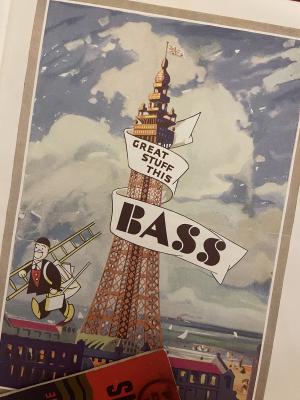
Curiosity got the best of us, so we travelled to the north of England this June, to attend the first edition of The Black Lights, a festival by the people behind Manchester’s beloved venue The White Hotel.
The line-up featured many zweikommasieben alumni such as Rainy Miller, Joanne Robertson, Moin, Kali Malone, Space Afrika, or Russell Haswell. And Blackpool, the city where all this took place, promised to merit a visit in its own right. So off we went, with a committed travel party arriving from Zurich, Berlin, and Amsterdam.
It’s hot in Europe. Many cities report temperatures above 40 degrees, debates around air conditioning become ideological battlegrounds, the Canal Saint-Martin in Paris is reclaimed as a public swimming pool. At Manchester’s Piccadilly station, on a Friday in late June, nearly every train is cancelled due to the heat. But we need to get to Blackpool. Not only because the seaside town in England’s North promises cooler temperatures, but also because The Black Lights is about to start. The festival is the brainchild of Austin Collings and Ben Ward, who run the Manchester venue The White Hotel, set to close at the beginning of next year. 2026 marks the first edition of The Black Lights, and hopefully not the last. Taking over venues big and small in a city described as “The Las Vegas of the North”, the festival is an ambitious undertaking, bringing together a line-up of many UK-experimental-music scene darlings and some international guests in a strange, beautiful, bonkers setting.
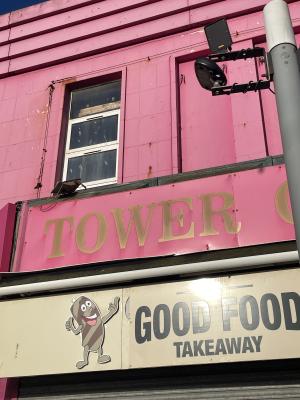
We arrive and jump straight into it, parading from the sunny North Pier to the Blackpool Tower, where, fittingly, The Caretaker “performs” an opening ceremony in the ballroom of the venue . The room is an ornamental marvel which, just like the city it is situated in, has seen better days. We have just begun, and it’s already impossible not to think: Mark Fisher! Hauntology! Let’s try and move past that by highlighting Klein’s performance, which happens on the same stage later in the evening. Her practice, so firmly embedded in contemporary experimentalism, is not that concerned with the spectres of the British past, opting for pushing things forward instead. Guitars, strobes, whistles, noise, samples of life in South London. Loud and present . At the end of her performance, doors open to the fifth floor of the building, where Mia Koden, A Guy Called Gerald, and Kode9 are scheduled to play the after-party portion of the night, and pretty much everyone who was just in the grand ballroom tries to get in. Hopeless, so we call it a night soon after.
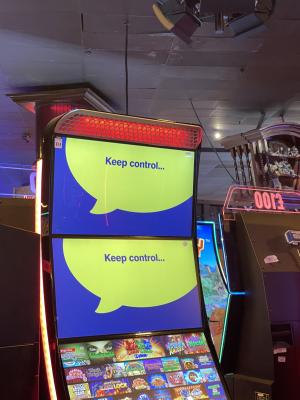
On Saturday, the infrastructure of this weirdly charming city is under even more pressure. A party in Blackpool’s Catholic Club feels almost utopian in its unchecked looseness, packed to the brim with people drinking, playing pool, doing all kinds of things. The stress this puts on the venue’s bar staff is palpable. At other venues in town, queues are forming and schedules are delayed, but no one really minds as distractions are easy to find. A cheap beer in the pubs, a trip to one of the many seaside arcades, people watching on the high street: all these activities prove to be as important for The Black Lights experience as the musical performances.
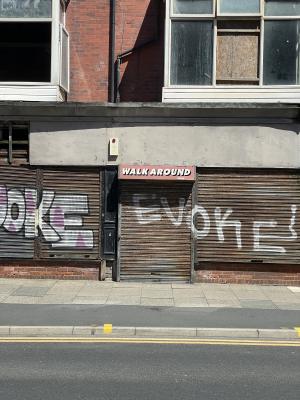
Once the programming gets going, we find ourselves on the boiling balcony of the Olympia Hall, a cavernous venue in the city centre, where Lintd present a fully-formed live act that refuses to be easily categorized. Let’s just say this is one of the cutest boy bands we’ve ever seen, while the music isn’t that: nervous rhythms, moving between poetic urgency and angry proclamations . Later on, Moin pick up on this energy, spiraling into walls of sound developed from deliberate moments of restraint.
The evening brings an anticipated performance of Space Afrika . The duo, who just announced their new album Quiet Storm which they will release in September, are set to play Blackpool’s Opera House. The venue seats 2,800, which makes it one of the biggest theatre spaces in Europe. Who would have thought. They start late, like two hours late, after a familiarly introspective Kali Malone performance on the same stage, which, like every other show during the weekend, is louder than expected. What follows from Space Afrika is ambitious, going beyond what we have seen and heard from them before. An opera singer, a live drummer, a guitarist, plus Joshua Tarelle Reid and Joshua Inyang on electronics, half-hidden behind a large screen, create a structured presentation, a dramaturgy worth following. The new album and how it is put on stage expand on the duo’s established musical framework, a sophisticated continuation of their body of work .
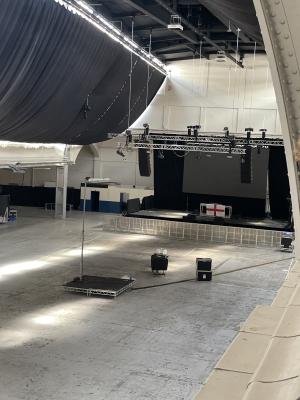
Back in the Olympia Hall, Blackhaine’s site-specific performance “Saints in the Wethouse” begins immediately after, encompassing new music that opts for an industrial sonic palette and a choreography that fills the space. The pressure on infrastructure that seems to be defining this day finds its musical and bodily expression in Blackhaine’s performance. Its physicality tests out the limits of the space. Its honest rawness becomes a manifestation of the experience of being here. Afterwards, in the lobby of the venue, we witness a beautiful chaos unfolding that extends well into the night, soundtracked by Evian Christ, Lee Gamble, and Crystallmess and Anz. A perfect Saturday.
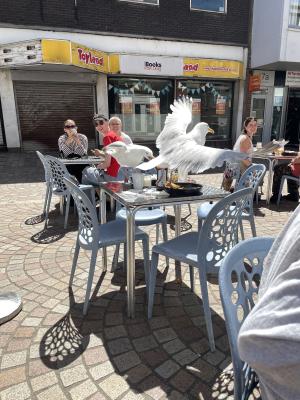
Sunday begins with a Full English at Compass Café that comes recommended if you ever find your way to Blackpool. There is the slight hope of catching Valentina Magaletti’s solo performance at the Blackpool Spiritualist Church, but 130 seats are approximately 500 too few to accommodate the interest her work generates. No harm done, though, as this leaves more time for side quests in this windy city. In the late afternoon, everyone rushes to the Opera House again, where the BBC Philharmonic Orchestra performs, amongst other compositions, a new work by Mica Levi that is over too quickly.
We unfortunately can’t report on the rollercoasters, but the closing ceremony of the festival takes place at Pleasure Beach, an amusement park at the southern city limits. Its carpeted two-floored welcome center is where we end. Nazar’s rough kuduro live-DJ-hybrid is really good , providing a sonic contrast to the plush space. The rest of the night is spent talking to new and old friends, going here and there, riding a Blackpool wave.
Comments
1 The British duo penned an essay for a previous issue of zweikommasieben, which touches on their upbringing in Manchester and important (musical) influences.
2 After experiencing Blackpool, we revisited a conversation with East Man, centered around considerations of the British working class.